Pink Princess Philodendron care guide
We grow pink princess philodendron in our Brooklyn home — here’s what actually keeps the variegation pink, plus soil, watering and pruning tips.

We are an ad-free community driven site. When you purchase through links on our site, we earn an affiliate commission, which helps sustain our blog!
care at a glance
How to care for pink princess philodendron?
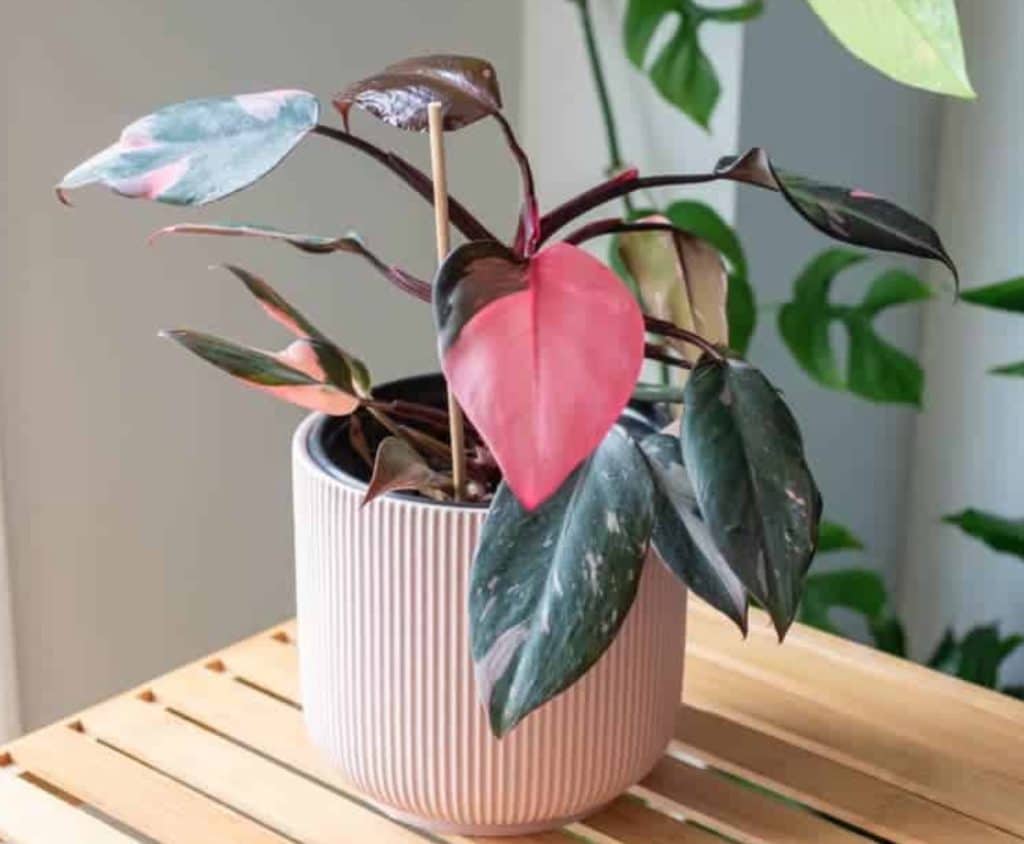
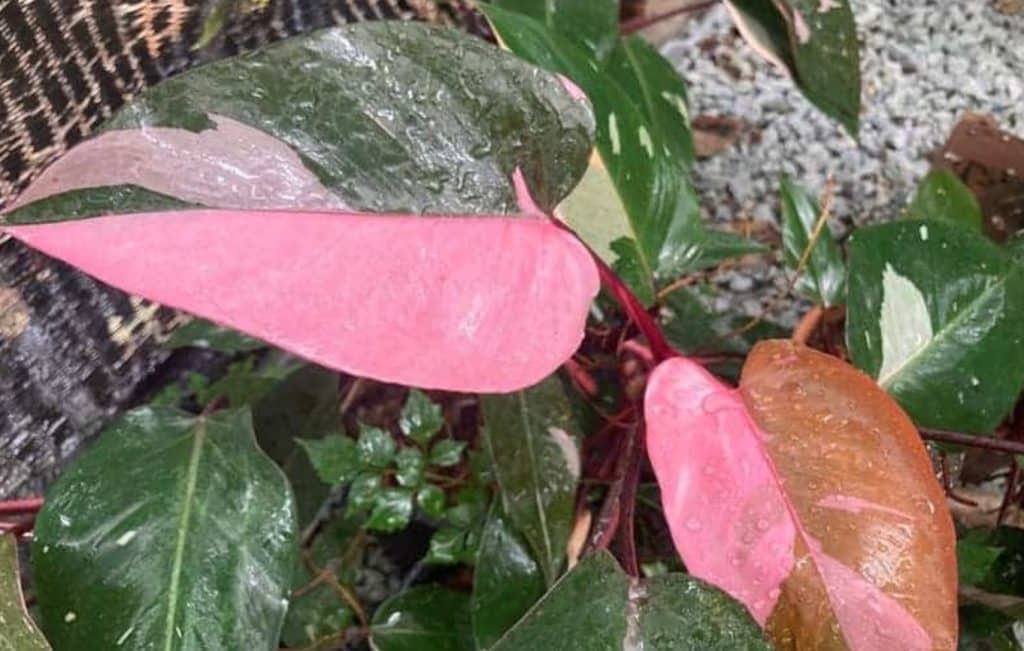
Pink Princess Philodendron is a variegated climbing Philodendron with dark green leaves splashed unpredictably with pink, cream and burgundy.
Common problems: Greener growth, drooping, brown edges, leggy stems, root rot, pests and occasional all-pink growth.
Light: Give it bright filtered or indirect light. Good light supports healthy variegated growth, but light cannot guarantee how much pink the next leaf will contain.
Water: Water thoroughly when the upper portion of the potting mix begins drying. Do not follow a fixed weekly schedule.
Soil: Use a loose, free-draining peat-free aroid mix.
Temperature: Warm indoor conditions suit it best; protect it from cold drafts.
Humidity: Average-to-moderately humid household air works well.
Fertilizer: Feed with a complete balanced fertilizer during active growth.
Support: Pink Princess is a climber and can be grown on a pole, plank or trellis.
Propagation: Root a stem cutting containing at least one viable node.
Pet safety: Philodendrons are toxic to cats and dogs because they contain insoluble calcium oxalate crystals.
Our favorite soil and fertilizer for pink princess philodendron

2. Care mistakes we have learnt to avoid with pink princess philodendron plant
Assuming every green leaf means the plant needs more light: Our own plant became pinker after we moved it beside an east-facing window, so light clearly mattered in our case. But variegation can fluctuate naturally, and a truly reverted green shoot does not become variegated simply because the plant receives more light.
Trying to create pink with fertilizer: Pink variegation is not a phosphorus or magnesium deficiency. We use a complete fertilizer to support healthy growth rather than trying to manipulate leaf color with a special nutrient ratio.
Growing it without support: Pink Princess is a climbing Philodendron. Once ours begins producing longer internodes and aerial roots, giving it something vertical to climb produces a much more natural growth habit than letting a heavy mature stem flop over the pot.
3. A real issue we have had with Pink princess philodendron in our home
Our Pink Princess once produced several increasingly green leaves while sitting about six feet from a living-room window.
The room looked bright to us, but the plant itself was receiving much weaker light.
After we moved it beside our east-facing window, the next two leaves contained much more pink.
That experience convinced us that insufficient light can reduce variegation. But we would not promise that brighter light will restore every green Pink Princess: true reverted growth is a different problem.
For the full diagnosis, see Why Is My Pink Princess Philodendron Losing Variegation?
lineage and common questions
What Makes Pink Princess Philodendron Different?
Pink Princess is a variegated cultivar associated with Philodendron erubescens, a climbing Philodendron native to Colombia.
NC State lists Pink Princess among P. erubescens cultivars and describes it as an upright vining plant with dark purplish-green leaves and pink variegation.
RHS treats ‘Pink Princess’ as a climbing or trailing tropical perennial capable of reaching roughly 3–5 feet under cultivation.
Is Pink Princess Philodendron a Climber?
Yes.
Pink Princess belongs to the climbing group of Philodendrons.
As the stem matures, aerial roots develop along the nodes and can attach to a moss pole, plank or trellis.
We prefer growing ours upward because the support keeps the heavy stem stable and gives the plant room to mature.
Does Pink Princess Need a Moss Pole?
Not specifically.
A moss pole works, but a wood plank, coir pole or sturdy trellis can also provide vertical support.
The important part is supporting the climbing stem rather than assuming that only sphagnum moss allows the plant to climb.
Can Pink Princess Grow in a Hanging Basket?
It can trail when young, and RHS describes the cultivar as both climbing and trailing.
But we prefer vertical support for a mature plant because the stem becomes thicker and heavier over time.
Why Is My Pink Princess Not Pink?
There are two different possibilities.
Low light or other stress can reduce the expression of variegation, so first make sure the plant receives strong filtered light and has healthy roots.
But a shoot can also genuinely revert to green. If several consecutive leaves and the stem itself show no variegation despite good growing conditions, improving light may not restore that growth point.
For the full diagnosis and pruning strategy, see our Pink Princess Variegation Guide.
Can You Make a Pink Princess More Pink?
You can provide conditions that support healthy variegated growth, but you cannot control the exact pattern of the next leaf.
Give the plant bright filtered light, healthy roots and balanced nutrition.
If a shoot has genuinely reverted, prune it back to growth that still shows variegation rather than trying to force the green shoot to become pink.
What Should You Do With an All-Pink Leaf?
One mostly pink leaf is not automatically an emergency.
Pink tissue contains little chlorophyll, so an entire plant producing only pink growth would eventually struggle to support itself.
We watch the next leaves. If the growing point repeatedly produces nearly chlorophyll-free foliage, we would prune back to a node showing a healthier balance of green and pink rather than removing every unusually pink leaf on sight.
\Also read: Alocasia Pink Dragon which is another Pink houseplant. And other plants in philodendron family: Philodendron Micans, Philodendron care

$43
What we wish we knew before buying
We wish we had known how unpredictable the variegation can be.
Good light matters, but buying a heavily pink plant does not guarantee that every future leaf will look the same.
We now judge ours over several new leaves rather than panicking over one greener leaf
Light and placement and seasons

How Much Light Does Pink Princess Philodendron Need?
We give ours bright filtered or indirect light.
RHS recommends bright filtered light, and our plant has produced its strongest growth beside an east-facing window.
It can tolerate somewhat lower light, but growth becomes slower and the plant may produce less conspicuous variegation.
Does More Light Make Pink Princess More Pink?
Sometimes better light helps, but we would not promise a direct “more light = more pink” relationship.
Adequate light gives the remaining green tissue enough energy to support the plant and can help maintain variegation.
The actual placement of pink tissue, however, is determined by the variegated growth point. A genuinely reverted green shoot cannot be forced to become pink simply by putting it in a brighter window.
Can Pink Princess Take Direct Sun?
Gentle morning sun can work once the plant is acclimated.
We protect the pink and cream sections from intense midday or afternoon sun because pale tissue scorches more easily.
How Does Pink Princess Change Through the Seasons?
Spring: Growth usually accelerates. We resume regular feeding and check the soil more frequently.
Summer: The plant generally grows fastest and the pot dries more quickly.
Fall: Growth slows as daylight falls, so we gradually increase the interval between waterings.
Winter: Growth can become very slow. We keep ours in our brightest practical position and water less frequently as the pot takes longer to dry.
We do not remove healthy greener winter leaves simply to “redirect energy.”
Soil
For detailed comparison, please refer to our article: Best soil and fertilizer for Pink Princes Philodendron
What soil composition to use for Pink princess philodendron plant?
Here’s our go-to blend:
40% coconut coir: Retains moisture without becoming waterlogged.
30% perlite: Enhances drainage and aeration.
20% bark chips: Mimics natural forest floor conditions.
10% compost: Provides essential nutrients.
This combination ensures the soil stays moist but not soggy, preventing root rot. We aim for a slightly acidic pH between 5.5 and 6.5, which suits the plant’s preferences. If you tend to overwater, consider increasing perlite to 40% to improve drainage.
Avoid using topsoil, as it’s too dense for container plants. Instead, start with a high-quality potting mix and amend it with the components recommended above for optimal results.
Best soil to use for Pink princess philodendron?
This is a great soil mix for all pink plants and especially this tropical Philodendron, You can also add more perlite!
Temperature and Humidity
What Temperature Does Pink Princess Prefer?
Warm indoor conditions suit it best.
We generally keep ours around 65–80°F and protect it from cold windows and drafts.
RHS recommends maintaining Pink Princess above about 15°C / 59°F.
How Much Humidity Does Pink Princess Need?
It appreciates moderate humidity but does not require an exact 60–80% range.
Around 40–60% RH is workable for many indoor Philodendrons, and we aim somewhat higher if the air becomes extremely dry.
Brown edges alone do not prove humidity is the problem. Dry soil, fertilizer salts, roots and previous sun damage can look similar.
For comparisons, see our humidity chart for 50 popular houseplants.
fertilizer
For detailed comparison, please refer to our article: Best soil and fertilizer for Pink Princes Philodendron
What is the best fertilizer composition to use for Pink Princess Philodendron?
we recommend using a balanced, water-soluble fertilizer with an N-P-K ratio of 20-20-20 during the growing season: this ensures the plant receives essential macronutrients: nitrogen for foliage, phosphorus for roots, and potassium for overall health.
How and when to fertilize Pink Princess Philodendron?
We fertilize every 4 to 6 weeks during the growing season (spring and summer) using a balanced, water-soluble fertilizer. In fall and winter we reduce feeding to every 8 to 10 weeks.
Before application, we ensure the soil is moist to prevent root burn. We dilute the fertilizer to half the recommended strength, then apply it evenly over the soil, avoiding direct contact with the leaves.
What are the signs Pink Princess Philodendron needs food?
Noticing yellowing leaves, especially on older foliage, are a sure sign your Philodendron pink princess needs fertilizing. We use fertilizer that has higher phosphorous content for this one. Read also: our favorite fertilizers and soil for pink indoor plants
Pots and planters
What are the best pots to use for Pink Princess Philodendron?
We recommend using a plastic, terracotta, or coir pot with adequate drainage holes to prevent waterlogging. A 4-inch (12 cm) diameter pot is ideal: it encourages healthy root development and helps prevent overwatering. The material or shape does not matter when it comes to this plant: just ensure your pot has holes for drainage as this one hates to sit in water.

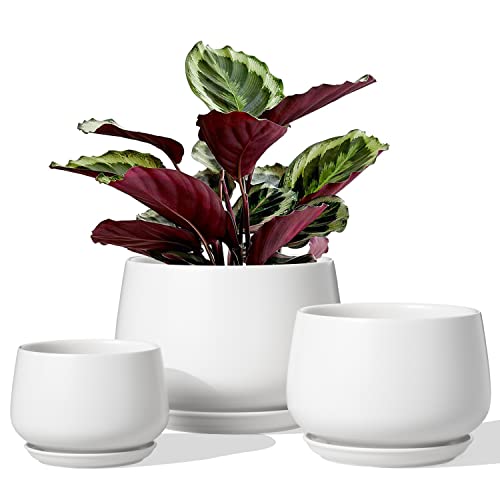
Read also: Our favorite pots and planters for Pink Houseplants
Watering
How Often Should You Water Pink Princess Philodendron?
We water when the upper portion of the potting mix begins drying, then soak the mix thoroughly and let the excess drain.
We do not water every seven days or every 10–14 days automatically.
Light, pot size, root mass, temperature and season all change how quickly the pot dries.
Why Is My Pink Princess Drooping?
Check the soil before watering.
If the mix is dry and the leaves are limp, the plant may simply be thirsty.
If it is already wet, drooping can indicate root stress or damage.
Because your page is already ranking around positions 3–4 for this query, we would make this answer prominent rather than hiding drooping only inside the Problems section.
What Does an Overwatered Pink Princess Look Like?
Watch for several symptoms together:
- persistently wet mix
- yellowing or soft leaves
- drooping despite moist soil
- soft or dark roots
- mushy stem tissue near the soil line
One yellow leaf alone does not prove overwatering.
pruning
Does Pink Princess Philodendron Need Pruning?
Not routinely.
RHS lists no regular pruning requirement for the cultivar.
We prune when the plant becomes too long, leggy or damaged, or when we need to remove a genuinely reverted green shoot.
How Do You Prune a Leggy Pink Princess?
Choose a healthy node below the section you want to remove and make a clean cut with sanitized pruners.
The remaining stem can activate a dormant bud below the cut, while the removed section can be used for propagation if it contains a viable node.
We do not automatically remove a fixed 20% of the plant or prune on a particular calendar.
How Do You Prune a Reverted Pink Princess?
If a shoot repeatedly produces plain green leaves and the stem at that growth point no longer shows variegation, cut the shoot back to the last node that still showed variegated tissue.
This is different from removing one green leaf from an otherwise variegated stem.
We would not cut off every green leaf simply because it lacks pink; those green leaves are actively photosynthesizing and can help support the plant.
For the full reversion diagnosis, see Why Is My Pink Princess Philodendron Losing Variegation?
Does Pink Princess Need Special Care After Pruning?
No.
Keep the plant in its normal bright filtered light and return to normal watering.
We do not water simply because a cut was made.
propagating

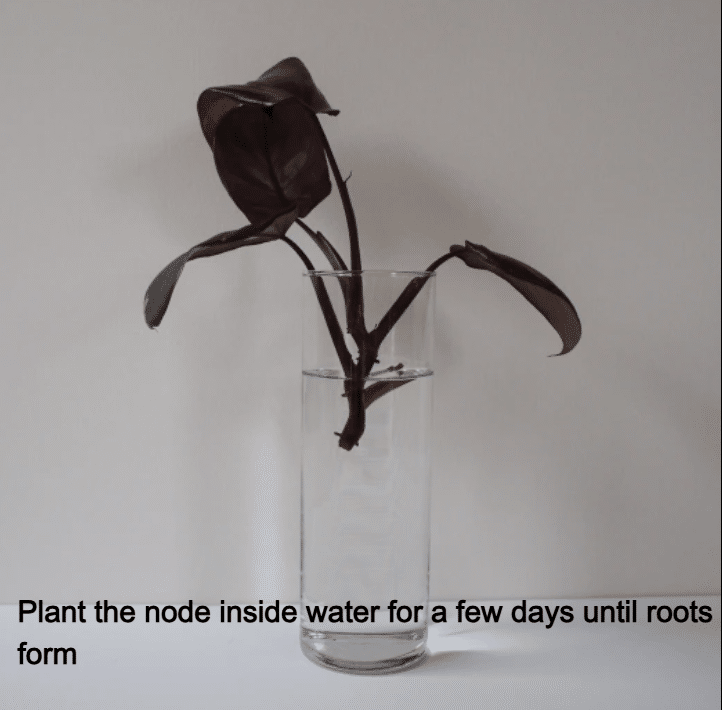
What Is the Best Way to Propagate Pink Princess?
Stem cuttings are the simplest method.
Take a healthy section containing at least one viable node. A leaf by itself without a node cannot produce a new climbing stem.
Root the node in water or an airy propagation medium and keep it warm in bright indirect light.
Can You Propagate a Pink Princess From a Green Stem?
Yes, but whether the new growth will be variegated depends on the tissue associated with that growth point.
If your goal is another pink-variegated plant, we choose a cutting from a stem/node that visibly carries variegation rather than one taken from completely reverted growth.
When Should You Pot a Water-Rooted Cutting?
We transplant when the cutting has developed a small established root system rather than waiting for roots to reach one exact length or promising they will appear within a fixed number of weeks.
After potting, we keep the mix slightly more evenly moist during the transition and then gradually move toward normal Pink Princess watering
Troubleshooting common issues
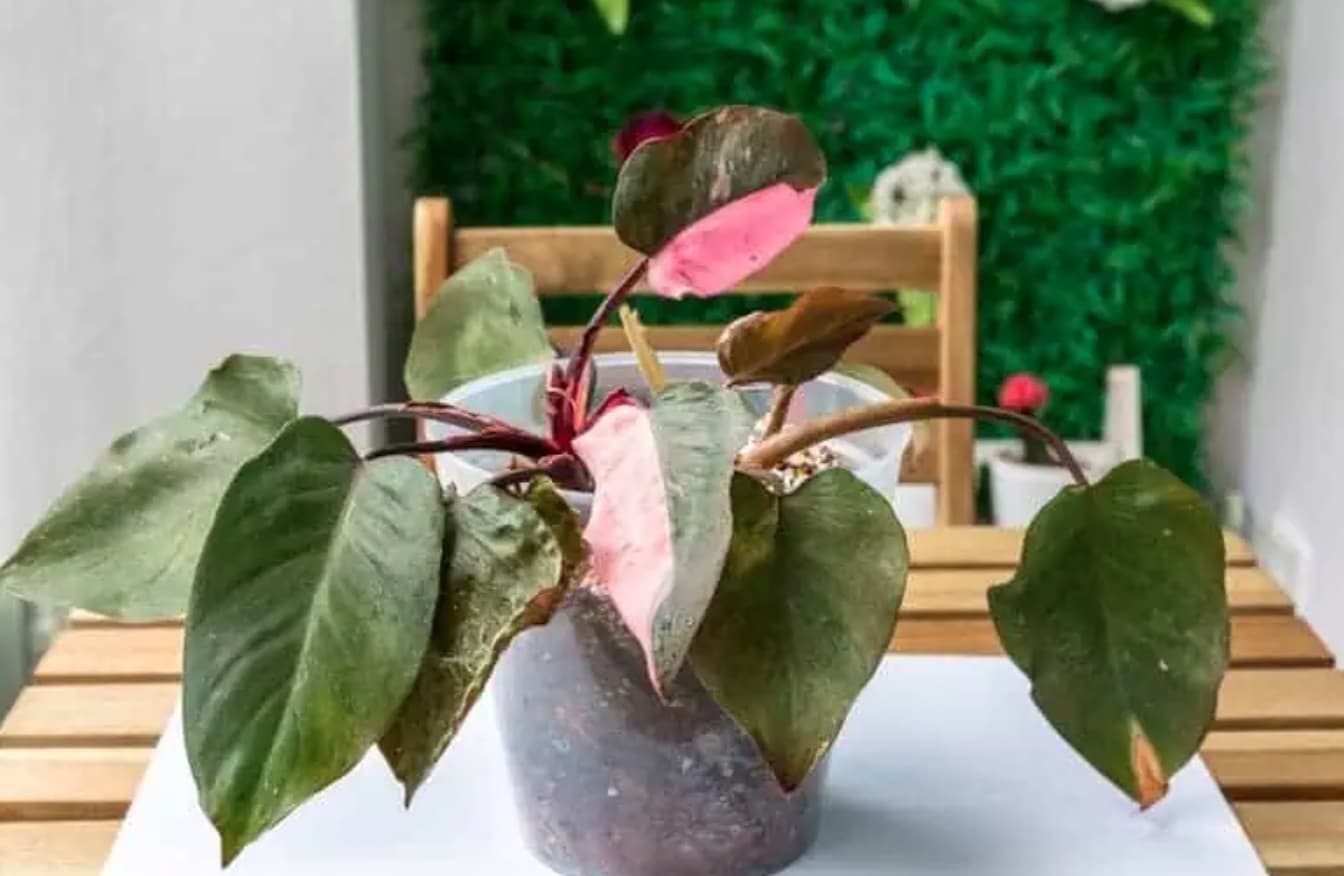


Pink Princess Problem Quick Guide
| Symptom | Likely cause | What to do |
|---|---|---|
| Several new leaves mostly green | Low light, stress or true reversion | Improve conditions and inspect the stem/growth point before pruning. |
| Mostly or entirely pink new leaf | Highly variegated growth | Watch subsequent leaves; repeated all-pink growth may need pruning back to balanced tissue. |
| Drooping | Dry soil, wet/damaged roots or environmental stress | Check soil before automatically watering. |
| Brown crispy edges | Dry soil, salts, low humidity, sun or root stress | Review watering and roots before changing humidity. |
| Long bare internodes | Low light, unsupported climbing growth or aging | Improve light and give the vine vertical support. |
| Yellow leaves + wet mix | Possible root stress or overwatering | Let the mix dry appropriately and inspect roots if decline continues. |
| Sticky leaves or visible pests | Scale, mealybugs, aphids or other sap-feeders | Identify the pest before choosing treatment. |
← Swipe horizontally on mobile to see the full table →
Why Is My Pink Princess Philodendron Losing Pink?
First look at several consecutive new leaves.
If the plant is sitting in weak light or has recently been stressed, improve its growing conditions and watch the next growth.
If the stem and several consecutive leaves from one growth point become completely green despite adequate light, the shoot may have genuinely reverted.
For the full diagnosis, see Why Is My Pink Princess Philodendron Losing Variegation?
Why Is My Pink Princess Drooping?
Check the potting mix before adding water.
If it is dry, the plant may simply be thirsty.
If the soil remains wet, drooping can indicate stressed or damaged roots.
Because both conditions can produce superficially similar leaves, soil moisture is more useful than the droop by itself.
Why Are My Pink Princess Leaves Turning Brown?
Brown edges can come from several sources, including repeated drying, fertilizer salts, very dry air, sun scorch or root problems.
We check the soil, roots and recent fertilizer use before automatically adding a humidifier.
Why Is My Pink Princess Growing Long Bare Stems?
Pink Princess is naturally a climbing plant, so an unsupported mature stem will not remain a compact rosette forever.
Weak light can make internodes even longer.
We give the vine vertical support and stronger filtered light before assuming the solution is repeated pruning.
Why Are My Pink Princess Leaves Turning Yellow?
One older yellow leaf may simply be aging.
Several yellow leaves appearing while the soil remains wet make us investigate root health first.
Yellowing alone is not a sure sign that the plant needs fertilizer.
Why Are My Pink Princess Stems or Roots Mushy?
Soft dark roots or stem tissue, particularly with persistently wet soil, can indicate rot.
Remove the plant from its pot and inspect the roots.
Healthy roots should feel firm rather than slimy or collapsing.
Why Are My Pink Princess Leaves Sticky?
Look closely for sap-feeding pests such as scale, aphids or mealybugs.
Spider mites can also occur on Philodendrons, but webbing and fine stippling are more typical clues than sticky honeydew.
We identify the pest before choosing an insecticide rather than spraying neem oil automatically.
FAQ
Is Pink Princess Philodendron Toxic to Cats and Dogs?
Yes.
ASPCA lists Philodendron species as toxic to cats and dogs because they contain insoluble calcium oxalate crystals.
Chewing the plant can cause oral pain and irritation, drooling, vomiting and difficulty swallowing.
How Big Does Pink Princess Philodendron Get?
RHS lists Pink Princess at roughly 3–5 feet tall with a spread around 1½–3 feet under cultivation.
Giving it vertical support allows the climbing stem to use that height much more naturally.
Is Pink Princess a Climbing or Trailing Philodendron?
It is fundamentally a climbing Philodendron.
A young stem can trail from a pot, but mature growth benefits from a pole, board or trellis.
Can Pink Princess Grow Outdoors in Summer?
Yes, once temperatures are reliably warm.
Acclimate it gradually and start in bright shade or filtered light rather than placing an indoor-grown plant directly into intense sun.
Can Pink Princess Grow Permanently in Water?
A cutting can root successfully in water.
Growing an established plant permanently in water becomes a hydroponic system and requires managing nutrients and oxygen rather than simply leaving a rooted cutting in a jar indefinitely.
Does Fertilizer Make Pink Princess More Pink?
No fertilizer can reliably create pink variegation.
Feed the plant to maintain healthy overall growth.
If new growth becomes greener, investigate light, stress and possible reversion rather than switching to a high-phosphorus or magnesium-heavy fertilizer.
Does Pink Princess Need High Humidity?
It appreciates moderate humidity, but we do not consider 60–80% mandatory.
RHS recommends standard houseplant cultivation in bright filtered light. We focus first on healthy roots, appropriate watering and useful light.