Why Do some Plants Have Pink Leaves?
The science behind why some plants have pink leaves, what causes it, and our favorite pink varieties to grow indoors — from our Brooklyn home

When you purchase through links on our site, we may earn an affiliate commission, which helps sustain our blog!
Pink-leaved plants stand out in any collection, but have you ever stopped to wonder what makes them pink? Unlike green foliage, which gets its color from chlorophyll, pink leaves owe their hues to a mix of pigments, including anthocyanins. But there’s more to it than just genetics—light exposure, temperature, and even soil conditions can all influence how vibrant a plant’s pink tones become.
In this article, we’ll break down the science behind pink leaves, exploring the role of plant pigments, how different conditions affect coloration, and why some plants shift from green to pink. Whether you’re a curious plant parent or a science enthusiast, understanding the natural mechanisms behind pink foliage will help you appreciate these stunning plants even more!
Why Do Some Plants Have Pink Leaves?
Most naturally pink leaves get their color from a combination of pigments, chlorophyll distribution and genetics.
Anthocyanins are especially important. These water-soluble pigments occur inside plant cells and can produce red, purple and pink coloration.
But “pink leaf” can describe several biologically different things:
- permanent or genetically determined pink foliage
- pink variegation mixed with green tissue
- pink or red juvenile leaves that later become green
- seasonal pigmentation
- temporary anthocyanin production triggered by environmental stress
That is why there is no single rule for making every pink plant pinker.
The Pigments Behind Pink Leaves
Anthocyanins: The Main Pink, Red and Purple Pigments
Anthocyanins are a major reason leaves appear pink, red or purple.
They accumulate inside cell vacuoles and absorb particular wavelengths of visible light, changing the color that reaches our eyes.
Their concentration and appearance are controlled partly by genetics and development, while environmental factors such as strong light, cold or drought can stimulate anthocyanin production in some species.
Anthocyanins can also play protective roles. Research has linked foliar anthocyanins with photoprotection and responses to environmental stress, although their exact ecological role is not identical in every plant.
How Chlorophyll Changes What Pink Looks Like
Chlorophyll gives leaves their familiar green color and performs most of the light capture used in photosynthesis.
A leaf can contain both chlorophyll and anthocyanins.
If anthocyanins are concentrated over green tissue, the leaf may look burgundy, purple or reddish even though photosynthetically active chlorophyll remains underneath.
In other forms of variegation, particular sections of the leaf contain much less chlorophyll. Those areas can appear pink, cream or white depending on the pigments and tissue structure present.
This is why two plants that both look “pink” may have very different photosynthetic capacity.
Do Carotenoids Make Leaves Pink?
Carotenoids primarily produce yellow, orange and golden colors.
They can contribute to the final appearance of foliage when several pigments occur together, but we would not describe carotenoids as the universal explanation for peach or salmon-colored houseplant leaves.
The final color depends on the particular pigments present, their concentrations, chlorophyll levels, cell structure and how the tissues reflect light.
Some plant groups also use pigments called betalains, which can produce red-to-purple coloration instead of anthocyanins.
Can Pink Leaves Photosynthesize?
Yes—some pink leaves can photosynthesize.
Pink does not automatically mean that a leaf contains zero chlorophyll.
If green chlorophyll remains underneath or alongside the pink pigment, that tissue can still capture light and contribute energy to the plant.
However, heavily variegated pink tissue with very little chlorophyll generally has lower photosynthetic capacity than green tissue.
Research on pink and variegated leaves has found measurable differences in chlorophyll content and photosynthetic performance between differently colored portions of the same or related plants.
So the useful rule is:
Pink tissue may photosynthesize, but how much depends on how much functional chlorophyll that particular tissue contains.
That is also why an almost entirely pink or white variegated plant can be harder to sustain than one with a healthy balance of green tissue.
Are Pink Leaves Natural?
Absolutely.
Some plants are genetically programmed to produce red, pink or purple foliage throughout the life of the leaf.
Others show pink only at particular developmental stages or under particular environmental conditions.
The existence of a pink leaf therefore does not automatically indicate stress, disease or nutrient deficiency.
What Does a Pink Leaf Mean?
Biologically, “pink” by itself is not a diagnosis.
It may represent normal pigmentation, genetic variegation, young growth, seasonal coloration or a stress response.
The important question is whether the pink is normal for that species or cultivar and whether the plant is otherwise growing normally.
Why a Leaf Can Look Pink
| Type of pink | What’s happening | Examples |
|---|---|---|
| Genetic pink foliage | Pigment production is part of the plant’s normal inherited foliage color. | Many Caladiums, Coleus and Cordylines |
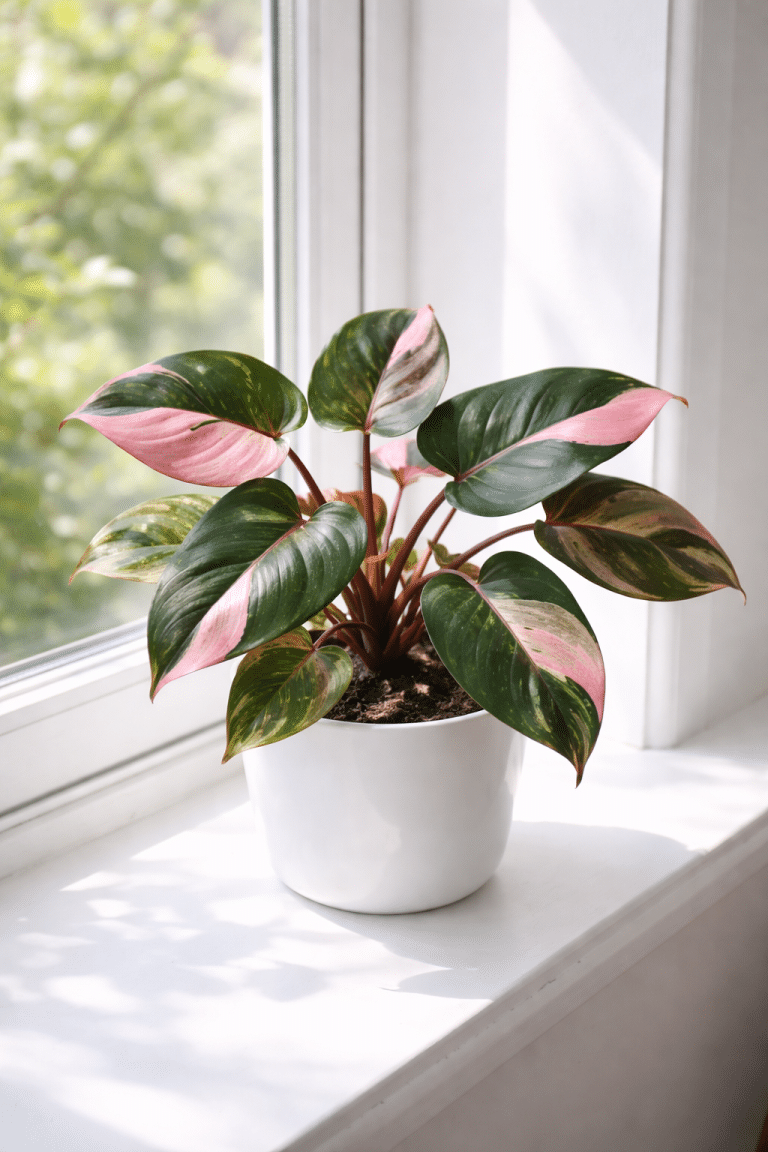
| Pink variegation | Different leaf sectors contain different amounts of chlorophyll and/or colored pigments. | Pink Princess Philodendron, pink-variegated Syngonium |
| Juvenile pink or red growth | Young leaves contain protective pigments and become greener as chlorophyll develops. | Many tropical shrubs and trees |
| Seasonal color | Pigment levels change with leaf age, season, temperature or light. | Autumn foliage and some evergreen plants |
| Stress-induced pink/red | Anthocyanins can increase in response to strong light, cold, drought or other stresses in some species. | Some succulents and outdoor foliage plants |
← Swipe horizontally on mobile to see the full table →
Environmental Factors That Influence Pink Leaf Color
Can Light Make Pink Leaves Pinker?
Sometimes—but it depends on the plant.
Light can stimulate anthocyanin production in some species, which is one reason leaves exposed to stronger light may develop deeper red or pink coloration.
Variegated houseplants can also lose some of their characteristic pattern when kept in inadequate light.
But we would not use the rule “more light = more pink” for every pink plant.
A Pink Princess Philodendron, Caladium, Stromanthe and sun-stressed succulent produce and display color through different mechanisms.
Too much direct light can also scorch pale or variegated tissue.
The useful approach is to follow the light requirements for the specific plant, then judge the newest growth.
Does Cold Weather Make Leaves Pinker?
Cold can increase anthocyanin production in some species.
That is one reason red and purple pigments become more obvious in certain outdoor plants during autumn or winter.
But we would not intentionally expose a tropical pink houseplant to cold simply to intensify its color.
For tropical plants, chilling injury can do far more harm than any potential pigment increase.
Does Soil pH Change Pink Leaves?
Not in the simple way we once described on this page.
The chemistry of anthocyanin color is strongly influenced by pH inside the cell vacuole, along with pigment structure and other molecules present in the cell.
That does not mean lowering the pH of a houseplant’s potting mix will automatically make its leaves pinker.
For plants such as Pink Princess Philodendron, Stromanthe or pink Aglaonema, we would not acidify the soil simply to change foliage color.
Instead, keep the soil within the appropriate range for that species.
Does Humidity Make Pink Leaves More Vibrant?
Humidity can help a humidity-loving plant keep healthy, undamaged foliage, but it is not a universal switch for pink pigmentation.
For example, Stromanthe may develop dry brown margins in very dry air. Maintaining appropriate humidity can prevent that damage and make the foliage look better.
That is different from saying humidity directly creates more pink pigment.
We choose humidity according to the plant species rather than according to whether its leaves happen to be pink.
Can Watering Change Pink Leaf Color?
Severe water stress can alter anthocyanin production in some plants.
But we would never deliberately underwater a houseplant to make it pinker.
If a normally green plant suddenly develops pink, red or purple coloration while also wilting, growing poorly or showing damaged roots, treat the color as one clue among several rather than assuming the change is desirable.
read also: styling pink plants
Why Some Green Plants Turn Pink Over Time
A green leaf can develop pink or red coloration for several very different reasons.
Genetics and Variegation
Some cultivars are genetically programmed to produce sectors of differently colored tissue.
Pink Princess Philodendron, pink Syngoniums and many Aglaonemas are examples where pink patterning is part of the plant’s inherited ornamental characteristics.
The amount and placement of pink can vary from leaf to leaf.
Environmental conditions can influence how well the plant grows and sometimes how strongly the pattern is expressed, but they do not give us complete control over where pink tissue appears.
Young Leaves That Start Pink or Red
Some plants naturally produce reddish or pink young leaves that become greener as they mature.
Anthocyanins may help protect delicate developing foliage while chlorophyll and the leaf’s protective tissues are still developing.
If this color change occurs predictably on every new leaf, it is usually normal rather than a nutrient problem.
Seasonal Pink or Red Color
Some plants increase anthocyanin production during seasonal changes, particularly under combinations of bright light and cool temperatures.
Autumn foliage is the familiar example.
Indoor tropical plants do not all follow the same seasonal mechanism, so we would not assume that a pink houseplant needs colder temperatures simply because an outdoor plant reddens in fall.
Pink or Red From Environmental Stress
Strong light, drought, cold and other stresses can stimulate anthocyanin production in some plants.
Succulents are a familiar example: some develop pink or red margins when exposed to stronger light or limited water.
That color response is very different from the genetically pink patch on a Pink Princess Philodendron.
We therefore do not deliberately stress ordinary tropical houseplants to make their foliage pinker.
Can Nutrient Deficiency Turn Leaves Pink or Purple?
It can, but color alone is not enough to diagnose a deficiency.
Phosphorus deficiency can cause reddish-purple anthocyanin accumulation in some plants, usually along with poor growth and other symptoms.
We would not add phosphorus simply because a leaf becomes pink or purple.
Check the species, root health, growing conditions and—where appropriate—soil or tissue nutrient levels before fertilizing.
Why Do Pink Pigments Help Plants?
Anthocyanins can serve several functions in leaves.
One of the best-supported is photoprotection: in some plants, the pigments absorb excess light and can help reduce photo-oxidative stress.
They can also act as antioxidants and are associated with responses to cold, drought, tissue development and other stresses.
But scientists continue to investigate exactly why particular species produce anthocyanins in particular tissues.
So we would avoid saying every pink leaf evolved specifically as “sunscreen.”
FAQ
Are There Plants With Naturally Pink Leaves?
Yes.
Many Caladiums, Coleus, Aglaonemas, Syngoniums, Cordylines and variegated Philodendrons naturally produce pink foliage or markings.
If you’re looking for plants rather than the science behind the color, see our guide to 9 Pink Indoor Plants.
Can a Completely Pink Leaf Survive?
A completely pink leaf may remain alive for some time, but its contribution to the plant depends on how much chlorophyll it contains.
If the tissue contains little or no functional chlorophyll, it contributes much less photosynthetic energy than green tissue.
One pink leaf on an otherwise green plant is very different from an entire plant repeatedly producing almost chlorophyll-free foliage.
Why Is My Pink Plant Turning Green?
The answer depends on the plant.
Low light can reduce ornamental coloration in some species, while genetically variegated plants can also produce greener leaves through normal variation or genuine reversion.
Do not assume every green leaf can be made pink again simply by increasing light.
If your plant has actually started losing previously stable pink coloration, see our Common Problems With Pink Houseplants guide.
Can I Make a Plant Produce More Pink?
You can give the plant the conditions that support its normal coloration, but you cannot universally force pink pigment.
Provide the correct light, temperature, water and nutrition for that species.
Avoid internet tricks involving extra phosphorus, acidic soil or deliberate drought unless they are actually appropriate for the plant you are growing.
Are Pink Leaves Less Efficient Than Green Leaves?
Often, but not always to the same degree.
Pink sectors with reduced chlorophyll generally have lower photosynthetic capacity than green tissue.
But leaves that appear pink or red because anthocyanins overlay chlorophyll can still contain substantial photosynthetically active tissue.
Visible color alone does not tell us exactly how much photosynthesis is occurring.
Conclusion
Pink leaves are not one biological phenomenon.
Some are pink because genetics determines where chlorophyll and other pigments develop. Some leaves contain chlorophyll hidden beneath anthocyanins. Others become pink or red temporarily as they develop, respond to strong light, experience seasonal change or react to stress.
That is why the best question is not simply “What makes leaves pink?”
It is:
“What makes this particular plant pink?”
Once we know whether the color comes from genetic variegation, normal pigment production, development or stress, the care advice becomes much more accurate.
Conclusion
The stunning pink hues in plant leaves aren’t just for show—they’re a result of complex biological processes involving pigments, environmental conditions, and plant genetics. By understanding what makes leaves turn pink, we believe we can better care for these unique plants, and even enhance their coloration!