Alocasia hilo beauty care and styling guide
Everything you need to grow alocasia hilo beauty indoors — light, soil, humidity, and what makes it different from other alocasias.

We are an AD-FREE site. When you purchase through links on our site, we may earn an affiliate commission
care at a glance
How to care for Alocasia hilo beauty?
Hilo Beauty is widely sold as Alocasia Hilo Beauty, but it is actually Caladium praetermissum, a tuberous/rhizomatous tropical aroid with distinctive camouflage-patterned leaves.
- Light: Give it medium to bright filtered light or semi-shade. Protect the leaves from intense hot sun.
- Water: Keep the potting mix consistently but moderately moist during active growth, allowing the surface to begin drying before watering again.
- Soil: Use a rich peat-free mix that holds moisture while draining freely.
- Temperature: Keep it warm and protect it from cold drafts.
- Humidity: It appreciates moderate-to-high humidity, especially during active growth.
- Fertilizer: Feed lightly with a complete fertilizer while the plant is actively producing leaves.
- Propagation: Divide healthy rhizome sections or offsets with a viable growing point.
- Pet safety: Treat Hilo Beauty as toxic to cats and dogs because Caladium species contain insoluble calcium oxalates.
- Common problems: Drooping, yellow leaves, brown edges, smaller new leaves, cold damage and rhizome rot.
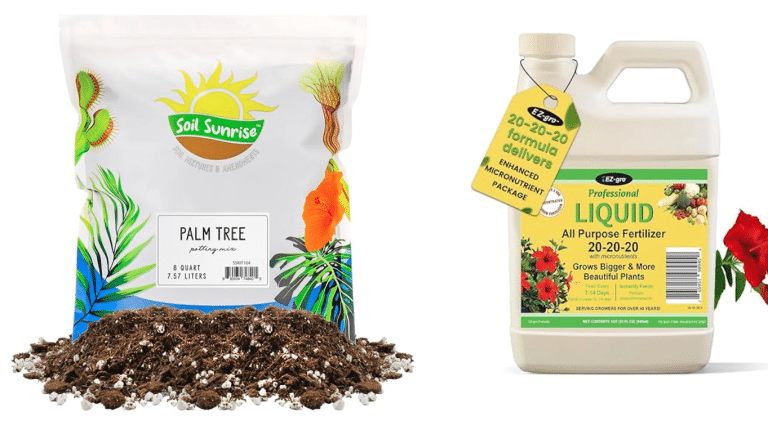
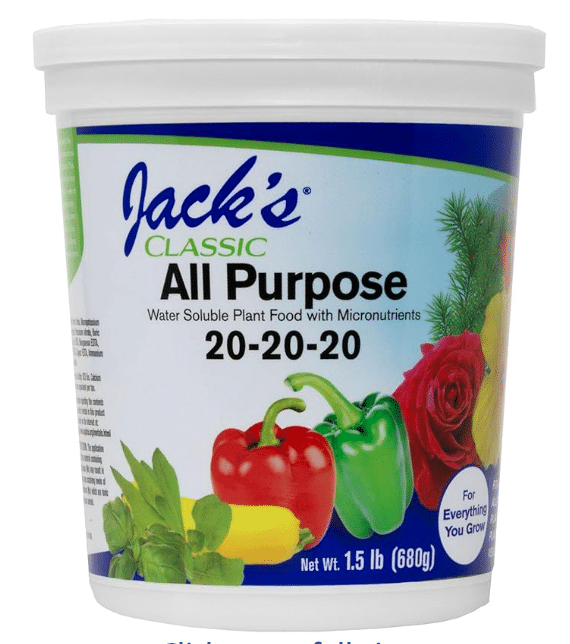
Our favorite soil and fertilizer for Alocasia Hilo beauty

2. Care mistakes we have learnt to avoid with alocasia hilo beauty
Treating it exactly like an Alocasia: We originally cared for ours as though Hilo Beauty were simply another Alocasia. Once we learned that it is actually a Caladium, its preference for consistently moist—but still well-aerated—soil made much more sense.
Letting the mix become too dry between waterings: Hilo Beauty is not a Snake Plant or Hoya. During active growth, we let only the surface begin drying rather than waiting for a large portion of the pot to become dry.
Keeping it wet when the room becomes cold: Moisture needs change dramatically when growth slows. Cool, wet potting mix creates a much greater risk of damage to the underground rhizome.
3. A real issue we have had with alocasia hilo beauty in our home
Our Hilo Beauty once began dropping leaves while sitting near a drafty living-room window.
At first we assumed the dramatic drooping meant it needed more water.
The soil was already moist.
After moving the plant away from the cold draft and letting the root zone warm, the decline stopped.
That experience changed how we diagnose this plant: a drooping Hilo Beauty is not automatically thirsty. We check soil moisture and temperature together before watering again.
Is Hilo Beauty Really an Alocasia?
No.
The plant widely sold as Alocasia Hilo Beauty is correctly classified as Caladium praetermissum.
RHS lists Alocasia ‘Hilo Beauty’ and Colocasia esculenta ‘Hilo Beauty’ as synonyms, while Kew accepts Caladium praetermissum as a distinct species.
The confusion persists because Hilo Beauty circulated in horticulture under the Alocasia name before the species was formally described.
Why Is It Still Called Alocasia Hilo Beauty?
Because the old trade name became established before the taxonomy was corrected.
Nurseries, collectors and Google searches still commonly use Alocasia Hilo Beauty, which is why we retain the name on this page while using the correct botanical name in our care advice.
Is Hilo Beauty a Colocasia?
No.
“Colocasia Hilo Beauty” is another old trade name.
The accepted genus is Caladium.
Is Hilo Beauty From Hawaii?
Despite the name, it is not known to be a Hawaiian native.
Kew considers the likely native range of Caladium praetermissum to be Tropical America, although the species is primarily known from cultivation.
lineage and common questions


What Makes Hilo Beauty Different?
The foliage is unusually easy to recognize.
Large green leaves develop irregular cream, pale-green and gray-green patches that create a camouflage-like pattern.
Interestingly, botanical descriptions note that some of the pale spots darken as the leaf ages.
That means a mature leaf becoming somewhat darker is not necessarily “losing variegation” because the plant needs more light.
Why Does My Hilo Beauty Leaf Pattern Change as It Ages?
Some change is normal.
The cream-to-grayish patches on Caladium praetermissum can darken as individual leaves mature.
We therefore compare several new leaves before assuming that a darker older leaf indicates insufficient light or nutrient deficiency.
Does Hilo Beauty Go Dormant?
It can slow dramatically or die back when conditions become cool and light decreases, but we would not describe annual dormancy as mandatory.
Caladium praetermissum is described as evergreen in warm tropical conditions.
If ours remains warm, bright and actively growing, we do not deliberately force dormancy.
If growth stops and foliage naturally declines in winter, however, we reduce watering substantially and let the underground rhizome rest rather than trying to force new leaves.
Read also about Alocasia Jacklyn, Alocasia Regal, and Alocasia Pink Dragon


“This is a rare but fortunately not so expensive plant, and the real delight is when the leaves become big and fan out with its variegation. We just love it!”
what we wish we knew before buying alocasia hilo beauty
We wish we had known that Hilo Beauty was not actually an Alocasia.
We initially applied some of the same dry-down rules we use for our Alocasias, but this plant prefers more consistent moisture during active growth.
The important distinction is still drainage: we want moist soil around the rhizome, not stagnant saturated soil.
alocasia Hilo beauty plant care infographic

Light and placement

How Much Light Does Hilo Beauty Need?
Hilo Beauty grows well for us in medium to bright filtered light.
Authoritative horticultural guidance describes Caladium praetermissum as a semi-shade plant.
We therefore give it plenty of useful daylight while protecting the broad foliage from intense hot afternoon sun.
Can Hilo Beauty Grow in Medium Light?
Yes.
Unlike a highly variegated Alocasia whose white tissue may demand exceptionally strong light, Hilo Beauty naturally grows as a shade-adapted Caladium.
Growth may slow when conditions become very dim, but we do not keep pushing it toward stronger sunlight simply because an older leaf becomes darker.
Why Are My Hilo Beauty Leaves Getting Darker?
First check whether the leaf is simply maturing.
Botanical descriptions of Caladium praetermissum specifically note that some of its pale markings darken as leaves age.
If several new leaves emerge progressively weaker, smaller or unusually stretched, then we investigate available light.
Can Hilo Beauty Take Direct Sun?
Some gentle morning sun can be fine after acclimation.
We avoid intense direct midday and afternoon sun, which can scorch or bleach broad Caladium foliage.
Soil
What Soil Is Best for Hilo Beauty?
Hilo Beauty prefers rich, consistently moist but well-draining soil.
Our starting indoor mix is:
3 parts peat-free houseplant mix + 1 part perlite or pumice.
If the base mix is very fine or compact, we add a small amount of fine orchid bark for additional air space.
We do not use an extremely coarse Alocasia mix that dries rapidly because this plant prefers more consistent root-zone moisture during active growth.
Best soil to use for Alocasia hilo beauty?
This is a great soil mix for your indoor alocasia hilo beauty, and other tropical plants as well! If you’re using other potting mixes, just make sure to add more perlite!
Temperature and Humidity
What Temperature Does Hilo Beauty Prefer?
Warm conditions suit it best.
We keep ours away from cold windows and drafts, especially while the soil is moist.
Cold combined with wet soil is much more concerning to us than either condition by itself.
How Much Humidity Does Hilo Beauty Need?
Hilo Beauty appreciates moderate-to-high humidity.
In our home, we aim for roughly 50–70% RH as a practical target, but we would not present that number as a hard published requirement for this species.
If the room becomes genuinely dry, we use a humidifier and hygrometer rather than relying on occasional misting.
Does Hilo Beauty Need 80% Humidity?
No.
It can appreciate humid tropical conditions, but there is no reason to chase 80% RH in an ordinary home if the foliage is healthy.
Soil moisture, warmth, light and airflow matter just as much.


fertilizer
What is the best fertilizer composition to use for Alocasia hilo beauty?
For the Alocasia Hilo Beauty, we recommend using a balanced liquid fertilizer with an N-P-K ratio of 20-20-20, applied at half strength every 4 weeks during the growing season.
For a simple DIY recipe: mix banana peels, eggshells, and coffee grounds into your compost for a nutrient-rich, slow-release fertilizer!
How and when to fertilize Alocasia hilo beauty?
We recommend fertilizing the Alocasia Hilo Beauty every 4-6 weeks during spring and summer when actively growing. Use a diluted liquid fertilizer (half strength) and apply it directly to the soil, avoid the contact with the leaves when applying. Pour it evenly around the base, but make sure the soil is moist beforehand to prevent root burn. During fall and winter, we suggest skipping fertilization.
What are the signs Alocasia hilo beauty needs food?
We’ll notice slower growth, smaller new leaves, or pale, faded foliage. Another sign is if the plant looks healthy but isn’t producing new leaves during its active growing season.
Best fertilizer to use for Alocasia hilo beauty?

Pots and planters
What are the best pots to use for Alocasia hilo beauty?
Use a container with drainage that comfortably fits the rhizome and roots without leaving a large volume of unused wet soil around them.
Plastic, glazed ceramic and terracotta can all work.
Plastic retains moisture longer. Terracotta dries faster.
We choose the material based on how quickly our mix dries rather than assuming Hilo Beauty universally needs either a shallow or deep pot.
Does Hilo Beauty Like a Small Pot?
We avoid dramatic overpotting.
A slightly larger container is enough when repotting.
The goal is to give the underground rhizome room to expand without surrounding it with a large mass of soil that remains wet for too long.


Watering
How Often Should You Water Hilo Beauty?
During active growth, we keep the potting mix consistently moist but never waterlogged.
We water when the surface begins to dry rather than waiting for half the pot to dry out.
Then we water thoroughly until excess drains from the container.
We do not use a fixed one-week or two-week schedule because warmth, pot size, light and season change how quickly the mix dries.
Does Hilo Beauty Like More Water Than an Alocasia?
This is one reason getting the identification right matters.
Caladium praetermissum is documented as preferring rich moist soil, and we generally keep ours more consistently moist during active growth than plants we deliberately allow to dry more deeply.
That still does not mean soggy soil.
The underground rhizome can rot if air is excluded from the root zone for long periods.
How Do You Water Hilo Beauty in Winter?
Follow the plant’s actual growth.
If it remains warm, leafy and actively growing, continue watering as the surface begins to dry.
If growth slows dramatically or the foliage naturally dies back, reduce watering substantially.
A resting rhizome requires much less moisture than a plant carrying several large active leaves.
Why Is My Hilo Beauty Drooping Even Though the Soil Is Wet?
Do not automatically water again.
Check the temperature and rhizome/root condition.
Cold or damaged underground tissue can leave the foliage drooping even while plenty of water remains in the pot.
pruning

Does Hilo Beauty Need Pruning?
Very little.
We remove leaves only when they are completely yellow, badly damaged or collapsing.
Follow the petiole down toward its base and make a clean cut without damaging the central growth or underground rhizome.
Should You Prune Hilo Beauty to Make It Bushier?
No.
This plant does not branch from pruning the way a Pothos or woody shrub does.
Fullness comes from healthy leaves and additional shoots produced from the underground rhizome.
Does Hilo Beauty Need Special Care After Pruning?
No.
Return it to normal care and continue watering according to the potting mix.
There is no need to give a small drink simply because one leaf was removed or to suspend fertilizer for a fixed number of weeks.
propagating

When to Propagate Alocasia hilo beauty?
For the Alocasia Hilo Beauty, the easiest method is division, as it grows from rhizomes. Other methods like stem cuttings aren’t suitable. Division is simple and ensures that each new plant has its own root system. Spring and summer when the temperature is warm is the best time to propagate!
how to Propagate Alocasia hilo beauty (step by step)?
Remove the Plant from the Pot
Gently take the plant out of its pot. We want to avoid damaging the roots, so loosen the soil around the edges before pulling the plant out.
Inspect the Root System
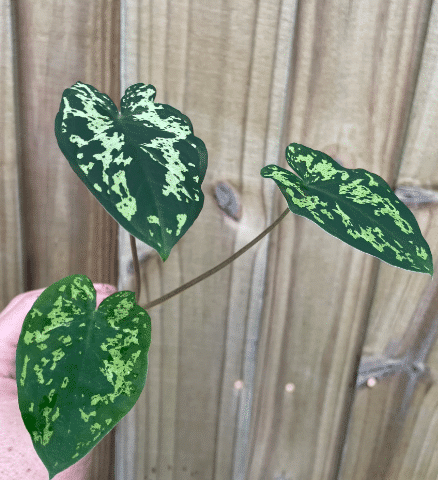
Shake off excess soil to expose the rhizomes. These are thick, underground stems that store energy for the plant. Look for natural separations where new shoots are growing. They should look like the first image above.
Divide the Rhizomes
Use a clean, sharp knife or your hands to carefully separate the rhizomes. Each division should have at least one healthy stem and a few roots attached. Avoid cutting through the main root system or damaging any healthy roots.
Repot the Divisions
Place each new division into a pot filled with a well-draining potting mix (2 parts potting soil, 1 part loam, 1 part perlite). Make sure the rhizome is just below the soil surface, and water it lightly after planting.
Can You Propagate Hilo Beauty From a Stem Cutting?
We would not.
The leaf petiole by itself is not the structure used to make a new Hilo Beauty plant.
Propagation depends on viable underground rhizome tissue and a growth point.
Troubleshooting common issues


Hilo Beauty Problem Quick Guide
| Symptom | Likely cause | What to do |
|---|---|---|
| Drooping leaves | Dry soil, cold stress or damaged rhizome/roots | Check both moisture and temperature before watering. |
| Several yellow leaves | Wet/cold roots, seasonal decline or stress | Check the rhizome and whether growth is slowing seasonally. |
| Brown crispy edges | Dry soil, very dry air, salts or sun scorch | Review moisture and exposure before treating. |
| Older camouflage patches become darker | Often normal leaf maturation | Compare the newest leaves before changing care. |
| New leaves become smaller | Low light, seasonal slowdown or root stress | Check light, warmth and roots before fertilizing. |
| Long petioles leaning toward light | Light too weak or one-sided | Move gradually toward stronger filtered light. |
| Soft or foul-smelling rhizome | Rhizome rot | Unpot immediately and remove clearly rotten tissue. |
← Swipe horizontally on mobile to see the full table →
Why Is My Hilo Beauty Drooping?
Check both the soil and the temperature.
If the mix is dry, the plant may simply need water.
If the soil is already moist, do not automatically water again. Cold conditions or damaged underground tissue can prevent the plant from taking up moisture normally.
Our own plant once drooped beside a cold window while the soil was still wet.
Why Are My Hilo Beauty Leaves Turning Yellow?
One old leaf can yellow naturally.
Several leaves declining together make us check whether the root zone is staying cold and wet, or whether the plant is slowing down seasonally.
If the rhizome remains firm and the decline is gradual as winter approaches, the plant may simply be reducing its foliage.
Rapid yellowing combined with soft or foul-smelling underground tissue is much more concerning.
Why Are the Camouflage Markings on My Hilo Beauty Getting Darker?
This can be normal.
Botanical descriptions of Caladium praetermissum specifically note that some of the pale cream-to-gray markings darken as individual leaves age.
We compare new leaves before changing the plant’s light or fertilizer.
Why Are My Hilo Beauty Leaves Getting Smaller?
Smaller new foliage is not automatically a nutrient deficiency.
Check whether daylight has decreased, temperatures have fallen or the rhizome/root system is stressed.
If the plant is otherwise healthy and entering winter, smaller foliage can simply accompany slower seasonal growth.
Why Does My Hilo Beauty Have Brown Crispy Edges?
Check whether the soil has been drying too far.
Hilo Beauty prefers more consistent moisture than many plants commonly sold as Alocasias.
Very dry air, fertilizer-salt buildup and strong sun can also contribute.
We investigate those before assuming a humidifier alone will fix the problem.
Why Does My Hilo Beauty Have Brown or Black Spots?
Do not automatically apply neem oil or fungicide.
Sun damage, cold injury, physical damage and leaf disease can produce similar markings.
Keep the conditions stable and watch whether the lesions continue spreading into healthy tissue before choosing a treatment.
Why Is My Hilo Beauty Getting Leggy?
Long petioles leaning strongly toward the window can indicate insufficient or highly one-sided light.
Move the plant gradually into stronger filtered light.
We do not prune healthy long petioles simply to make the plant shorter; the next leaves are a better indicator of whether the new position is helping.
Why Is My Hilo Beauty Rhizome Soft?
A healthy rhizome should feel firm.
Soft, dark or foul-smelling tissue is consistent with rot and warrants immediate inspection.
Remove clearly decomposing material and repot healthy tissue in fresh, airy but moisture-retentive mix.
FAQ
Is white Alocasia hilo beauty toxic to pets?
Yes, the Alocasia Hilo Beauty is toxic to pets if ingested, causing symptoms like oral irritation, drooling, and vomiting
Does Alocasia hilo beauty like to be placed outside in summer?
Yes, we can move it outdoors during summer, but only in shaded areas with indirect light. Direct sun can scorch its delicate leaves
What are advantages and disadvantages of Alocasia hilo beauty?
Advantages: Stunning foliage, air-purifying, and unique variegation.
Disadvantages: Sensitive to overwatering, and toxic to pets.
Can alocasia hilo beauty grow in low light?
Not really, Alocasia Hilo Beauty needs bright, indirect light. In low light, the plant will become leggy, and its leaf patterns will fade.
Why are the leaves of my alocasia hilo beauty growing smaller over time?
Smaller leaves often indicate that the plant is root-bound or lacking nutrients – we can repot the plant into a slightly larger pot and fertilize it monthly during the growing season.
Why does my Alocasia hilo beauty drop leaves frequently?
Frequent leaf drop can happen due to stress: such as being moved, overwatering, or drafts. We can stabilize the plant’s environment by keeping it away from cold air and adjusting the watering routine to once in 2-3 weeks in sumer and spring and once in 3-4 weeks in winter.
What is the difference between alocasia hilo beauty and other alocasias?
Alocasia hilo beauty is distinguished by its camouflage-like variegation — irregular patches of pale green, cream, and mid-green across each leaf that look unlike the solid or striped leaves of most other alocasias. It stays more compact than large varieties like regal shield or macrorrhiza variegata, making it better suited to shelves and smaller spaces. Care requirements are similar to other alocasias but the variegated leaves mean it needs more light than solid green varieties to maintain the pattern — in low light the variegation fades and the leaves come in greener.
Is Hilo Beauty Rare?
It is less common than many mass-market houseplants, but we would no longer call it extremely rare.
The plant is increasingly available through specialist nurseries and online growers.
Its unusual history and camouflage foliage make it collectible, but rarity changes as commercial propagation increases.