Alocasia regal shield care
Alocasia regal shield needs bright indirect light, high humidity, and careful watering. Learn how to fix drooping leaves and keep this dramatic plant thriving.

We are an Ad-Free, community driven site. When you purchase through links on our site, we earn an affiliate commission
Care at a glance
How to care for Alocasia regal shield?
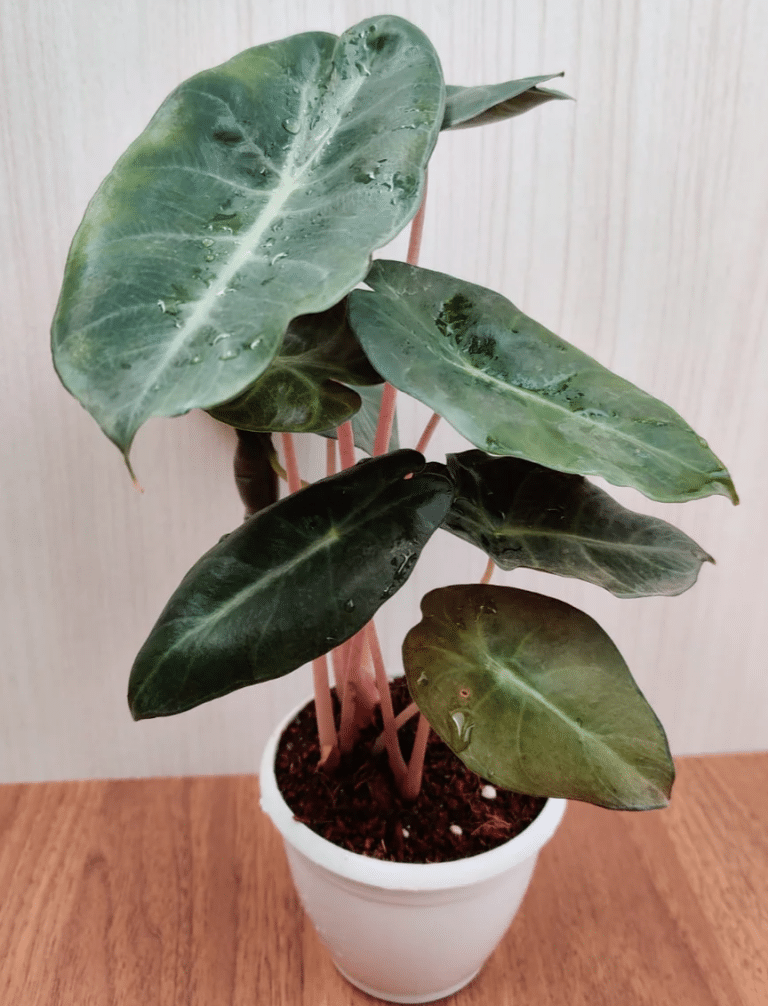
The registered cultivar name is actually Alocasia ‘Regal Shields’, although “Alocasia Regal Shield” is the name most commonly used by growers and plant shops.
- Light: Give it bright filtered or indirect light. It tolerates some shade but grows more slowly there.
- Water: During active growth, water thoroughly when roughly the top 2 inches of potting mix have become just dry.
- Soil: Use an airy, moisture-retentive, well-draining aroid mix.
- Temperature: Keep it warm, ideally around 65–80°F indoors.
- Humidity: Medium-to-high humidity suits it well; we aim for roughly 50–70% RH rather than treating 80% as mandatory.
- Fertilizer: Feed monthly during active growth with a complete liquid houseplant fertilizer.
- Pruning: Very little is required. Remove only yellow, badly damaged or dead leaves.
- Propagation: Divide established clumps, rhizomes, offsets or corm-like growth rather than taking ordinary leaf cuttings.
- Pet safety: Alocasia is toxic to cats and dogs because it contains insoluble calcium oxalate crystals.
- Common problems: Drooping, yellow leaves, curling, brown edges, root damage and spider mites.
2. Care mistakes we have learnt to avoid with alocasia regal shield plant
Watering just because a leaf droops: Our Regal Shield can droop when it is thirsty, but wet damaged roots can also produce limp foliage. We now check the potting mix before deciding whether water is actually the solution.
Keeping it in a potting mix that stays wet deep in the container: We once had a Regal Shield begin collapsing one leaf at a time even though the surface looked ready for another watering. The deeper mix was still wet. After we repotted into a more aerated mix and a container that dried more predictably, the plant recovered.
Assuming the pot must always be shallow: A wider, shallower container helped in our particular case, but several things changed at once—including pot volume and soil aeration. We now choose the pot according to the actual root system rather than assuming every Regal Shield needs one particular shape.
3. A real issue we have had with alocasia regal in our home
Our plant once started losing leaves rapidly even though the top of the potting mix seemed relatively dry.
When we removed it from the pot, the deeper soil was still holding much more moisture than we realized.
That changed how we water large Alocasias.
lineage and common questions

Is the Correct Name Regal Shield or Regal Shields?
The registered cultivar name is Alocasia ‘Regal Shields’.
The singular “Regal Shield” has become extremely common in plant shops and online searches, which is why we use it naturally throughout this guide.
Botanically, however, ‘Regal Shields’ is the formal cultivar name.
What Is Alocasia Regal Shields?
Alocasia ‘Regal Shields’ is a cultivated hybrid rather than a naturally occurring species.
The original plant patent identifies it as a cross between Alocasia odora and Alocasia reginula.
Hybridizer LariAnn Garner made the cross in 2007 in Florida, and the cultivar was later selected for its distinctive dark foliage, upright habit and durability.
Is Regal Shields the Same as Black Velvet Alocasia?
No.
Black Velvet is associated with Alocasia reginula, one of the species behind the Regal Shields hybrid.
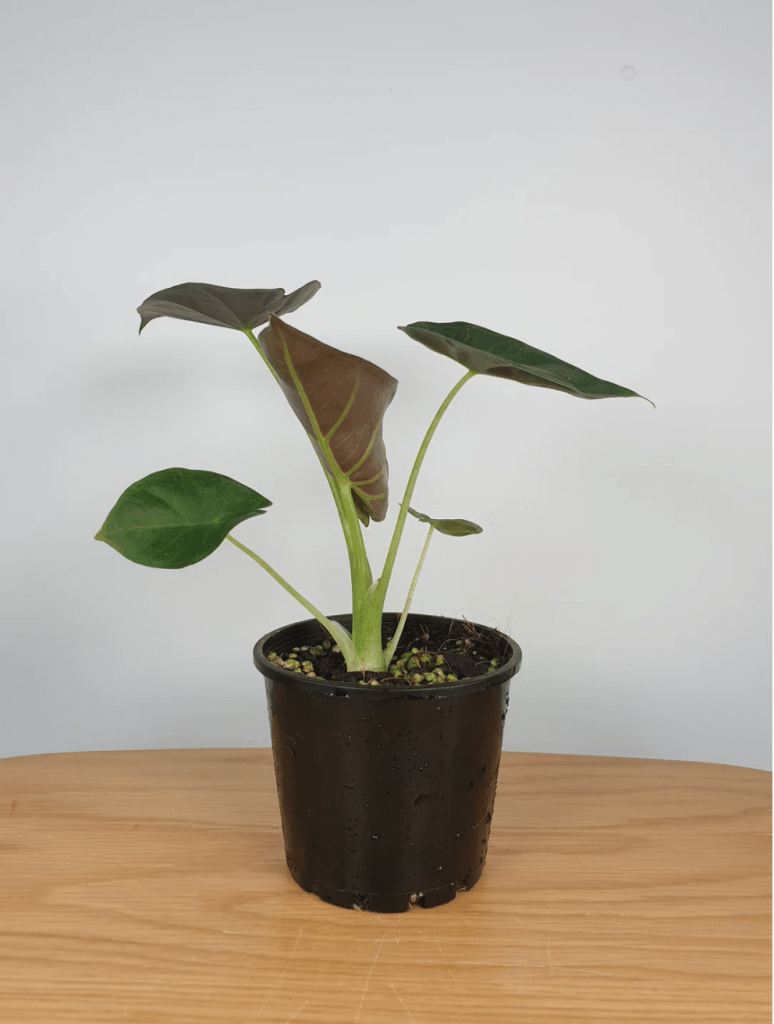
Regal Shields is a much larger, more upright plant whose mature foliage combines dark green upper surfaces with purple-maroon undersides.
Why Are Regal Shield Leaves Purple Underneath?
The purple-maroon underside is a normal cultivar characteristic.
The original plant description specifically identifies mature leaves with dark green upper surfaces and persistent purple coloration below.
A purple underside therefore does not mean the plant is nutrient-deficient, sun-stressed or unhealthy.
How Big Does Alocasia Regal Shield Get?
Size depends greatly on growing conditions.
The original patent documented plants up to about 1.2 metres, or roughly 4 feet, while RHS gives the cultivar a larger ultimate size under favorable protected cultivation.
Container-grown houseplants are often smaller than the maximum outdoor or greenhouse dimensions.
What Are the Benefits of Regal Shield?
For us, the benefits are practical and ornamental.
It gives us unusually large, dark foliage without needing full sun, grows upright rather than sprawling across a room, and can become a substantial floor plant.
We would not describe air purification as a meaningful household benefit.
Also read: Alocasia Pink Dragon, Alocasia Jacklyn, Alocasia Hilo Beauty, Variegated Alocasia


What we wish we knew before buying
We wish we had known how dramatically growth can slow when winter light drops.
Ours can go from producing large leaves regularly in summer to doing almost nothing for weeks in winter.
That does not automatically mean it is dying or that it needs more fertilizer.
We now follow the plant’s actual growth: as new growth slows and the pot dries more slowly, we naturally increase the interval between waterings.
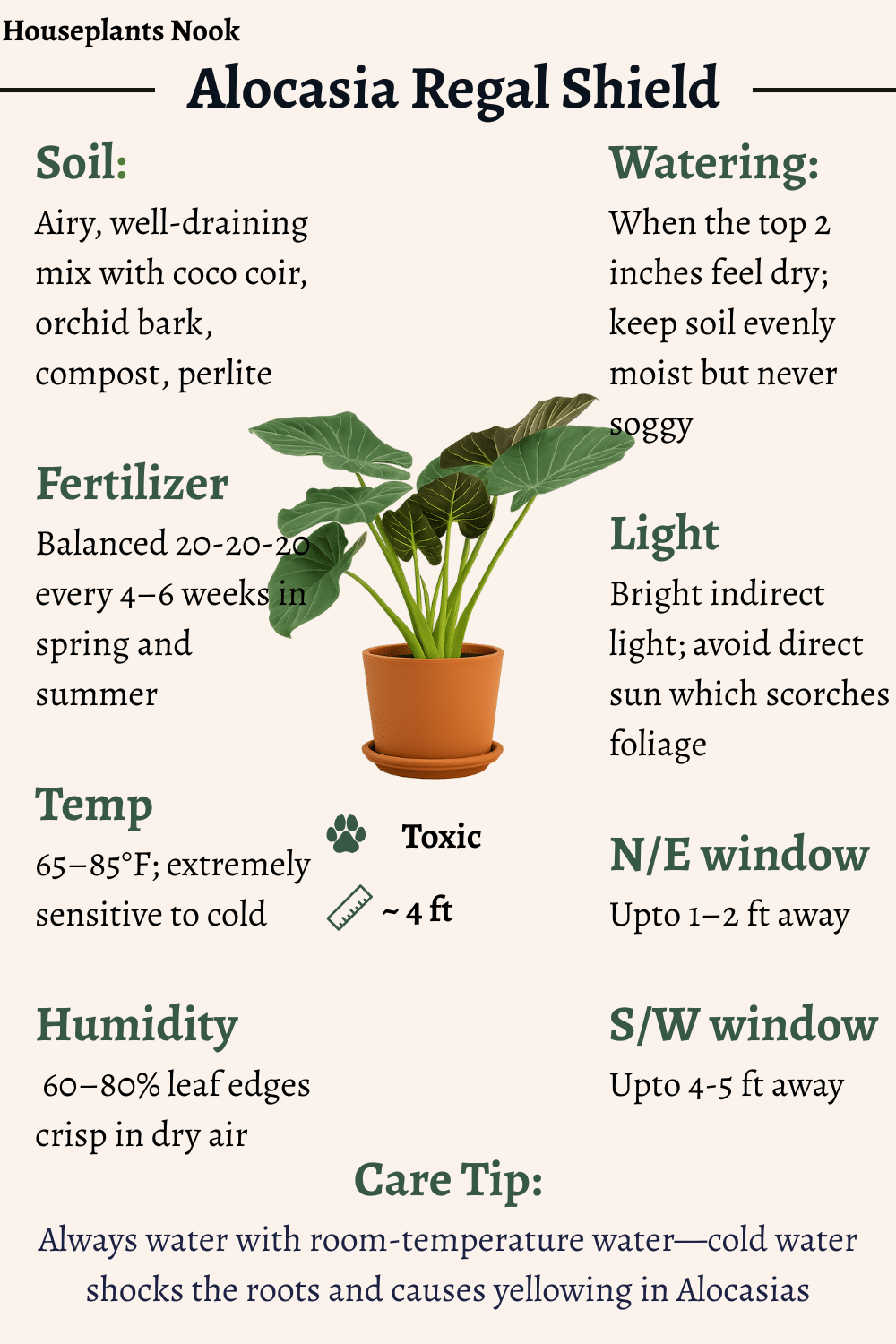
alocasia regal shield plant care infographic
Light and placement and seasons

How Much Light Does Alocasia Regal Shield Need?
We give ours bright filtered or indirect light.
RHS recommends bright diffused light for Alocasia ‘Regal Shields’.
It can tolerate somewhat shadier conditions, but growth becomes slower and new leaves may remain smaller.
Can Regal Shield Grow in Lower Light?
It can tolerate partial shade better than many sun-loving houseplants.
But we distinguish between tolerating shade and producing its largest indoor foliage there.
If growth stops or new leaves become progressively smaller, increasing useful filtered light is one of the first things we check.
Can Regal Shield Take Direct Sun?
It can tolerate more light than its dark foliage might suggest, but an indoor plant should be acclimated gradually.
Strong sun through hot glass can still scorch foliage.
Outdoors in summer, we start it in bright shade or partial shade rather than moving it directly from an indoor room into full sun.
How Does Regal Shield Change Through the Seasons?
Spring: New growth resumes as light and warmth increase. We begin regular feeding once the plant is actively producing leaves.
Summer: This is usually the strongest growth period. The plant uses water more rapidly and may produce progressively larger foliage.
Fall: Growth slows and the pot begins taking longer to dry.
Winter: Growth can become extremely slow and some Alocasias may lose foliage. We reduce watering frequency according to how slowly the pot dries rather than switching to a fixed three-week schedule.
Soil
What Soil Is Best for Alocasia Regal Shield?
Regal Shield needs a mix that combines air space with steady moisture.
Our starting indoor mix is:
2 parts peat-free houseplant mix + 1 part fine orchid bark + 1 part perlite or pumice.
If the base mix is already coarse, we use less amendment.
The goal is not to create an extremely dry mix. RHS recommends an open, moisture-retentive but well-draining medium.
What pH Does Regal Shield Prefer?
Slightly acidic to neutral conditions are appropriate.
RHS recommends acidic-to-neutral growing media.
We would not routinely add lime or other alkaline amendments.
Best soil to use for Alocasia regal shield?

This is a great soil mix with use for all alocasia, and suitable for most other indoor plants as well! You can also add more perlite!
Temperature and Humidity
What Temperature Does Regal Shield Prefer?
Warm, stable conditions suit it best.
We generally aim for 65–80°F, while RHS recommends roughly 18–25°C / 64–77°F under glass.
Keep it away from cold drafts and air-conditioning vents.
How Much Humidity Does Regal Shield Need?
Regal Shield appreciates medium-to-high humidity.
In our home, roughly 50–70% RH is a useful practical range, but we would not claim that the plant requires exactly 60–80%.
Healthy roots, appropriate watering and useful light matter just as much.
Do Brown Tips Mean Regal Shield Needs More Humidity?
Not automatically.
Dry air can contribute, but brown margins can also follow dry soil, salt buildup, root damage, water-quality issues or sun injury.
We use the humidity reading as one piece of the diagnosis rather than assuming a humidifier is always the answer.


fertilizer
What Fertilizer Is Best for Regal Shield?
We use a complete liquid houseplant fertilizer during active growth.
A specific 20-20-20 ratio is not required.
RHS recommends monthly feeding during the active growing season.
How Often Should You Fertilize Regal Shield?
About once a month while the plant is actively producing leaves is a reasonable starting point, following the fertilizer label.
We stop or reduce feeding when winter growth slows dramatically.
How Can You Tell if Regal Shield Needs Fertilizer?
We do not diagnose nutrient deficiency from one yellow leaf or one smaller leaf.
Low light, root stress, seasonal slowdown and excessive moisture can produce the same symptoms.
If conditions are good and the plant is actively growing, regular complete fertilizer is usually enough.
Should You Use Banana Peel Tea, Eggshells or Coffee Grounds?
We don’t.
Those homemade mixtures do not provide the predictable, complete nutrient profile of a labeled houseplant fertilizer.
Best fertilizer to use for Alocasia regal shield?

Pots and planters
What Kind of Pot Is Best for Regal Shield?
Use a container with drainage that is only modestly larger than the existing root system.
As the plant becomes top-heavy, a heavy ceramic or terracotta pot can provide useful stability.
Plastic also works but keeps the mix moist longer.
Does Regal Shield Need a Shallow Pot?
Not specifically.
A shallower pot helped one of ours because the old setup was staying wet too long, but we would not generalize that shape to every Regal Shield.
We choose pot dimensions according to the actual root and rhizome system and how quickly the mix dries.


Watering
How Often Should You Water Alocasia Regal Shield?
During active growth, we water when roughly the top 2 inches of potting mix have become just dry.
Then we water thoroughly until excess drains from the pot.
We do not use a fixed one-week or two-week schedule.
Should Regal Shield Soil Stay Moist?
Yes—moist but well drained is the goal.
We do not let the entire root ball become bone dry during active growth.
At the same time, a pot that remains saturated for long periods can deprive the roots of oxygen and cause rot.
How Do You Water Regal Shield in Winter?
Follow the plant and the potting mix.
As growth slows, the plant uses less water and the mix stays wet longer.
We therefore increase the interval between waterings while still watering thoroughly when the upper layer has dried appropriately.
We do not give tiny amounts of water or automatically wait exactly three weeks.
What Water Is Best for Regal Shield?
If your tap water is relatively soft and the plant is healthy, it can work.
RHS recommends clean rainwater where tap water is hard because repeated alkaline water can gradually raise the growing medium’s pH.
pruning
Does Alocasia Regal Shield Need Pruning?
Very little.
RHS lists no routine pruning requirement for the cultivar.
We remove only leaves that are completely yellow, badly damaged or dead.
Where Do You Cut a Regal Shield Leaf?
Follow the leaf’s petiole down toward the base of the plant and make a clean cut without damaging the crown, rhizome or neighboring emerging growth.
We do not look for a vine-like “node” and we do not prune healthy leaves simply because they overlap.
Does Pruning Make Regal Shield Bushier?
No.
This is not a branching vine or woody cane plant.
Fullness comes from healthy basal growth, offsets and additional shoots from the rhizomatous/corm-forming plant.
Does Regal Shield Need Special Care After Pruning?
No.
One removed leaf does not require misting or a special watering schedule.
Return the plant to its normal care.
propagating
What Is the Best Way to Propagate Regal Shield?
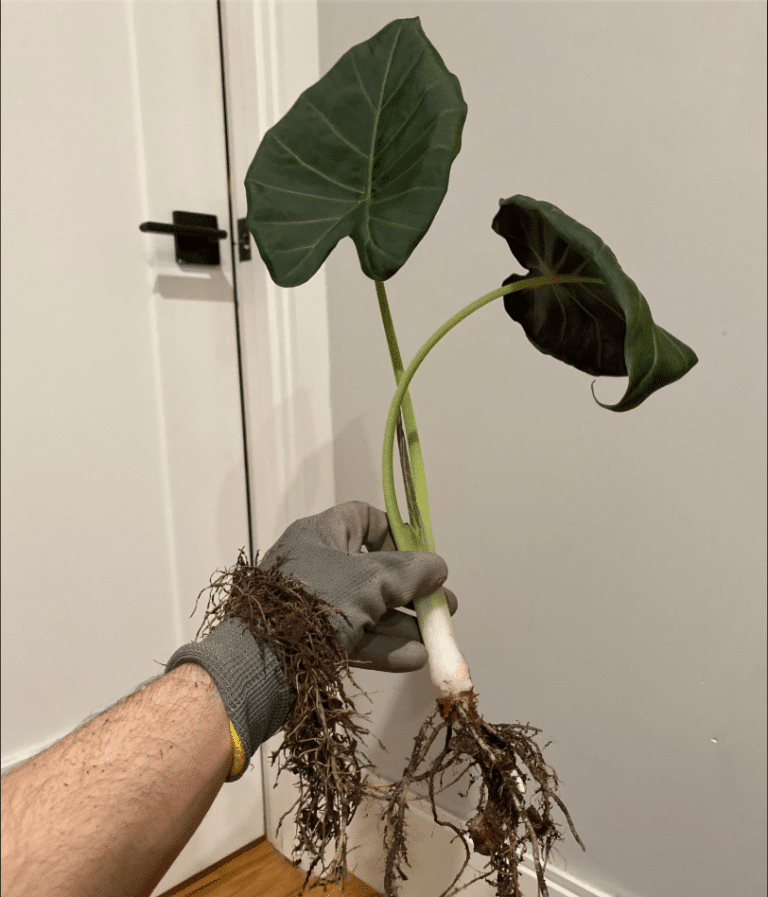
For home growers, the most practical methods are division, offsets and corm/rhizome propagation.
When repotting, expose the underground growth carefully and look for natural offsets or separable sections with a viable growing point.
Can You Propagate Regal Shield From a Leaf or Node?
Not in the way you would propagate Pothos or Philodendron.
A detached Regal Shield leaf or petiole does not contain the type of node needed to create a new plant.
New plants come from viable underground corm, rhizome or offset tissue.
What Is a Regal Shield Baby Plant?
Small shoots can develop from offsets or corm-like structures around the established plant.
We wait until a baby has a viable growing point and preferably its own roots before separating it.
If it is still tiny and strongly dependent on the parent root mass, leaving it attached longer usually makes separation easier.
How Do You Divide Regal Shield?
Remove the plant gently from its pot and expose the root and rhizome system.
Find a natural division or offset with a viable growth point.
Separate it carefully with clean hands or a sterile knife where needed.
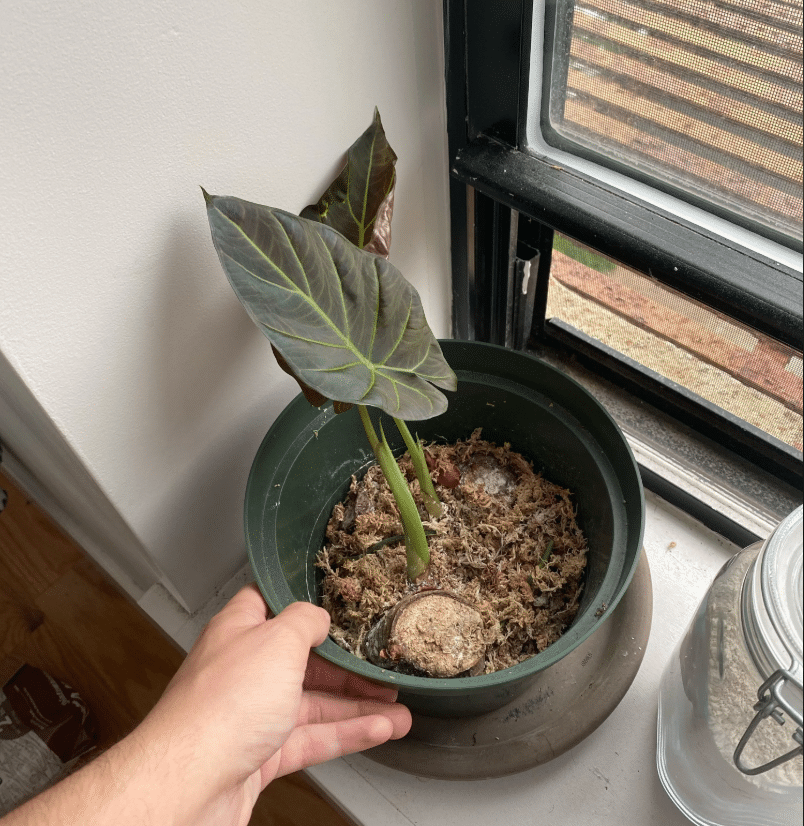
Pot it into a small container of airy, moisture-retentive mix and keep it warm in bright filtered light while it establishes.
Does a Regal Shield Division Need a Leaf?
Not necessarily.
The important part is viable underground tissue with a healthy growth point.
A section can produce new foliage even if it does not carry a mature leaf at the moment of division.
Troubleshooting common issues
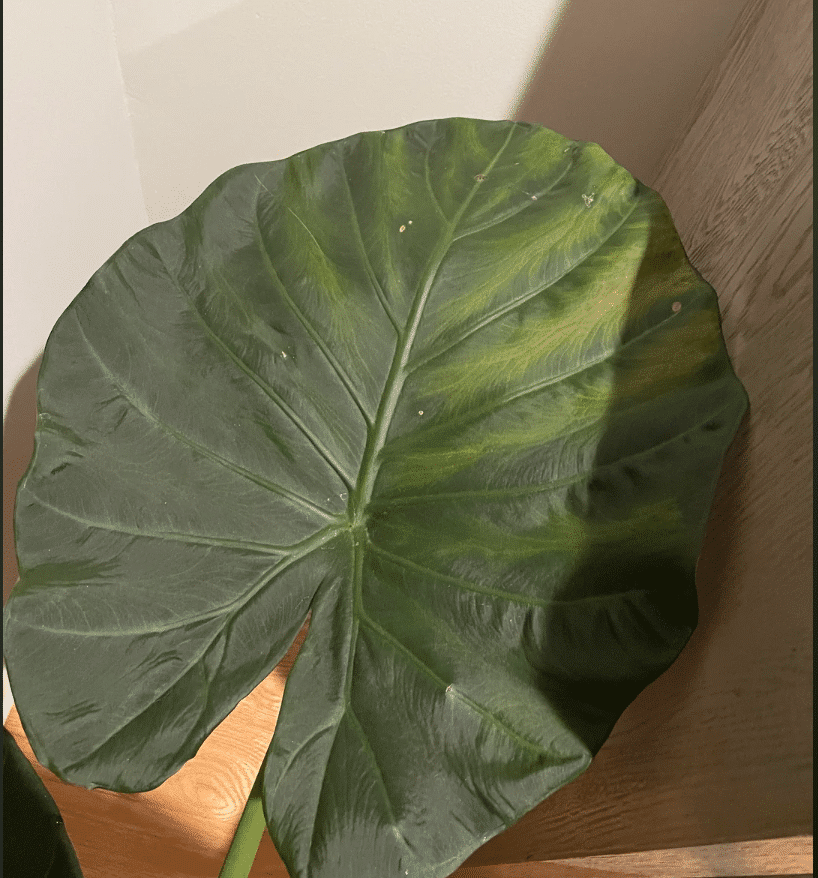
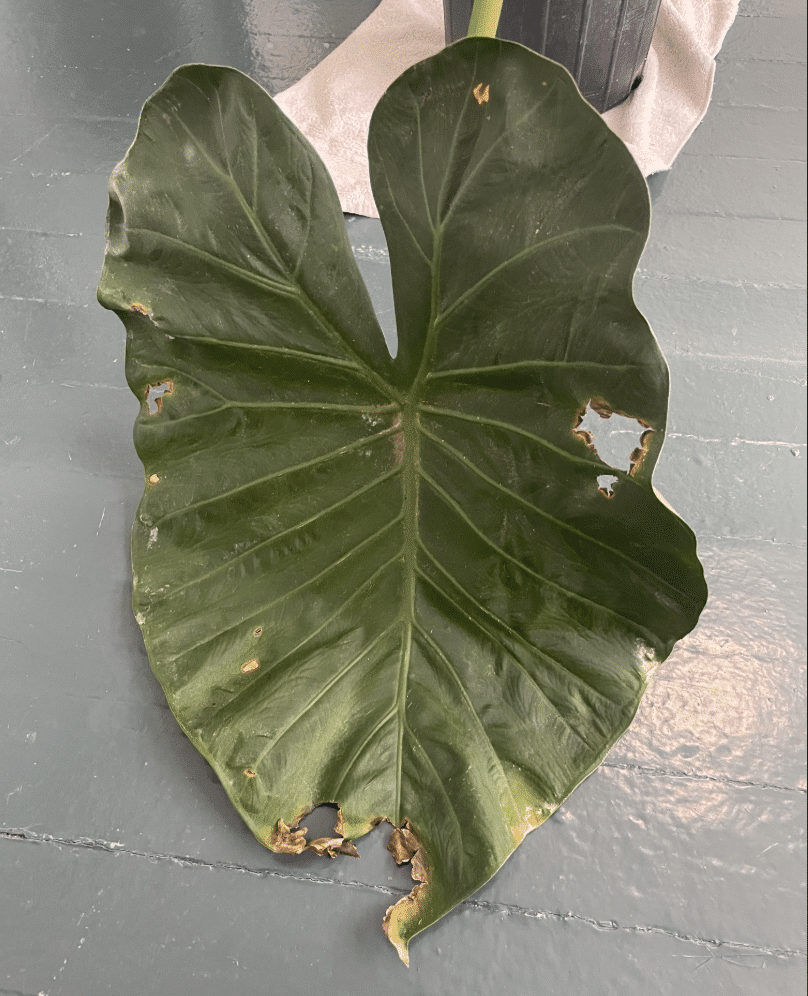
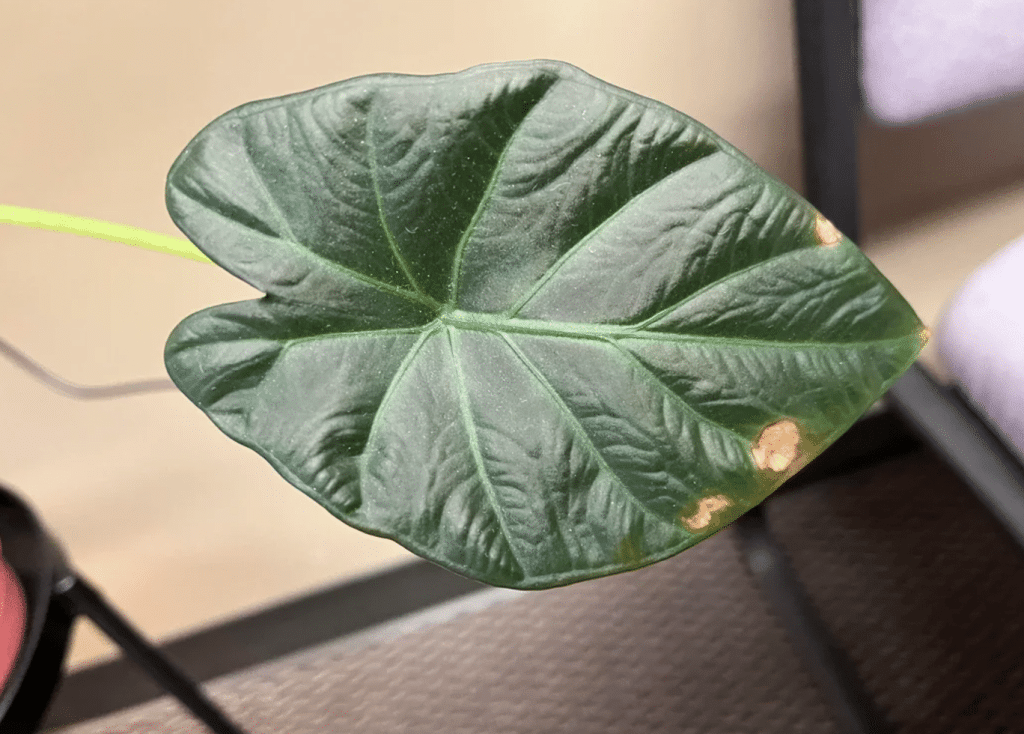
Regal Shield Problem Quick Guide
| Symptom | Likely cause | What to do |
|---|---|---|
| Drooping + dry soil | Underwatering | Water thoroughly and let excess drain. |
| Drooping + wet soil | Root stress, rot, cold or transplant shock | Do not water again; inspect roots if decline continues. |
| Several yellow leaves | Wet roots, low light, cold or seasonal slowdown | Check roots, light and temperature before fertilizing. |
| Brown tips or edges | Dry soil, dry air, salts, root stress or sun damage | Review moisture, roots and exposure before increasing humidity. |
| Leaves curling | Dry soil, temperature stress, root stress or pests | Check soil and inspect leaf undersides before treating. |
| Smaller or leaning new leaves | Weak light, seasonal slowdown or root stress | Improve conditions before increasing fertilizer. |
| Fine stippling or webbing | Spider mites | Isolate and inspect the undersides closely. |
| Brown or black spots | Physical injury, sun/cold damage, pests or disease | Do not spray automatically; watch whether lesions spread. |
← Swipe horizontally on mobile to see the full table →
Alocasia Regal Shield Problems
Why Is My Alocasia Regal Shield Drooping?
Check the soil before watering.
If the root ball is dry, Regal Shield can droop dramatically when thirsty.
Water thoroughly and let the excess drain.
If the soil is already wet, do not add more water. Root damage, prolonged saturation, cold conditions or recent transplant stress can also produce limp foliage.
Our own plant once drooped while the deeper part of the pot was still wet, which is why we now check beyond the surface before reacting.
Why Is My Regal Shield Drooping Even Though the Soil Is Wet?
Wet-soil drooping deserves more attention than another watering.
Check whether the pot has remained heavy and wet for a long period.
If the plant continues declining, inspect the roots and underground corm/rhizome tissue.
Healthy tissue should feel firm. Soft, dark or foul-smelling tissue is much more concerning.
Why Are My Regal Shield Leaves Turning Yellow?
One old yellow leaf can simply be aging.
Several leaves yellowing together can point to wet roots, cold conditions, insufficient light or seasonal slowdown.
We would not jump directly to fertilizer.
First check the root zone and whether environmental conditions recently changed.
Why Does Regal Shield Have Brown Tips?
Brown tips are not a humidity diagnosis by themselves.
Dry soil, extremely dry air, fertilizer salts, root damage and sun injury can all create similar margins.
We look at soil moisture, roots, recent feeding and light exposure before deciding what to change.
Why Are My Regal Shield Leaves Curling?
Start with the root zone.
Dry soil can cause curling, but so can stressed roots or abrupt temperature changes.
Also inspect the leaf undersides closely for mites.
We do not automatically mist the plant or apply insecticide simply because the leaves curl.
Why Is My Regal Shield Getting Long Stems or Leaning?
Alocasia leaves naturally sit on long petioles, so a tall petiole is not automatically “legginess.”
If several new leaves become smaller, weaker or strongly lean toward the light source, insufficient usable light becomes more likely.
Move the plant gradually into stronger filtered light.
Why Is My Regal Shield New Leaf Not Unfurling?
Give it time before touching it.
A new Alocasia leaf can remain rolled while it expands.
If the leaf stays firm, green and continues changing, we leave it alone.
If it becomes dry, yellow, soft or stops progressing entirely, then we investigate root moisture, temperature and humidity.
We never peel a new leaf open manually.
Why Does My Regal Shield Have Brown or Black Spots?
Do not automatically apply neem oil or fungicide.
Physical damage, cold injury, direct sun, pests and disease can produce spots that look similar.
Keep conditions stable and monitor whether the lesions expand or appear on new leaves.
If they continue spreading, isolate the plant while you determine the cause.
Does Regal Shield Get Spider Mites?
Yes.
RHS lists spider mites among possible Alocasia Regal Shields pests, along with scale and mealybugs.
Interestingly, the original plant patent described Regal Shields as moderately resistant to spider mites.
That does not mean immune.
We still inspect the leaf undersides regularly, particularly in warm, dry indoor conditions.
FAQ
Is Alocasia Regal Shield Toxic to Cats and Dogs?
Yes.
ASPCA lists Alocasia species as toxic to cats and dogs because they contain insoluble calcium oxalate crystals.
Chewing the plant can cause oral pain and swelling, excessive drooling, vomiting and difficulty swallowing.
Is Regal Shield the Same as Regal Shields?
Yes.
They refer to the same cultivated plant.
Alocasia ‘Regal Shields’ is the registered cultivar name; Regal Shield is the extremely common singular trade/search name.
Is Regal Shield an Elephant Ear?
Yes.
“Elephant ear” is a broad common name applied to several large-leaved aroids, including Alocasia.
Regal Shields is specifically an Alocasia hybrid.
Can Regal Shield Go Outside in Summer?
Yes, once temperatures are reliably warm.
Acclimate it gradually and begin in bright shade or partial shade.
An indoor-grown plant can scorch if moved suddenly into intense outdoor sun.
Does Regal Shield Go Dormant in Winter?
It can slow dramatically and may lose leaves as light and temperatures fall.
But indoor plants kept warm and bright do not all go completely leafless.
We follow the plant’s actual growth rather than trying to force dormancy.
How Fast Does Regal Shield Grow?
Growth is fastest during warm, bright conditions.
We would not promise one new leaf every four to six weeks because light, temperature, roots, plant age and season can change the pace substantially.
How Long Does One Regal Shield Leaf Last?
There is no reliable fixed lifespan for an individual leaf.
Older leaves eventually yellow as the plant reallocates resources, but environmental stress can shorten leaf life considerably.
We judge the plant by whether it is maintaining or increasing its overall healthy leaf count.
Can Regal Shield Grow Permanently in Water?
It can be grown in a deliberately managed hydroponic or semi-hydroponic system.
That is different from leaving an ordinary soil-grown plant indefinitely in plain water.
For our normal care, we use an airy potting mix with drainage.
Does Regal Shield Flower?
Yes.
Mature plants can produce a typical aroid inflorescence consisting of a spathe surrounding a spadix.
RHS notes that flowers are produced relatively infrequently in cultivation and that the foliage is the main ornamental feature.
Is Regal Shield Easy to Grow?
Among Alocasias, it can be relatively vigorous when its core conditions are stable.
The original plant patent specifically selected Regal Shields for durability and ease of production.
Indoors, the most important variables are useful filtered light, warmth, an airy but moisture-retentive root zone and avoiding prolonged saturation.