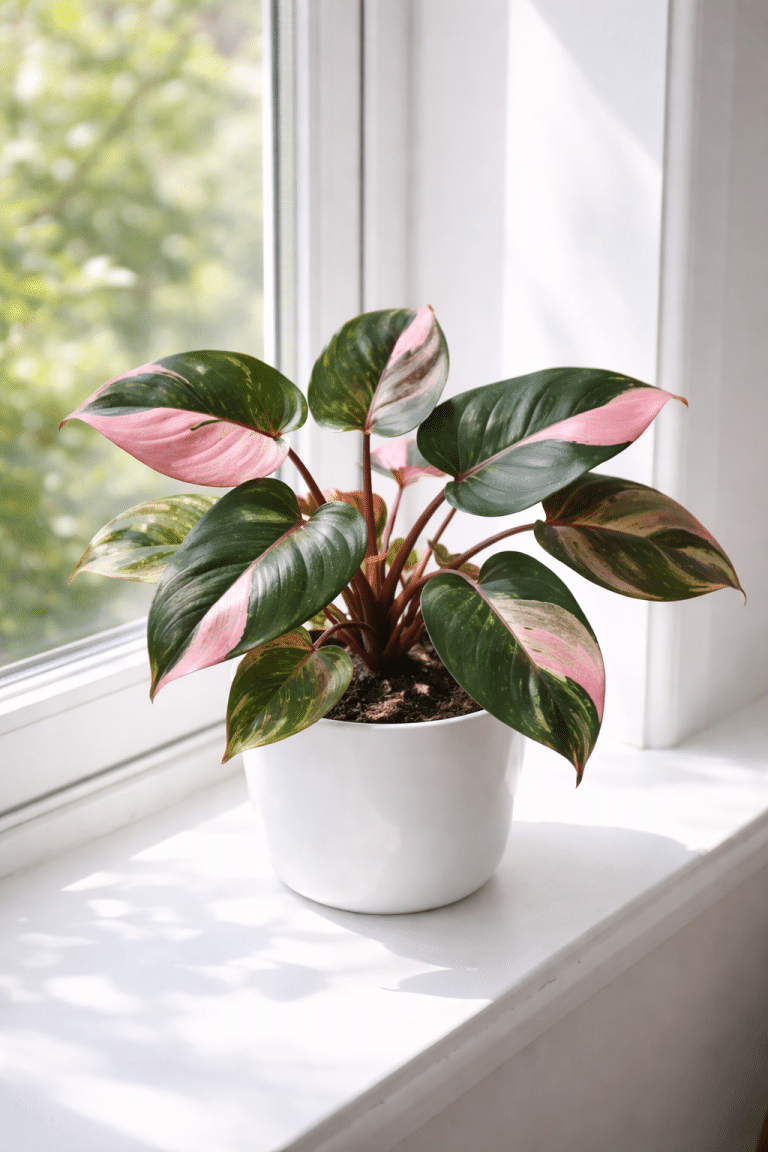
Monstera Deliciosa
Discover watering, soil, fertilizing, pests, styling, and troubleshooting tips for Monstera Deliciosa plant from our experience growing and caring for it in our Brooklyn home!

We are an AD-FREE, community driven site. When you purchase through links, we may earn a commission, which helps sustain our blog!
Monstera Deliciosa care guide
care at a glance
How to care for Monstera Deliciosa?
Monstera deliciosa is a bold, upright plant with large, glossy green leaves that naturally split into deep, dramatic fenestrations as it matures.
- Water when the top 2 inches of soil feel dry, soaking thoroughly and letting excess drain—avoid soggy roots or bone-dry soil.
- Needs bright, indirect light to develop leaf splits; thrives in 65–85°F temperatures and dislikes cold drafts.
- Mildly toxic to pets if ingested, potentially causing oral irritation, drooling, or vomiting (ASPCA).
- Use a chunky, well-draining mix with bark and perlite; feed every 4–6 weeks in spring and summer with a balanced, diluted fertilizer.
- Common issue: yellowing leaves from overwatering—check for drainage holes and let soil fully dry between waterings.
- Propagate by cutting a stem with one node and aerial root, then root it in water or moist soil until new growth appears.
Our favorite soil and fertilizer for Monstera deliciosa

2. Care mistakes we have learnt to avoid with Monstera deliciosa plant
- Watering before the top half of the soil dries: Monsteras have thick, slow-to-dry roots, and moist soil sitting deep in the pot leads to yellowing and mushy stems. This plant hates being kept evenly damp in an apartment. We wait until the soil is dry halfway down and the pot feels lighter before giving it a deep soak.
- Putting it too far from a window and expecting big fenestrations: Everyone online shows huge split leaves, but indoors that only happens when the plant gets strong, consistent light. In dim corners the leaves come in small and heart-shaped. We keep ours within 2–3 feet of a bright east or west window so the new leaves actually develop holes.
- Choosing a pot that’s too big “so it can grow”: Monsteras slow down in oversized pots because the soil stays wet for too long around the root ball. We made this mistake once and didn’t see new growth for months. Now we upsize just one pot size at a time and use chunky soil so excess moisture has somewhere to go.
- Watering the same amount in winter as in summer: In our Brooklyn apartment, winter heat and low light nearly stop Monstera growth. Summer watering habits cause yellowing and base rot by January. We now water much less from November to March and gradually increase again when days lengthen and the plant starts pushing new leaves.
3. A real issue we have had with monstera deliciosa in our home
Our Monstera once kept giving us tiny, hole-less leaves, which confused us because the plant looked healthy otherwise. We thought it needed more fertilizer, but the real cause was how far it was sitting from the window in winter. It simply wasn’t getting enough consistent brightness to form fenestrations. Sliding it two feet closer to our west window changed everything—the next leaf came in twice the size with clean splits.
lineage and Symbolism
The Monstera deliciosa (aka Swiss Cheese Plant), part of the Araceae family, is known for its large, dramatic leaves with natural splits and holes. These fenestrations not only look stunning but help the plant survive heavy tropical rain and strong winds in its native Central American jungles.
Ours stretches toward a skylight on a moss pole in our Brooklyn home, reaching nearly 6 feet. (at least as of now!) With proper support, it climbs gracefully and produces large, perforated leaves. It’s ideal for bright corners or tucked beside tall furniture, where its trailing roots and vertical shape create structure and greenery.
What surprises people is that in the wild, it produces a fruit that smells like pineapple and banana. It’s rarely seen indoors, but the name “deliciosa” comes from that sweet edible trait!
Monstera symbolizes expansion, creativity, and hidden beauty. Its ambitious growth — ideal for bold and expressive Leos.


$58
“I love the dramatic look of the Monstera leaves. It’s been growing beautifully with minimal care.”
What we wish we knew before buying
Fenestrations are earned, not guaranteed: We assumed those dramatic holes would appear automatically as the plant aged, but indoors they only show up when the Monstera gets truly bright, consistent light. Without that, it just produces smaller heart-shaped leaves no matter how well you water or fertilize. We wish someone had told us that getting the “Instagram Monstera” look requires prime window space, not just time.
monstera Deliciosa plant care infographic
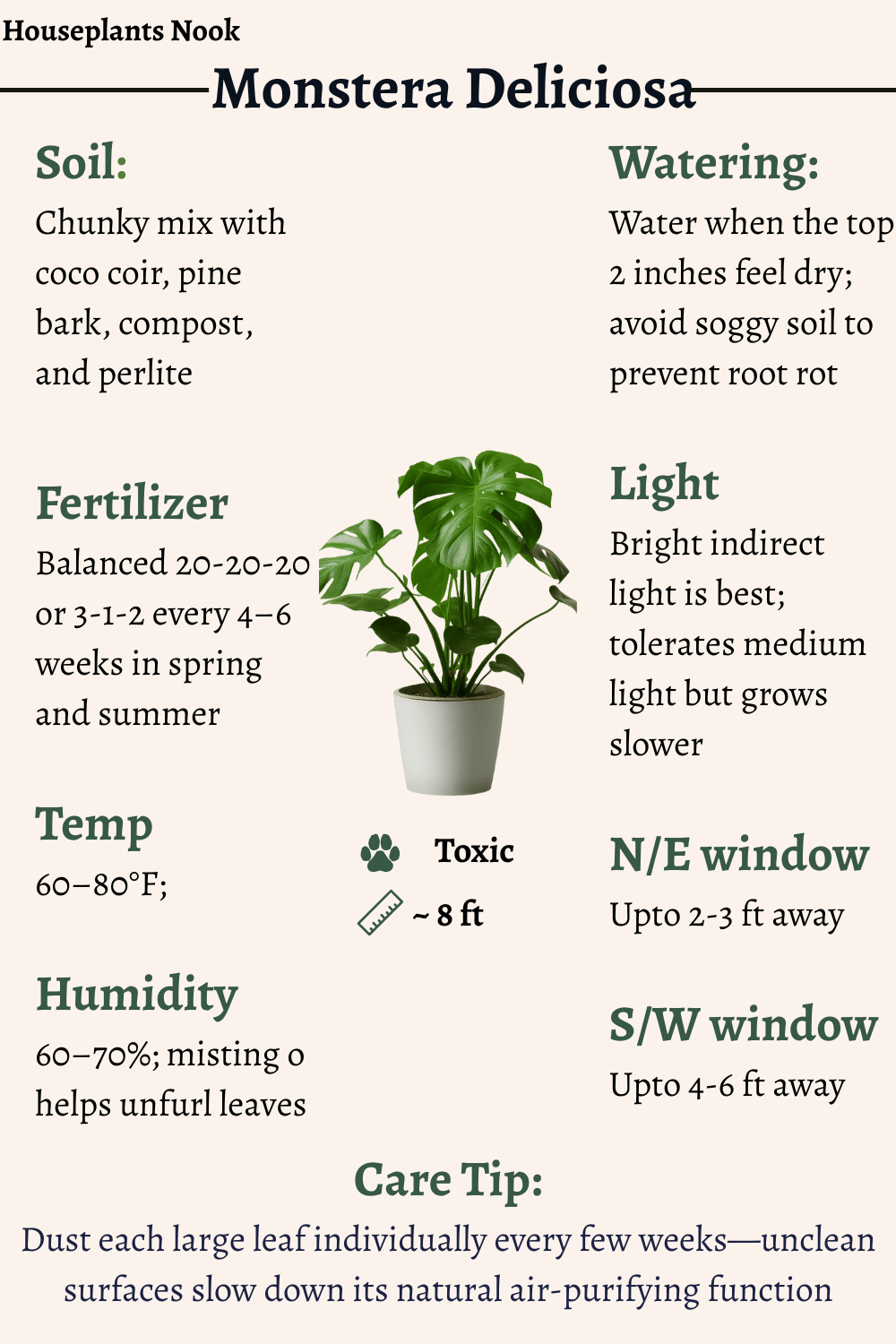
📋 Use this infographic on your site — copy the code below:
Plant that pairs well with similar care needs

Light and placement and season
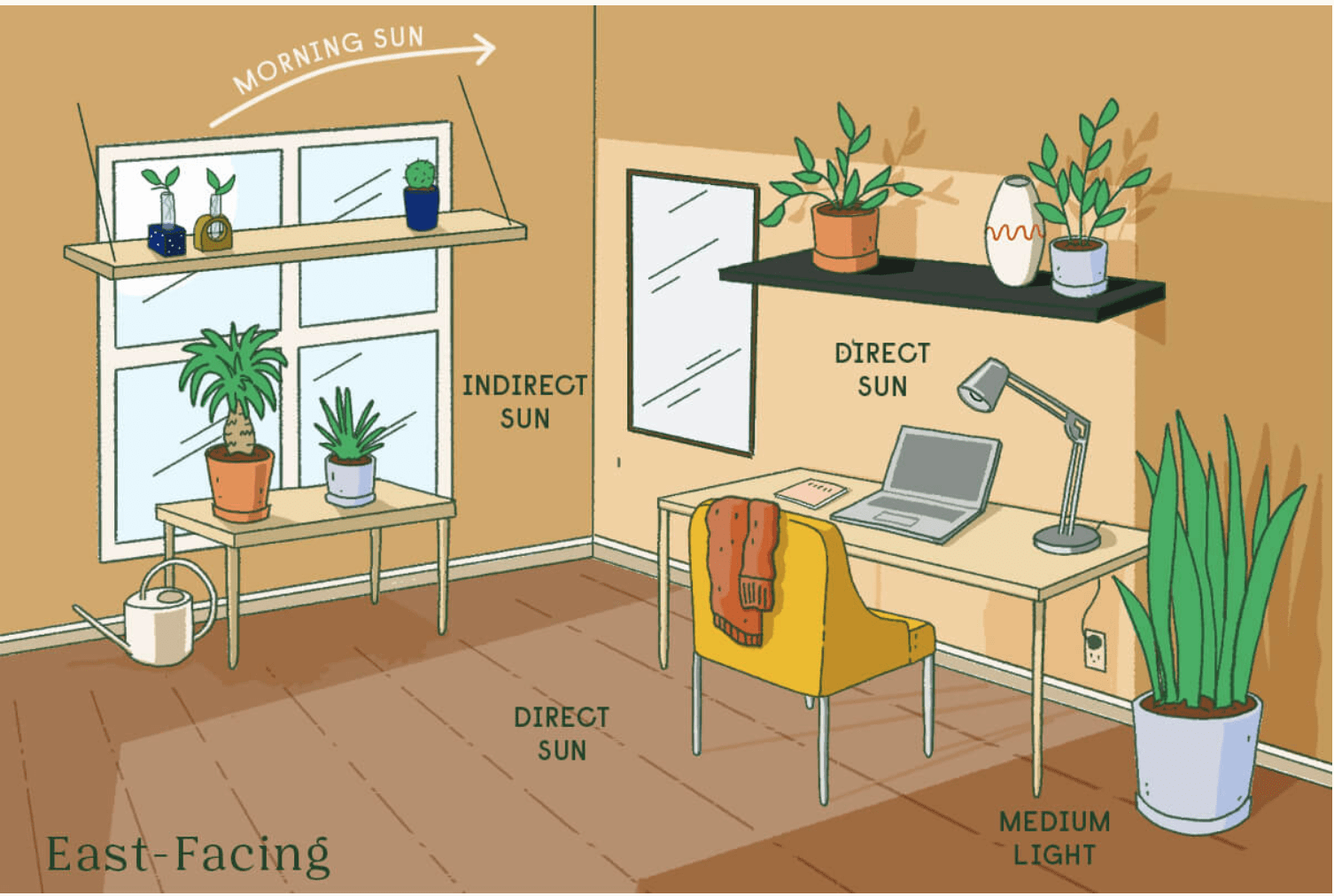
What is the light requirement for Monstera Deliciosa plant?
Monstera deliciosa thrives in bright, indirect light and can tolerate medium light, but low light limits leaf size and fenestration. We have ours currently near an east-facing window with sheer curtains—it gets morning sun without harsh exposure. According to TheSill: “Monsteras thrive in bright to medium indirect light.”
How to know if Monstera Deliciosa is not getting right amount of light?
Insufficient light causes small leaves, lack of fenestration, and leggy growth. We once left ours in a hallway too long, when it was smaller, and it started reaching sideways with tiny, unsplit leaves. And too much direct sun leads to scorched, bleached, or curling edges. Afternoon light especially needs filtering.
Where to place Monstera Deliciosa and where to avoid?
Monstera grows best near east- or north-facing windows with bright filtered light. South-facing spots work with sheer curtains. We place ours about 4 feet from a large east window and rotate it monthly.
Avoid placing it in direct afternoon sun, deep shade, or near radiators or cold drafts. Growth stalls in too-dark corners.
how does monstera deliciosa behave through seasons
Spring: Growth picks up fast, and new leaves arrive larger and more frequent. We water more often because the soil finally dries evenly, and we restart monthly fertilizing. We pull it closer to our bright west window to encourage fenestrations. Any winter yellowing stops once the plant finds its footing again.
Summer: This is its strongest season, with big leaves and long petioles that reach for light. We water deeply when the top half of the soil dries and fertilize lightly every few weeks. Strong light from a south or west window keeps the new leaves splitting. Heat can trap moisture, so chunky soil helps prevent hidden rot.
Fall: Growth slows, and leaves get slightly smaller as daylight shrinks. We water less often because cooler nights keep the pot moist longer. We move it a bit closer to the window so the remaining light reaches the canopy. Occasional yellow leaves appear as the plant resets for winter, and we prune lightly.
Winter: Growth almost stops, and this is when overwatering becomes the biggest threat. We water sparingly—sometimes every 2–3 weeks—only when the pot feels light and the top half is dry. Our west window still works, but we avoid cold drafts near the glass. The plant may produce one tiny leaf in winter, but we don’t expect fenestrations until light returns.
Soil
What soil composition to use for Monstera Deliciosa?
Monstera prefers a chunky, well-draining soil mix with good airflow around roots. We use 40% potting soil, 30% orchid bark, 20% perlite, and 10% compost, which keeps things light and rich.
Avoid peat-heavy mixes that retain too much moisture. A slightly acidic to neutral pH (6–7) works best.
Best soil to use for Monstera Deliciosa?
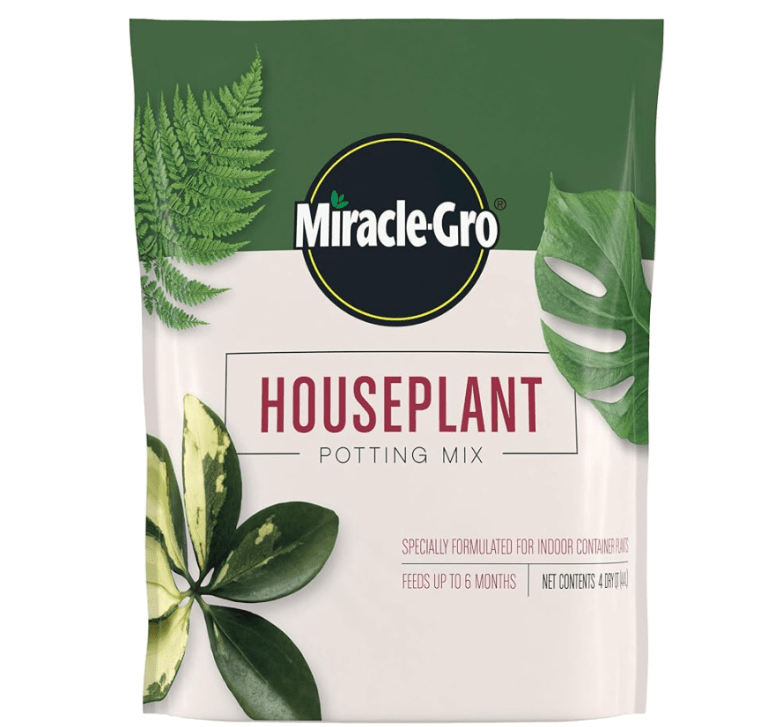
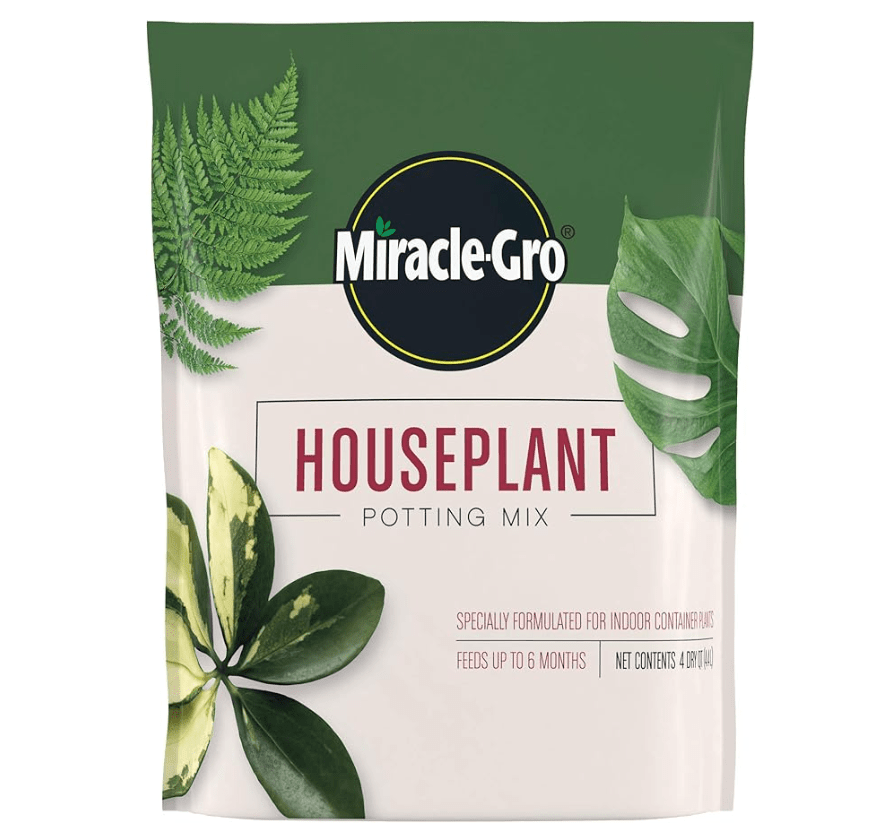
This Miracle Gro soil is a great, versatile and efficient soil mix we have used for our monsteras and swear by!
Temperature and Humidity
What is the best temperature condition for Monstera Deliciosa?
Ideal temperatures are 65–85°F. Cold air below 55°F causes slowed growth, leaf curl, or blackening. We avoid drafty windows and never leave ours near an open patio door in winter.
Warmth helps push new leaves, but extreme heat over 90°F without airflow can also stress the plant.
What is the best humidity condition for Monstera Deliciosa?
Monstera does well in 50–60% humidity, mimicking its tropical roots.
When winter hits and radiators dry the air, we group it with other plants and run a small humidifier nearby. But if you notice brown edges or crisp tips, especially on new leaves, the air’s likely too dry!


fertilizer
What is the best fertilizer composition to use for Monstera Deliciosa?
Use a balanced 20-20-20 fertilizer or one slightly higher in nitrogen to support leaf growth. We dilute it to half-strength and avoid overfeeding, which causes salt buildup.
DIY Fertilizer Recipe: Mix 1 part worm castings, 1 part compost, and a pinch of ground kelp meal into the top 2 inches of soil in spring. This supports leaf growth and potential blooming by providing nitrogen, phosphorus, and trace minerals without overwhelming roots.
How and when to fertilize Monstera Deliciosa?
Fertilize once a month from spring through early fall with a balanced liquid fertilizer diluted to half strength. Water first to avoid root burn, and apply directly to the soil around the root zone. Pause feeding in winter!
What are the signs Monstera Deliciosa needs food?
Nutrient deficiencies appear as pale or slow-growing new leaves and fewer splits in mature foliage. We correct that with a gentle feed and better light, and the following leaf usually improves.
Check for root crowding too—sometimes poor nutrition stems from outgrown pots.
Best fertilizer to use for Monstera Deliciosa?
We’ve used Plant Magic Organic Fertilizer on our Monsteras for a while now, and it’s one of those products that quietly works – within days, we have seen the leaves perk up and turn a richer green. It’s reliable for maintaining health, but if a plant looks really sluggish, we’ll swap in a fish or kelp-based mix to push new growth.
We feed it once a month during spring and summer, always diluted. In fall and winter, we ease off. That rhythm has kept our Monsteras happy without any yellowing or burn. It’s a solid choice if you want something organic, low-risk, and easy to trust!
Pots and planters
What are the best pots to use for Monstera Deliciosa?
We use terracotta or ceramic pots with drainage holes. The material keeps roots dry and stable.
The pot should be deep and heavy, especially if supporting a moss pole for climbing.
Monsteras outgrow smaller pots every 2–3 years, so we size up only by 2 inches at a time to prevent overwatering issues.


Watering
How and When to water Monstera Deliciosa?
Water when the top 2–3 inches of soil are dry—usually once a week in summer, every 2–3 weeks in winter. We water thoroughly until liquid drains from the bottom, then empty the saucer.
Monstera dislikes soggy roots: use your finger or a chopstick to check soil moisture before watering.
what are the Signs of over or under watering Monstera Deliciosa?
Overwatering: Yellowing lower leaves, black spots, and mushy stems from root rot.
Underwatering: Drooping leaves that feel limp and curl inward, usually from dry soil.
We’ve had to unpot one that got soggy and trim rotted roots before repotting into fresh soil — it recovered slowly with careful drying.

pruning
When to prune Monstera Deliciosa and why?
Pruning encourages compact growth and removes damaged or leggy stems.
When to prune:
Spring or early summer
After rapid vertical growth
When leaves yellow, tear, or crowd each other
how to prune Monstera Deliciosa?
how to care after pruning Monstera Deliciosa?
– Keep the plant out of harsh sun for 2–3 days
– Don’t water immediately—let any cuts callous naturally
propagating
When to Propagate Monstera Deliciosa?
The simplest method is stem propagation in water, ideal for beginners and reliable.
When to propagate:
Spring or early summer
After pruning a healthy, mature stem is ideal and practical!
how to Propagate Monstera Deliciosa?
Cut below a node on a stem with 1–2 leaves
Place cutting in clean water, ensuring the node is submerged
Change water weekly
Once roots reach 2–4 inches (in 3–5 weeks), plant in soil
Keep in bright, indirect light and water lightly
how to care after propagating Monstera Deliciosa?
- Transition slowly to soil—keep humidity high during adjustment
- Avoid direct sun until roots establish in potting mix
Troubleshooting common issues

1. Why are the leaves of the Monstera deliciosa drooping?
Drooping is typically caused by underwatering or sudden cold exposure.
Let the soil dry 2 inches down before soaking thoroughly and move it away from drafts.
2. Why are the leaves of the Monstera deliciosa turning yellow?
Yellowing is usually a sign of overwatering and poor drainage.
Ensure the pot has holes and let the soil dry out completely between waterings.
3. Why are new Monstera deliciosa leaves not splitting?
Lack of light or nutrients prevents proper fenestration.
Brighten the location and feed monthly in spring and summer to encourage full growth.
4. Why are new Monstera deliciosa leaves not splitting?
Lack of light or nutrients prevents proper fenestration.
Brighten the location and feed monthly in spring and summer to encourage full growth.
5. Why is my Monstera deliciosa growing sideways?
Plants lean toward the light if not rotated regularly.
Use a moss pole for support and rotate the pot monthly for even growth.
6. Why are the leaf edges of the Monstera deliciosa brown and crispy?
Low humidity or salt buildup can cause this. Increase humidity and flush soil monthly with distilled water.
7. Why is my Monstera deliciosa getting leggy??
Cause: Leggy growth means it’s stretching for light.
Solution: Move closer to a bright, filtered light source and prune to encourage fullness.
FAQ
Why are the aerial roots of the Monstera deliciosa turning black or dry?
Aerial roots naturally dry out in low humidity.
Mist them occasionally or guide them into moss poles, but trimming is also fine if they’re messy.
Is Monstera deliciosa toxic to pets?
Yes, it’s toxic due to calcium oxalates. Chewing it may cause drooling, vomiting, or irritation.
What are the benefits of a Monstera deliciosa?
Its dramatic, fenestrated leaves add tropical flair and purify indoor air. It’s also fast-growing and sculptural.
Why are my Monstera deliciosa leaves not splitting?
Too little light or nutrients are common reasons. Move it to a brighter spot and fertilize monthly.
How often should I water a Monstera deliciosa?
Water every 7–10 days in summer, letting the top 2 inches dry out first.
Why is my Monstera deliciosa leaning?
It may be reaching for light. Rotate regularly and support with a moss pole.
Can Monstera deliciosa live in low light?
It survives in medium light but won’t thrive or develop fenestrations in low light.
How do I propagate a Monstera deliciosa?
Take a stem cutting with a node and leaf, root in water, then pot when roots are 2–3 inches.
Does Monstera deliciosa like humidity?
Yes. It prefers 50–60% humidity and benefits from misting or grouping with other plants.
Can Monstera deliciosa grow outdoors?
Yes, in zones 10–12. Place in filtered light and protect from direct sun and cold.
Why is my Monstera deliciosa turning yellow?
Usually from overwatering or poor drainage. Check soil moisture and repot if roots are soggy.
Does Monstera deliciosa bloom indoors?
Rarely. Indoor conditions often lack the light and maturity needed for flowering.
Does Monstera deliciosa like to climb?
Yes, aerial roots naturally seek support. A moss pole helps it grow upward.
Can I grow Monstera deliciosa from seed?
Yes, but it’s slow and less common. Most propagation is done by cuttings.
Can I place my Monstera deliciosa outside in summer?
Yes, but only if temps stay above 60°F.
Keep it in filtered shade and gradually reintroduce it indoors in early fall.
How should I pot my Monstera deliciosa?
Use a tall, weighted pot with drainage and room for a moss pole.
Repot every 2–3 years with chunky soil to support its growth.
Personal Quotes & Tips from Houseplants Nook (and Beyond!)
- “I polish both my monsteras and orchids with a water, few drops lemon and mayonnaise solution using paper towels. I easily remove hard water and dust with the solution then remove any extra and gently polish with paper towels or napkins.” Source: Reddit
- Water: The bigger the pot, the easier the root rot. I engorged my Monstera with water after transplanting, which ultimately helped contribute to its death.” Source: Reddit
- “I rotate this plant once, maybe twice per year. The leaves will turn to grow towards the light. I rotate smaller plants a lot more frequently to keep their growth more even. But since this plant is so large I do it less often. It is one of the strategies I use to keep the plant balanced: a vine will grow in one direction for a year, then I will rotate the plant 180 degrees and it will start to grow in the opposite direction for another year.” Source: Sarah K. Benning
- “I had a long, floppy stem that kept falling over the pot. I hoped burying part of the stem would encourage the aerial roots to grow into the soil and support the plant. But I buried the stem too deeply, which caused it to start rotting from all the moisture.” Source: Flowerri.com
- “She’s been happy with regular misting, watering every other week, and occasional pruning. Lately she started growing like crazy with new shoots and leaves.” Source: Reddit