Best soil for English ivy – We tested three popular mixes for 30 days
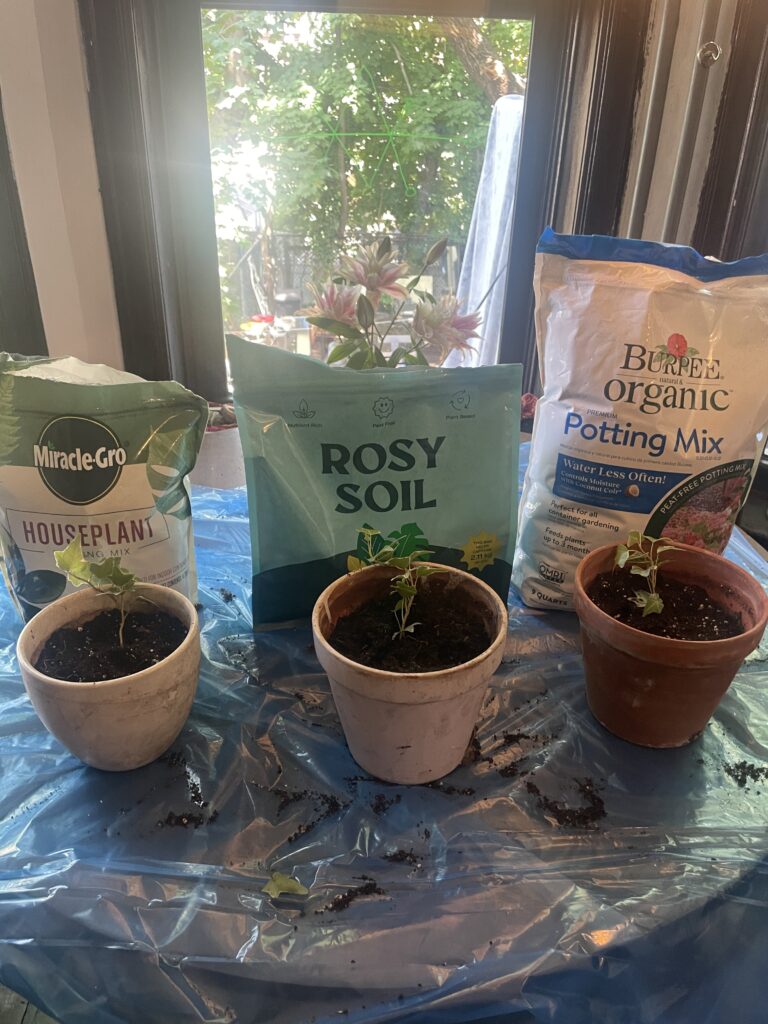
We tested three soil mixes — Rosy Soil Indoor Potting Mix, Miracle-Gro Houseplant Potting Mix, and Burpee Premium Organic Potting Mix — over four weeks to find the best growing medium for a healthy, fast-rooting English ivy.
We are an Ad-free community driven site. When you purchase through links here, we may earn an affiliate commission, which helps sustain our blog!
Clemson Extension’s houseplant guide puts it plainly: the two things that kill indoor English ivy fastest are too much water and soil that doesn’t drain quickly enough.
English ivy gets called indestructible. It mostly is — except for one thing: soil. Root rot causes most of the ivy deaths we’ve seen, not neglect. Skip a watering and ivy bounces back fine. Sit it in the wrong soil for a few weeks and it usually doesn’t.
We at our Brooklyn community home, tested three mixes side by side for four weeks — and the results genuinely surprised us. Miracle-Gro Houseplant Potting Mix, the cheapest of the three at ~$11 a bag, won by the widest margin we’ve seen in any of our soil tests. It out-performed a $19 premium mix on every single thing we measured.
How we tested all of this — same conditions, same plant’s cuttings, same timeline, same moisture meter — is laid out in full further down, so you can run the exact same test yourself if you want to check our numbers.
Quick Pick
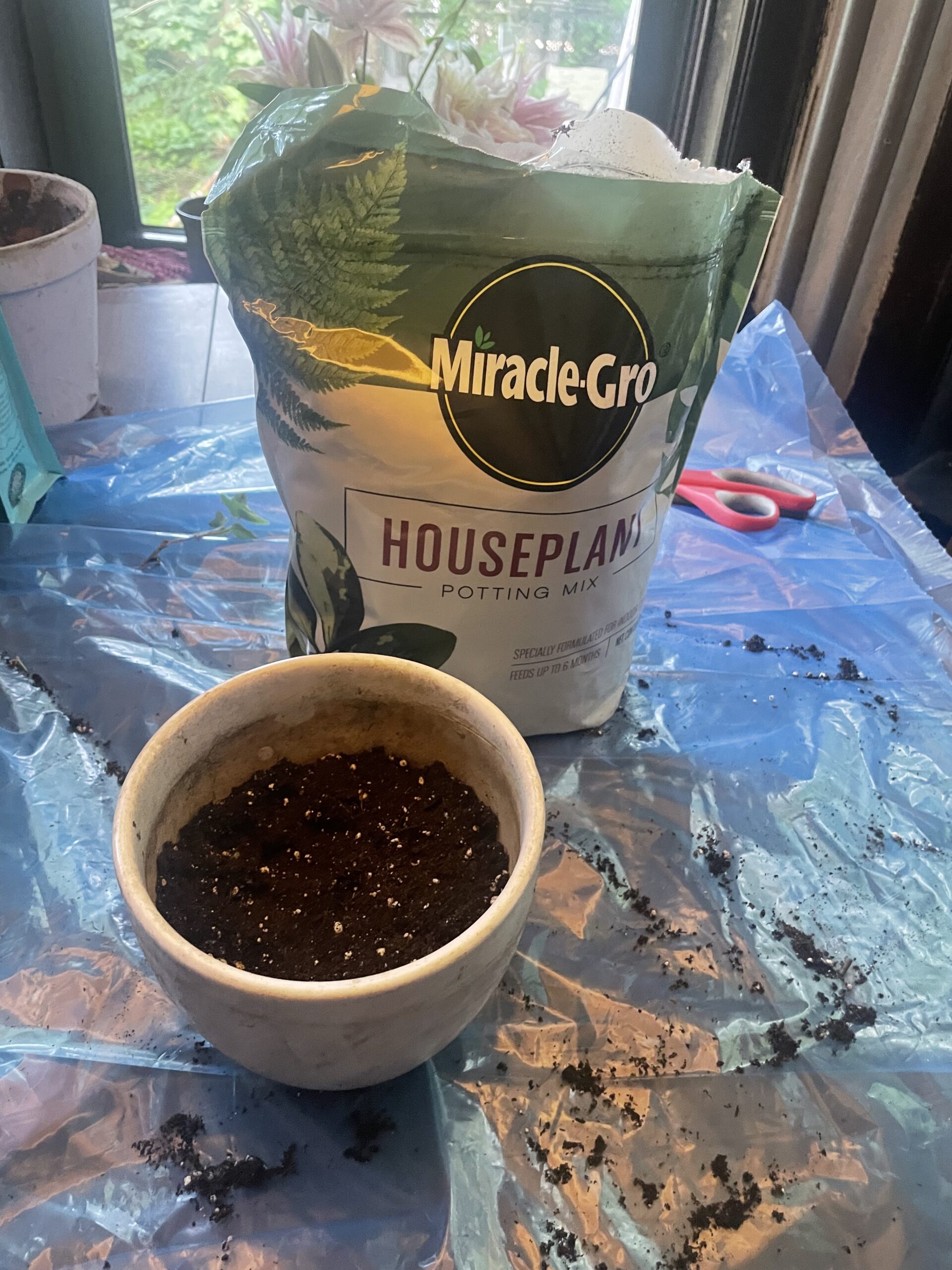
Best Overall — Miracle-Gro Houseplant Potting Mix
Cheapest of the three we tested, and the clear winner across every metric we measured:
- Overall Score: 88/100, well ahead of – Burpee (54) and Rosy Soil (48)
- Held moisture the longest — still reading 3 on day 7, when the other two had already dried out
- Best root development by day 15 — roughly double Rosy Soil’s growth
- Fastest leaf growth — 6 new leaves in 15 days (11 → 17)
Scoring based on our analysis of the three soil mixes for English Ivy
| Mix | Overall Score | Drainage (20%) | Moisture Retention (30%) | Root Health (35%) | Growth Response (15%) |
|---|---|---|---|---|---|
| Rosy Soil | 48 | 5 21s to first drop, 57s to fully stop — slowest of the three | 5 Dropped from a 6 to a 2 by day 7 | 4 Least new root growth of the three by day 15 | 6 11 → 15 leaves (+4) over 15 days |
| Miracle-GroWinner | 88 | 8 Tied fastest first drop (17s), but slowest to fully finish (55s) | 9 Still reading 3 on day 7 — moist two inches down when the others needed water | 9 Roughly double the root length/size of Rosy Soil by day 15 | 9 11 → 17 leaves (+6) over 15 days, nearly bushy |
| Burpee | 54 | 6 Tied fastest first drop (17s), fastest to fully finish (42s) | 5 Dropped from a 4 to a 1.5 by day 7 — driest of the three | 6 Root growth in the middle, ahead of Rosy Soil | 4 11 → 13 leaves (+1) over 15 days — slowest of the three |
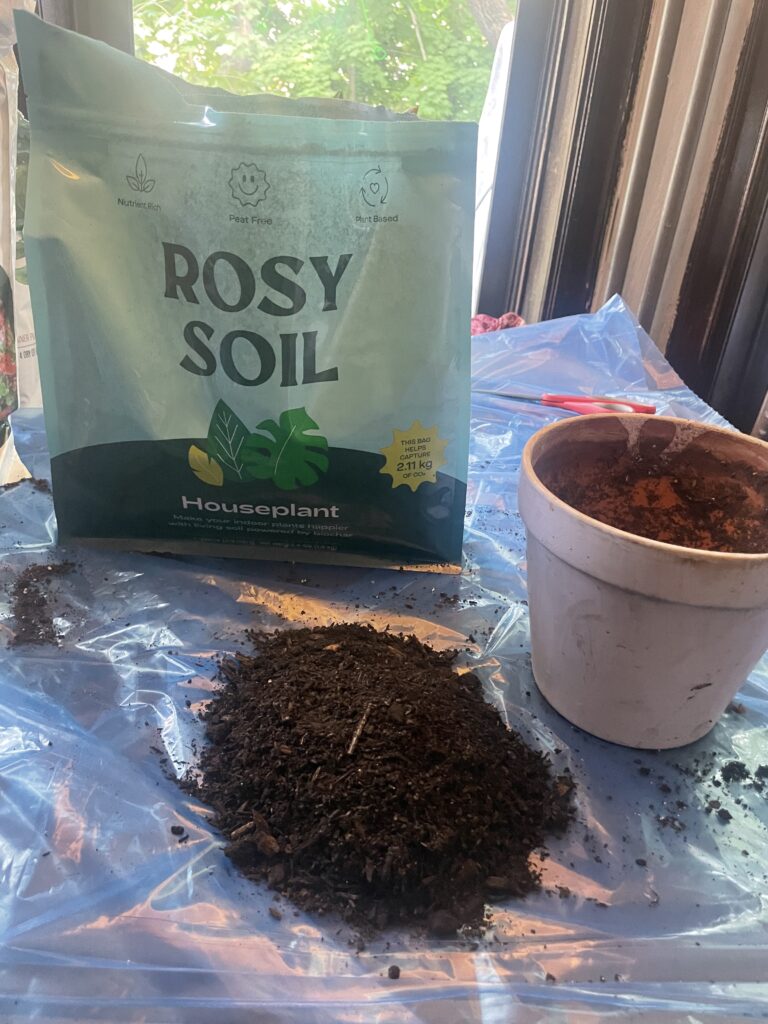
Rosy Soil mix review for English Ivy
Pros
- Peat-free, biochar and pine bark fines
- Online community reviewers report plants “perking up” fast after repotting
- Good growth in our test — 4 new leaves in 15 days
Cons
- Weakest root health of the three we tested. Very short roots after 15 days
- Slowest to drain, both to start and finish. Took 52 seconds for 500 ml water
- Needed to be watered after day 7, same as Burpee — despite the higher price Priciest of the three at $19/bag.
Review
Rosy Soil is the priciest of the three at ~$19 a bag, and going in, we expected the premium price to show up in the results. It didn’t, not in this test with English Ivy
- It was the slowest to drain from the very first drop — 21 seconds to start, 57 seconds to fully finish, the slowest of the three at both ends (see the drainage results below).
- By day 7 it had dried down to a reading of 2, similar to Burpee, and root development at day 15 was the weakest of the three we tested (see the root photos below).
- Growth was a genuine bright spot, though — four new leaves in 15 days, ahead of Burpee (see the growth strip below).
- One of us noted the bag “smelled rich, like real soil” straight out of the bag. The quality is visibly there in texture and ingredients — it just didn’t translate into the strongest results for ivy specifically in our test.
Should you use it?
This is the one place price and performance didn’t line up in our test. At $19 a bag — the most expensive of the three — we expected Rosy Soil to at least match Miracle-Gro. It didn’t come close on root health or moisture retention.
If you’re drawn to it for the peat-free, biochar-based formula on principle, that’s a legitimate reason to choose it anyway. But if you’re optimizing purely for ivy performance, Miracle-Gro did more for less money in our test.
Miracle Gro soil mix review for English Ivy
Pros
- Best root health, moisture retention, and growth of the three we tested
- Held real moisture through day 7 without needing a top-up, while the other two dried out
- Went from 11 to 17 leaves in 15 days — nearly bushy by the end of the test
- Cheapest of the three at $11/bag
- Built specifically to avoid the fungus-gnat problem Miracle-Gro’s other lines are known for
Cons
- Miracle-Gro’s other soil lines have real gnat/mold complaints — this one’s formulated to dodge that, but worth naming honestly
Review
Miracle-Gro didn’t just win — it won by a wide margin, across every single thing we measured.
- It drained fast enough to avoid pooling, at 17 seconds to the first drop, but was the slowest of the three to actually finish letting water through (see the drainage results below) — a pattern that, combined with everything else it did, points to good structure rather than a fluke.
- By day 7, it was still holding meaningful moisture at a reading of 3, while the other two mixes had already dried past the point where we’d want to wait any longer to water (see the moisture readings below).
- That translated directly into results at the roots: at day 15, Miracle-Gro had roughly double the root length and development of Rosy Soil (see the root photos below). Growth followed the same pattern — six new leaves in 15 days, going from 11 to 17, nearly bushy by the end of the test (see the growth strip below).
This is the mix to reach for if you want the least fuss and the fastest, fullest growth, full stop.
Should you use it?
If there’s a reason to hesitate, it’s brand reputation, not performance. Miracle-Gro’s other potting soil lines have real, well-documented complaints about gnats and mold. This specific product is formulated without the compost and bark that usually cause that problem, and our own test backs it up — no pest or mold issues over 15 days.
If you’ve sworn off the brand before, this is worth reconsidering. There’s no real competition here from the other two mixes on performance — this one won clearly across the board.
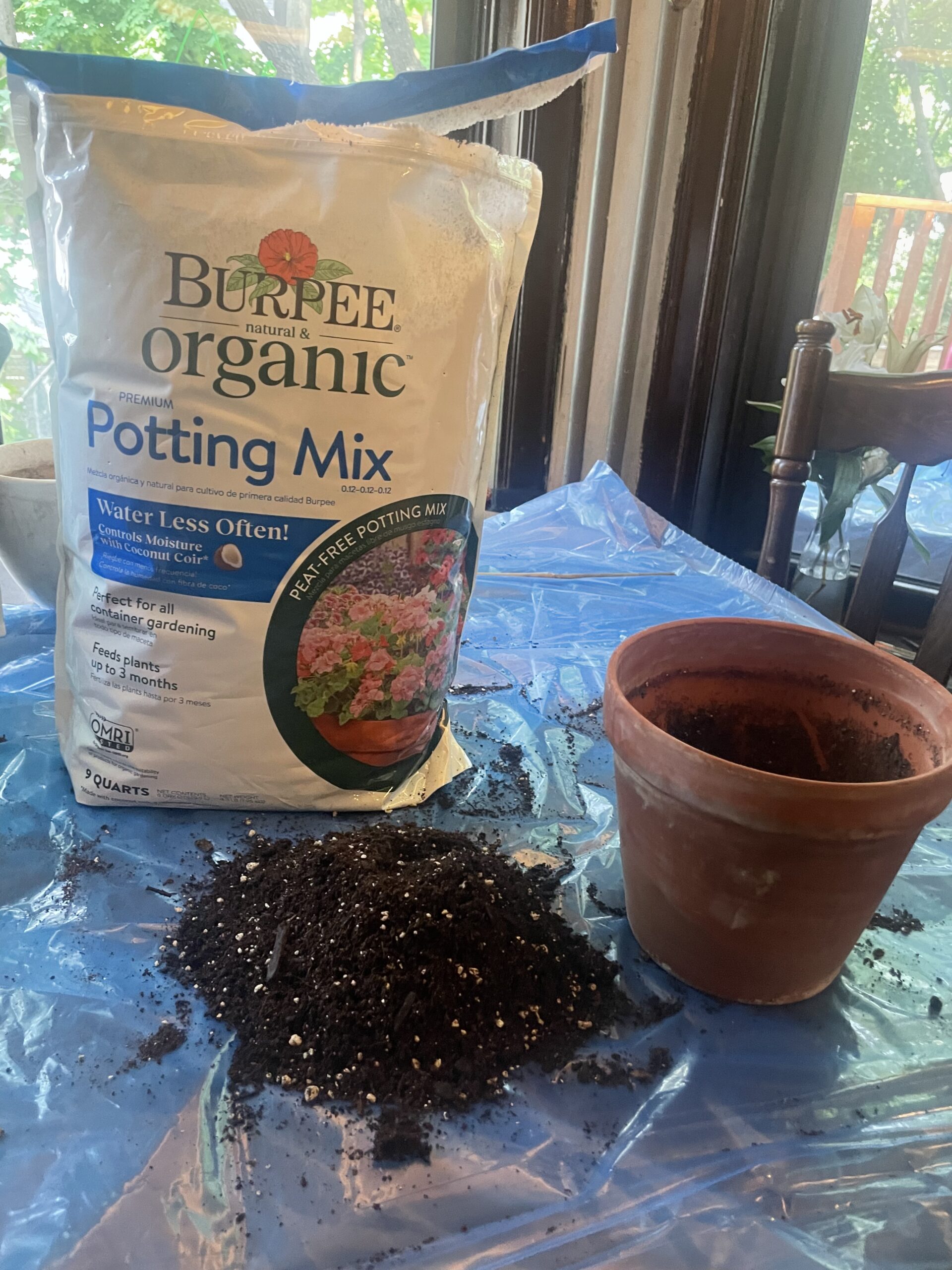
Burpee soil mix review for English Ivy
Pros
- Coarse, well-aerated texture — fastest of the three to fully drain
- Reasonable root development, ahead of Rosy Soil Cheaper than Rosy Soil at $14/bag
- Online reviewers report clean bags, free of pests or debris
Cons
- Weakest leaf growth of the three — just 1 new leaf in 15 days
- Dried out fastest by day 7, same tier as Rosy Soil
- Some online reports of seeds failing to thrive — though that’s a seed-starting complaint, not a houseplant one
Review
Burpee’s biggest strength showed up immediately: it was the fastest of the three to fully drain, finishing in 42 seconds against Miracle-Gro’s 55 and Rosy Soil’s 57 (see the drainage results below). That’s the coarse texture at work — water moves through quickly with little risk of pooling.
- Root development landed solidly in the middle of the pack by day 15 — noticeably ahead of Rosy Soil, though not close to Miracle-Gro (see the root photos below).
- Where it fell short was moisture and growth: it dried out fastest of all three, down to a reading of 1.5 by day 7 (see the moisture readings below), and only pushed out one new leaf across the full test, going from 11 to 13 (see the growth strip below).
- One of us described the texture as “almost gritty, like it’s mostly bark” while repotting — which tracks with how fast it drains.
Should you use it?
If a fast-draining, low-fuss mix matters more to you than fast growth, Burpee is a fair pick — it’s cheaper than Rosy Soil and dries out predictably. Its also versatily meaning it can be used for patio gardens.
But if you want the fullest, fastest-growing ivy, Miracle-Gro beat it on every growth metric we measured, at a lower price. The only real reason to reach for Burpee over Miracle-Gro is if you’re repotting somewhere that already tends to stay too wet, and you want the extra drainage margin.
Analysis and test results for soil mixes
How did we test?
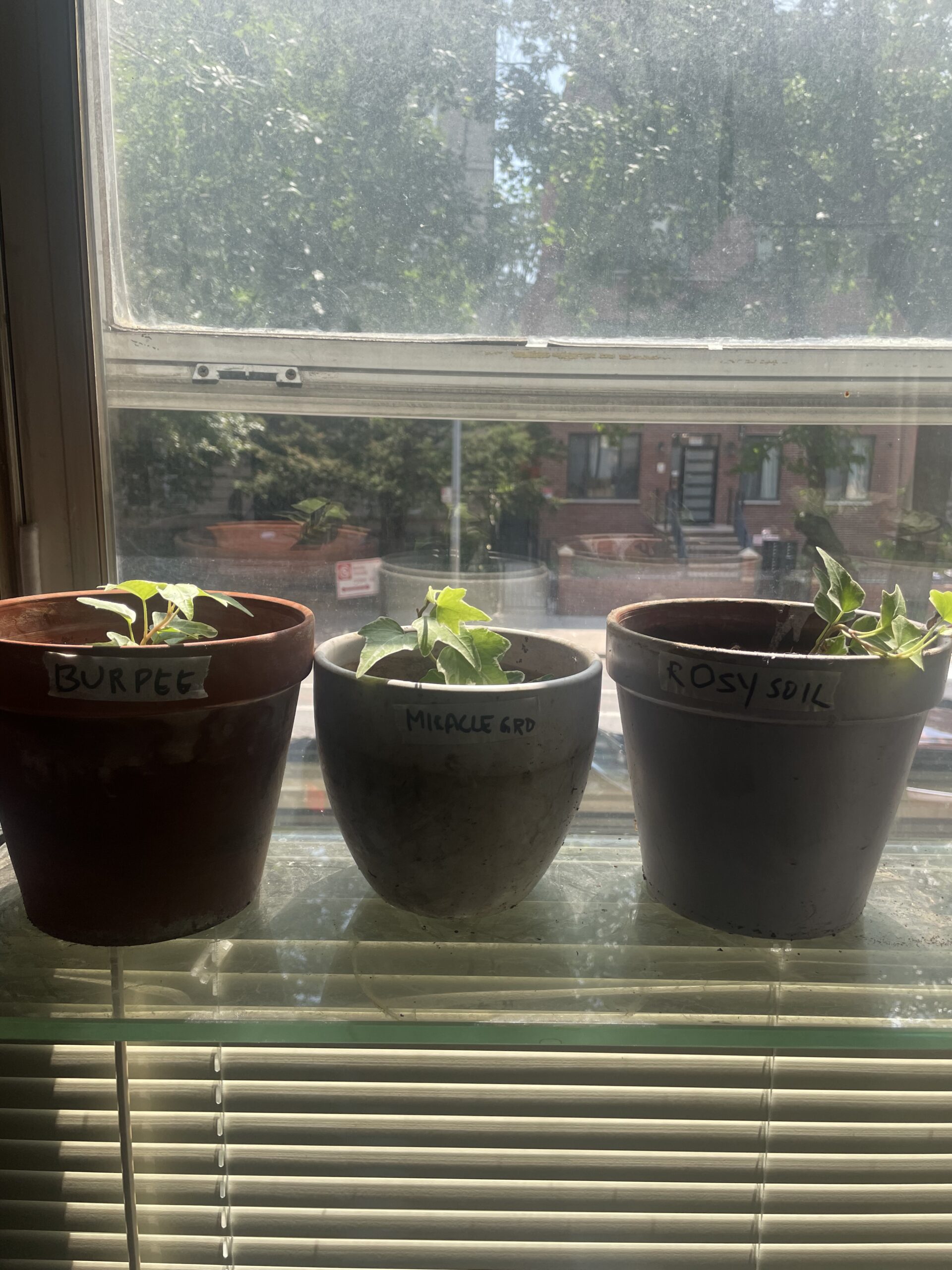
We tested all three mixes side by side, in the same conditions, over the same test window — same room, same light, same pot size and drainage hole, same water source, and rooted English ivy cuttings of comparable size and vigor going into each pot. All three cuttings came from the same parent plant, so there’s no genetic variation between them skewing the results. Full methodology for each metric is below.
1. Drainage test
How did we test for Drainage?
- 500ml of water poured at a steady rate, timer started the second we began pouring.
- Recorded time to first drop and time to full stop.
- Runoff caught in a clear jar to check color and clarity. All three mixes started at the same moisture level.
Why does Drainage matter for English ivy? Drainage is how quickly water moves through the mix and out of the pot after watering.
- Root rot in English ivy usually comes from soil that doesn’t drain quickly enough, or from watering too often, per Clemson’s Home & Garden Information Center.
- Ivy’s roots need air between waterings — a mix that holds water too long starves the roots of oxygen, which is the real mechanism behind rot.
What did we find?
Rosy Soil drainage: Score: 5/10. Rosy Soil’s drainage is slower than we expected for a biochar-based mix, and it showed in our numbers. It was the slowest of the three to even begin draining, taking 21 seconds for the first drop to appear, and slowest to fully finish as well, at 57 seconds. That lag at both ends suggests the mix holds onto water a bit longer before releasing it — not dangerously slow, but the least aerated-feeling of the three when we watered it.
Miracle-Gro drainage: Score: 8/10 Miracle-Gro’s drainage held the best balance of the three we tested. It let water start passing through immediately — tied with Burpee for the fastest first drop at 17 seconds — but took noticeably longer to fully finish, at 55 seconds. That combination matters: water isn’t pooling on top, but the mix is also taking its time absorbing a real amount before letting the rest go, rather than just letting everything rush straight through.
Burpee drainage: Score: 6/10 Burpee’s drainage was the fastest of the three overall, and it’s easy to see why once you handle the mix — it’s noticeably coarse, almost gritty, clearly built for quick water movement. It tied for the fastest first drop at 17 seconds and finished draining fastest of all at 42 seconds. Good news if you’re worried about a pot staying soggy; less good news, as we found later, for how much moisture the mix actually holds onto in between waterings.
2. moisture retention test
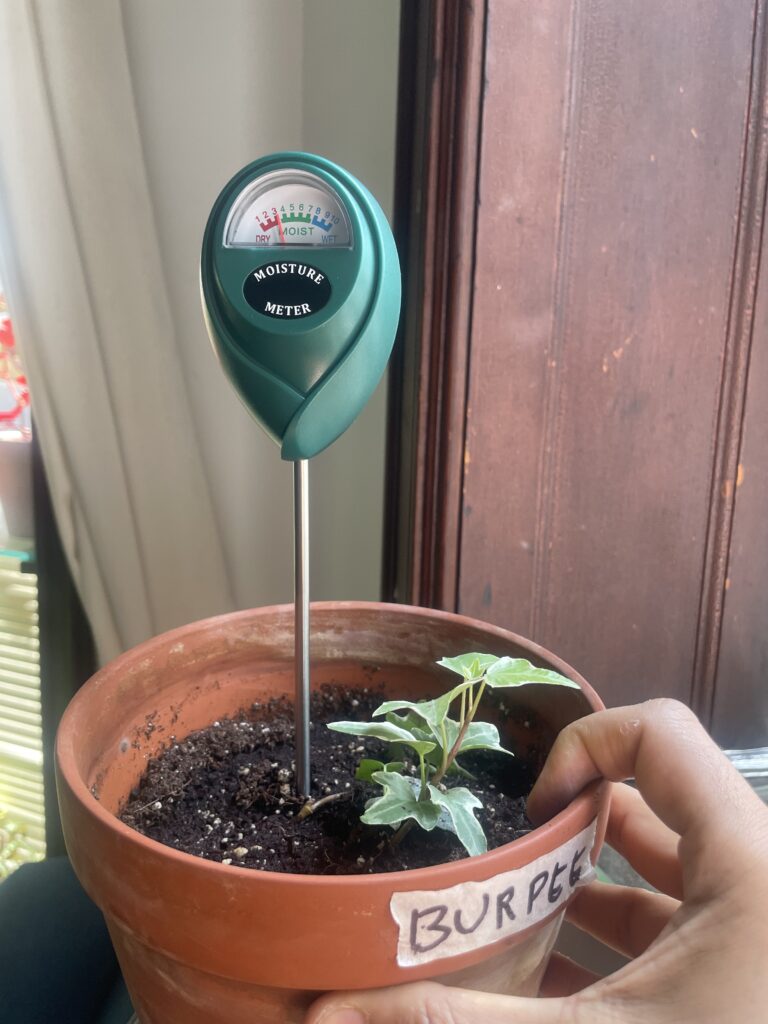
 Burpee mix moisture reading of 4 on day 1
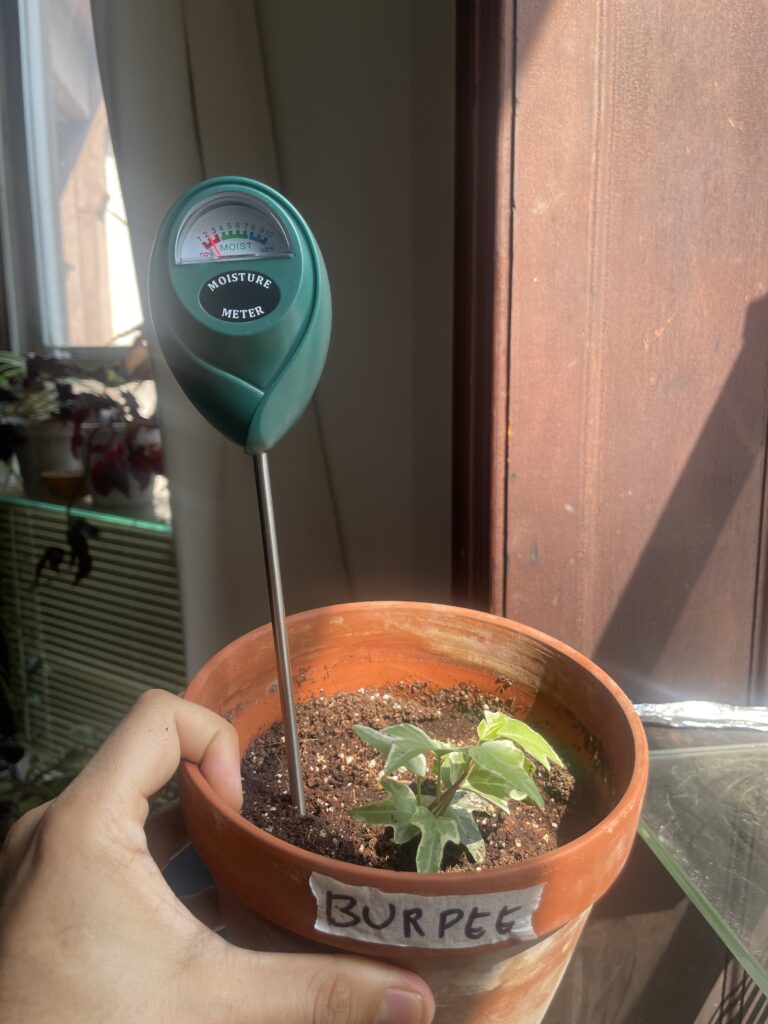
- Burpee mix moisture reading of 3 on day 3
- Burpee mix moisture reading of 2 on day 4
- Burpee mix moisture reading of 2 on day 4
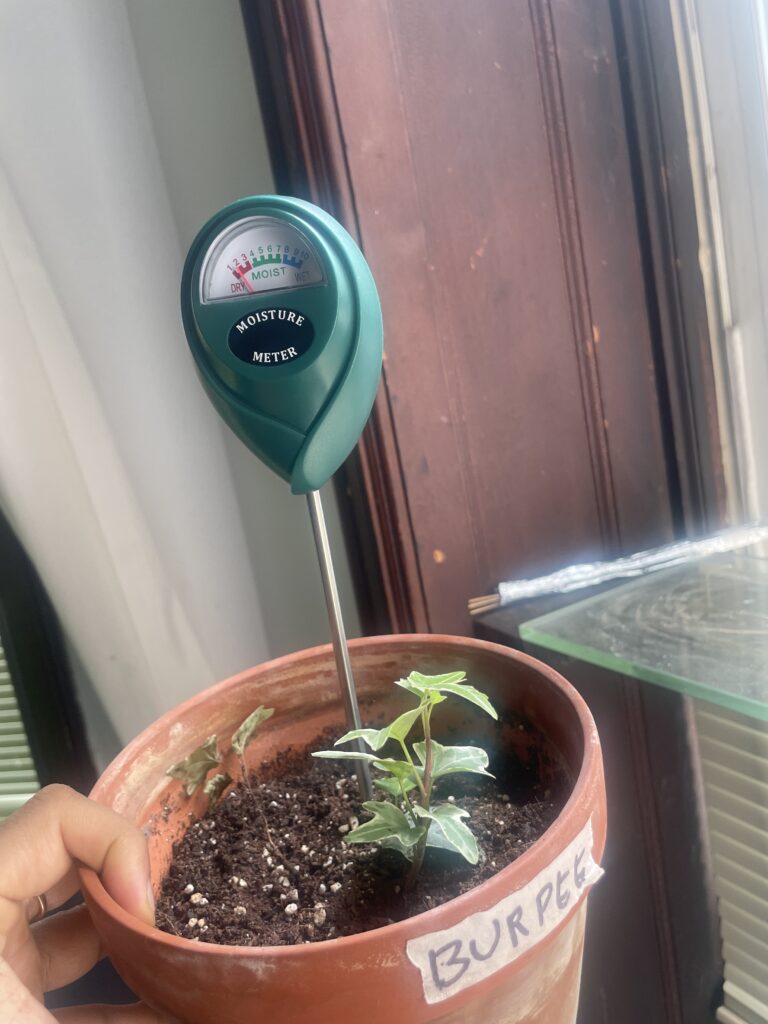
- Burpee mix moisture reading of 1.5 on day 6
- Burpee mix moisture reading of 1.5 on day 7
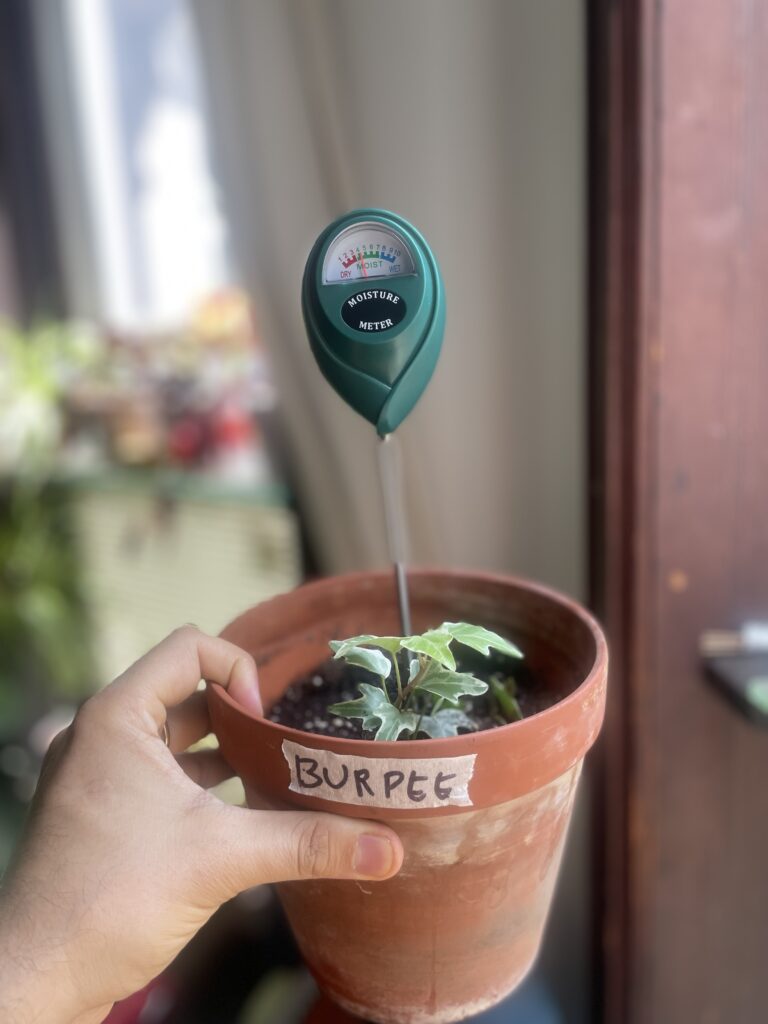
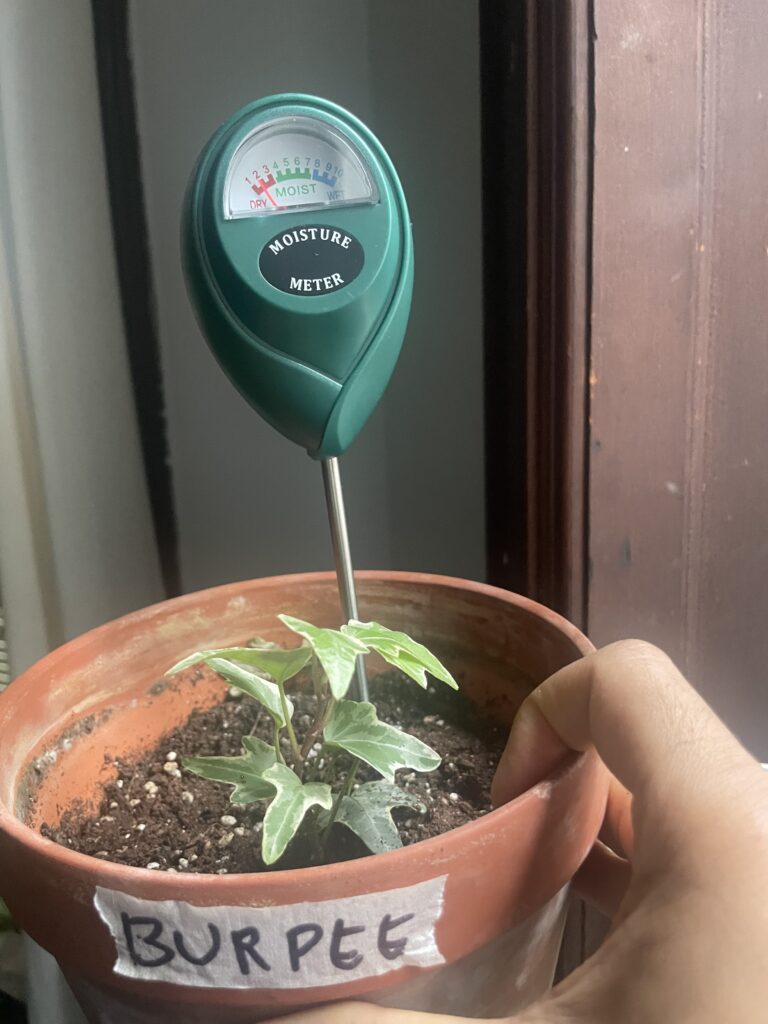
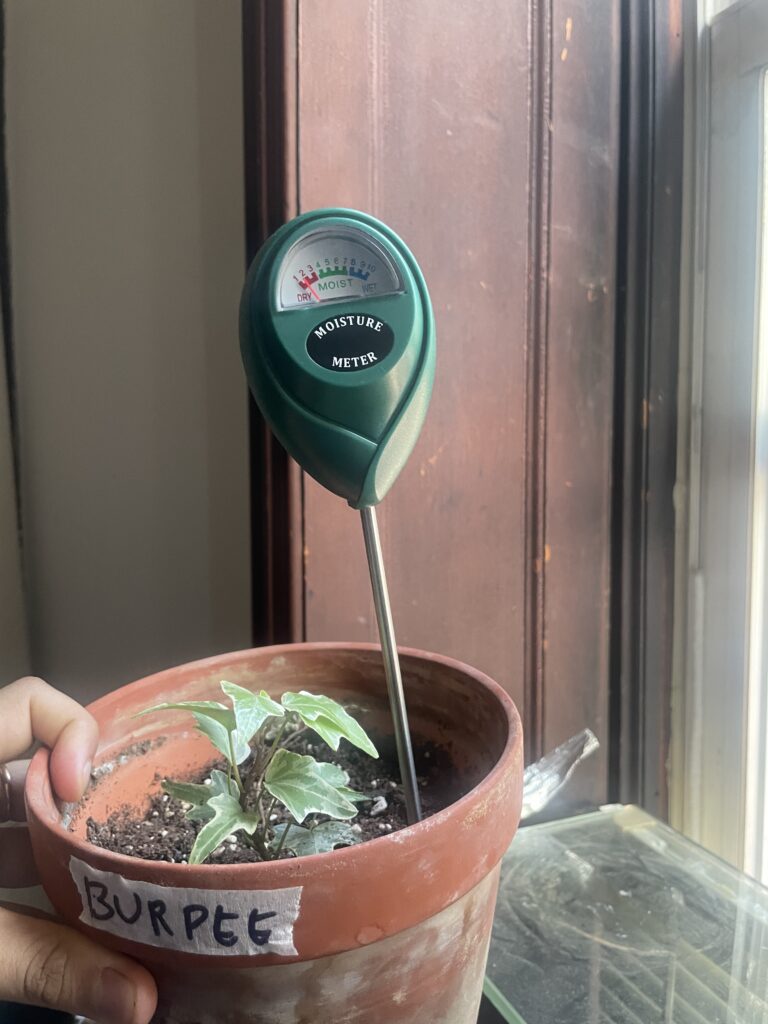
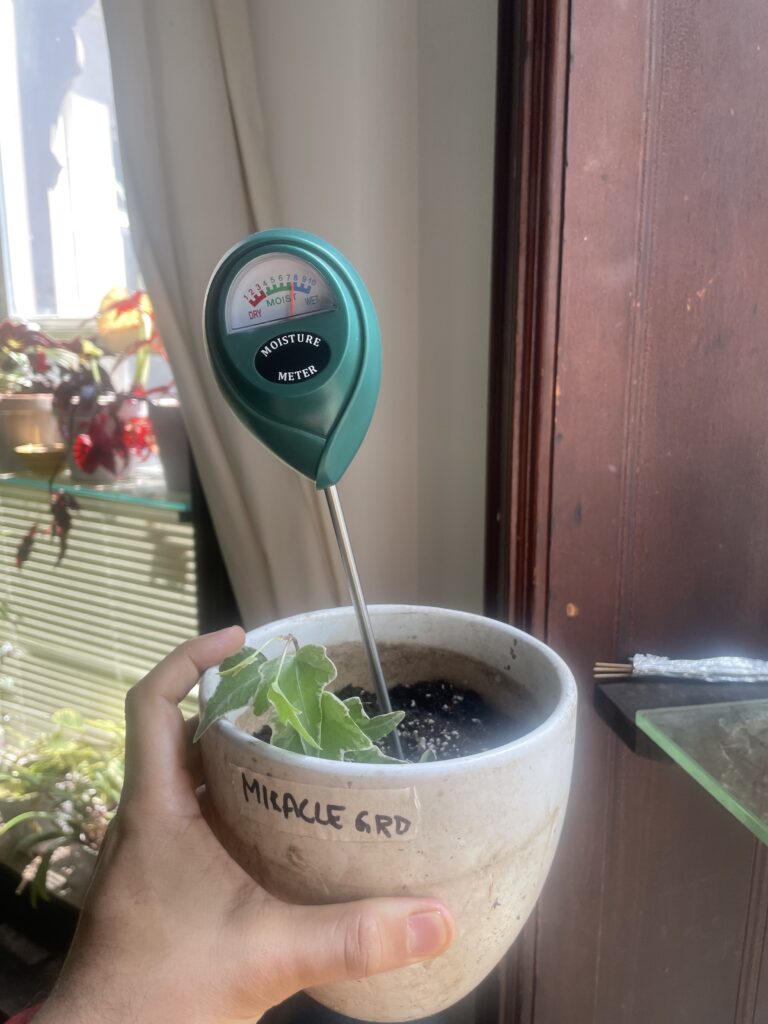
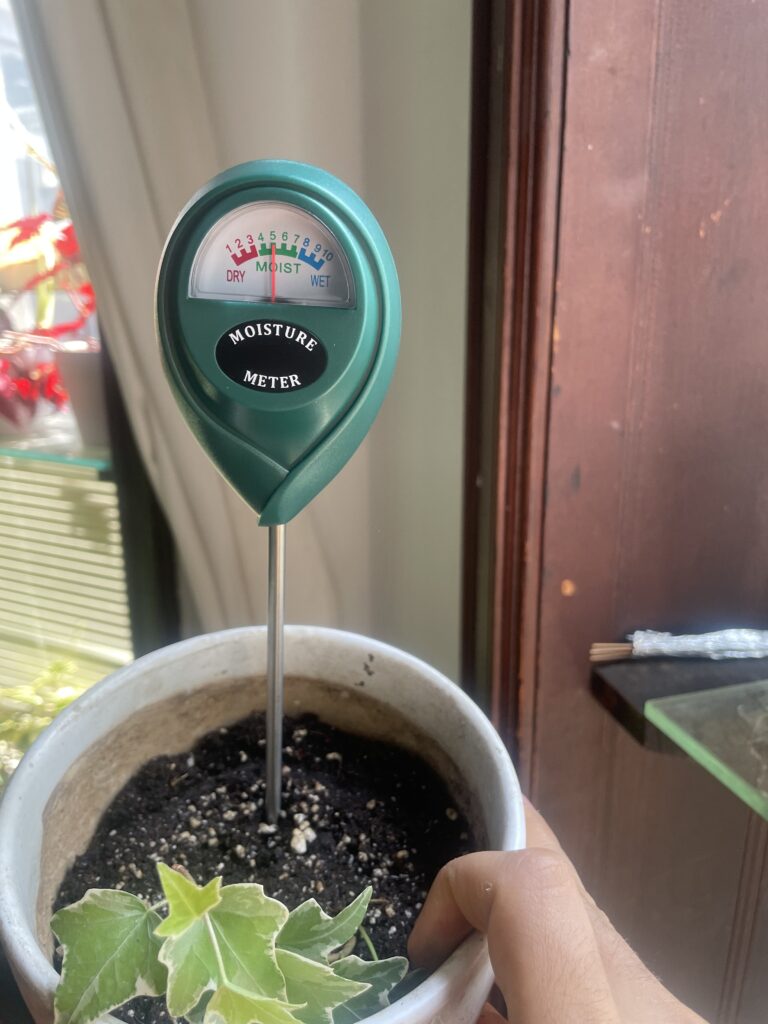
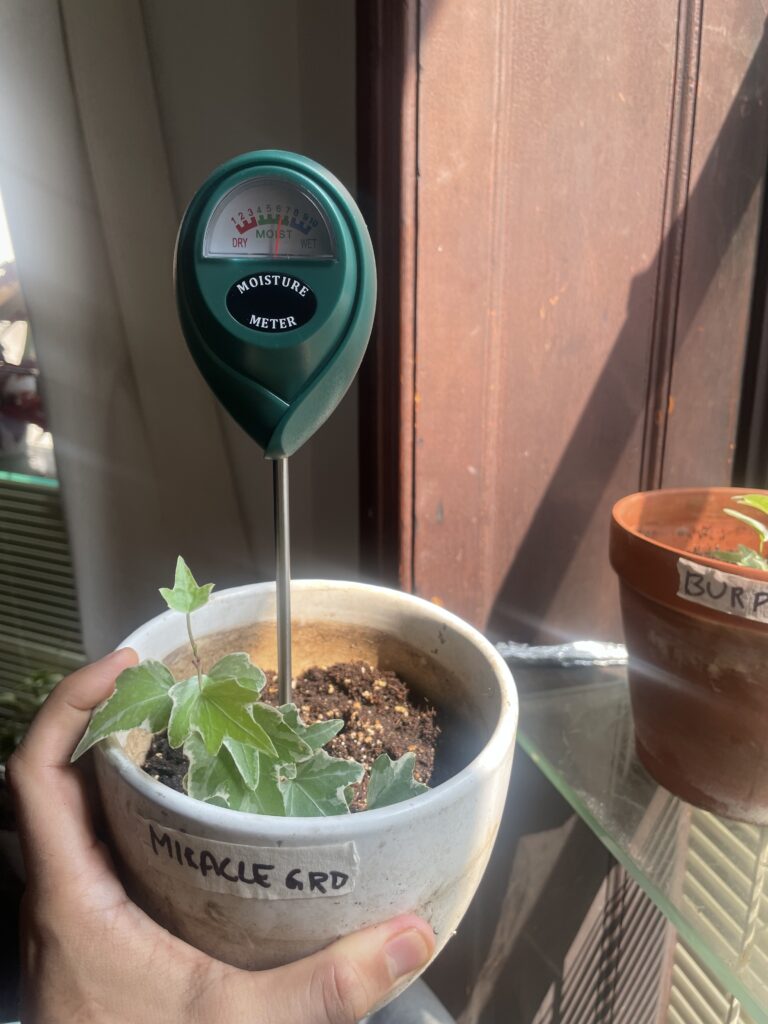
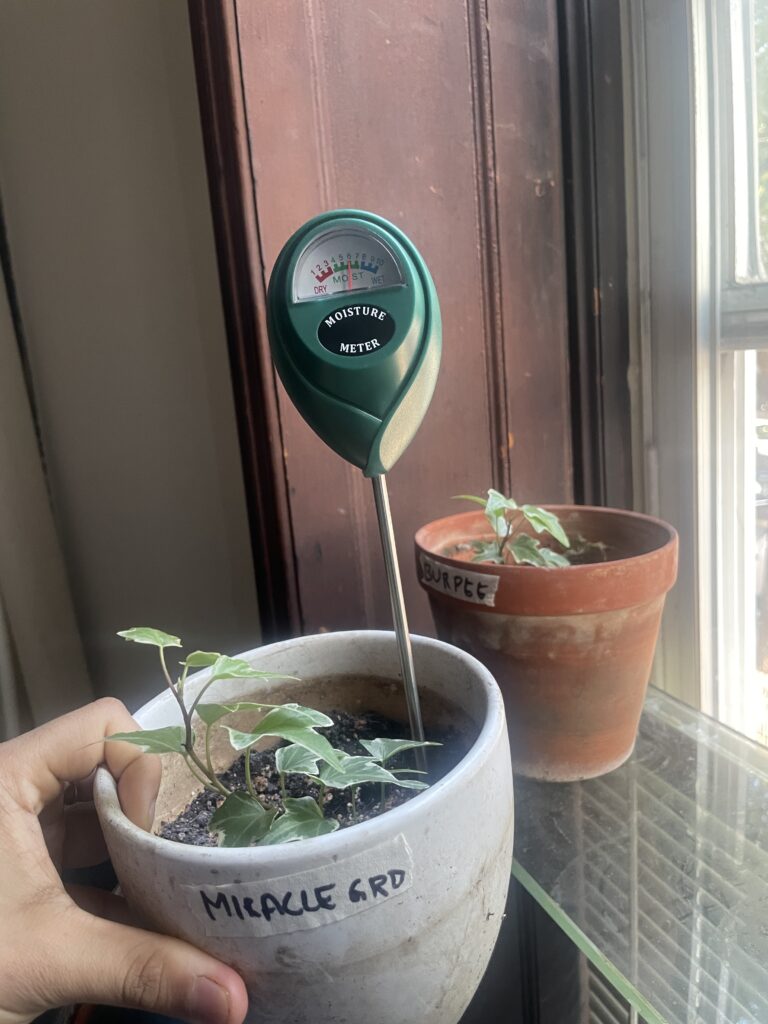
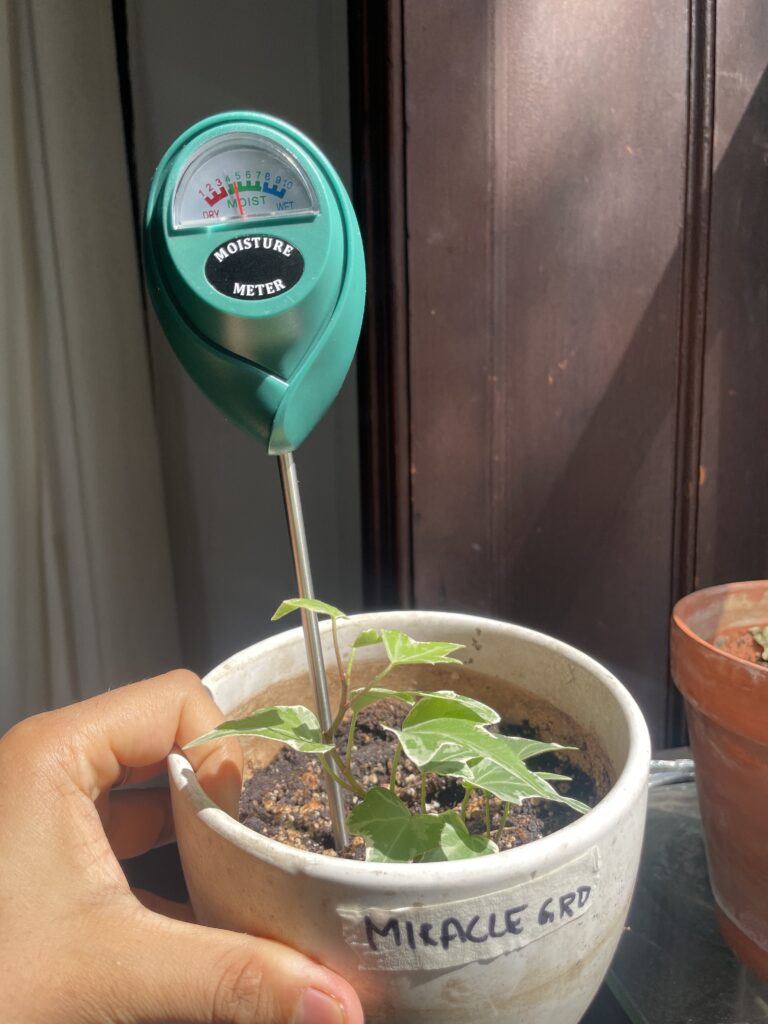
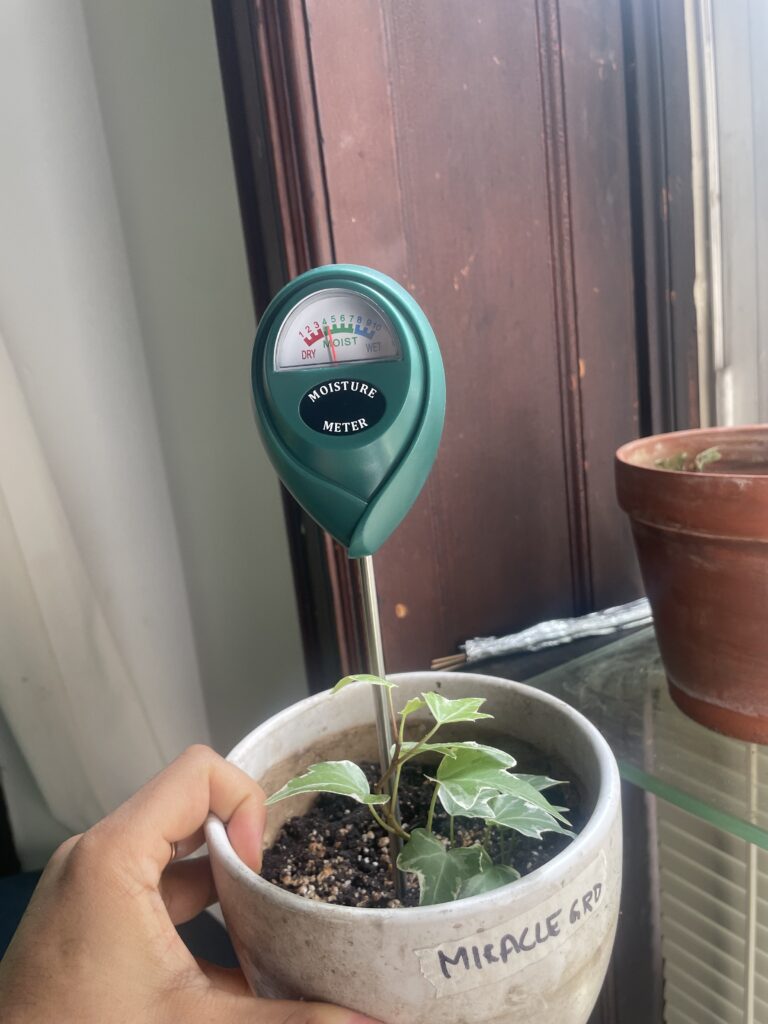
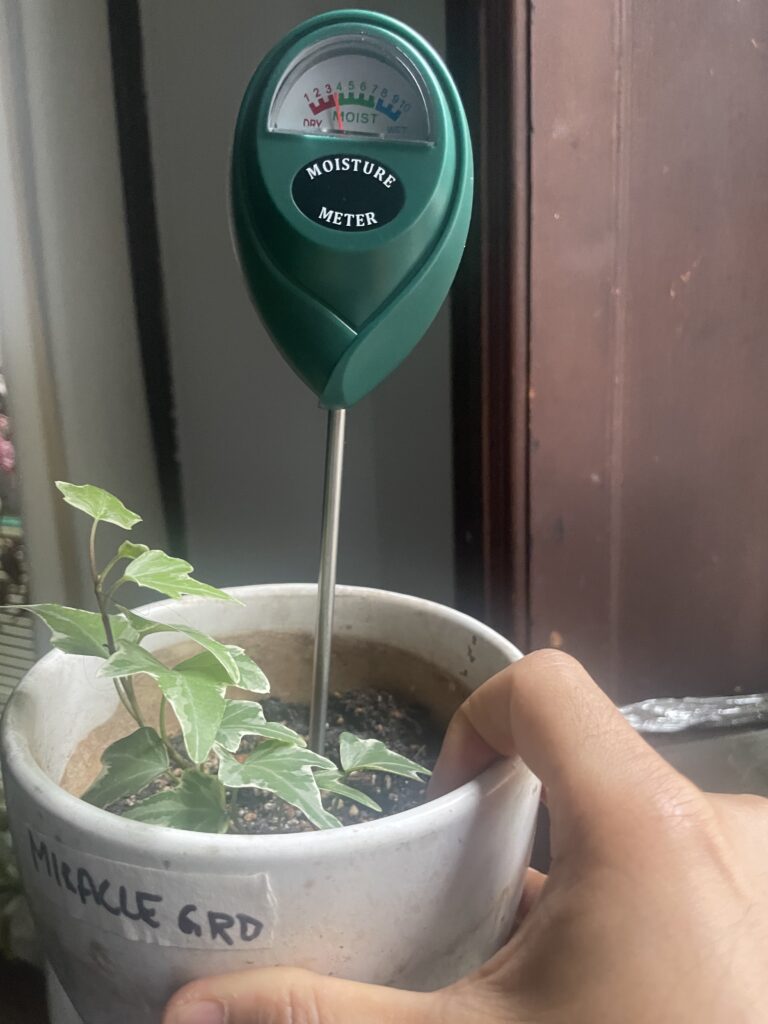
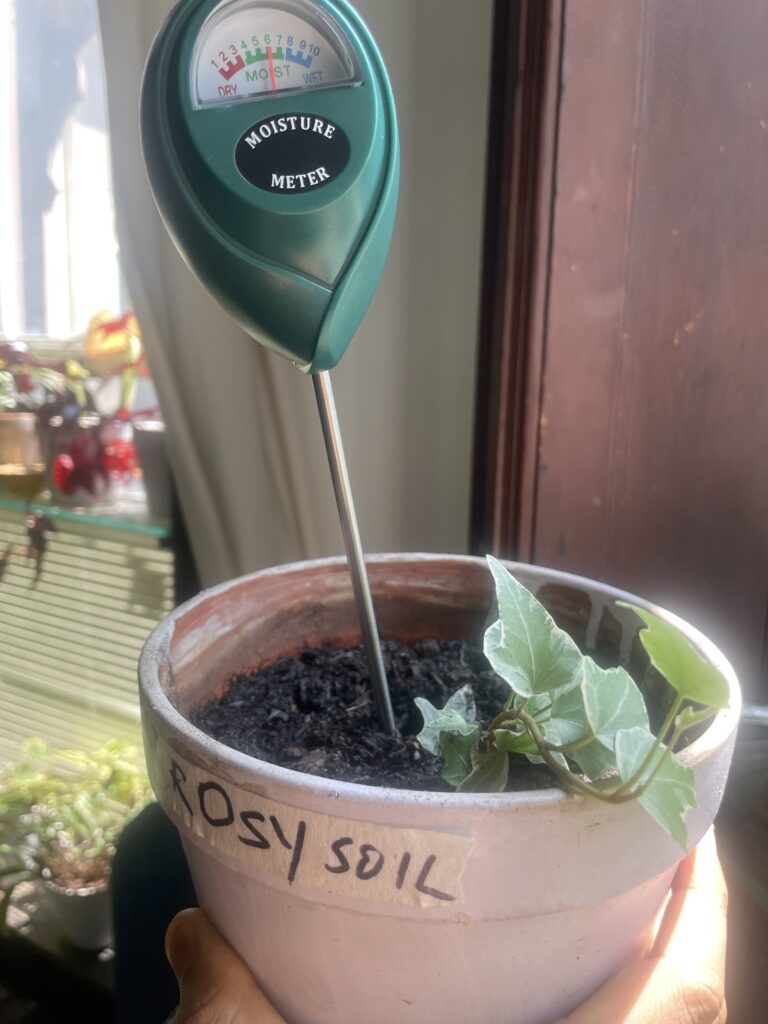
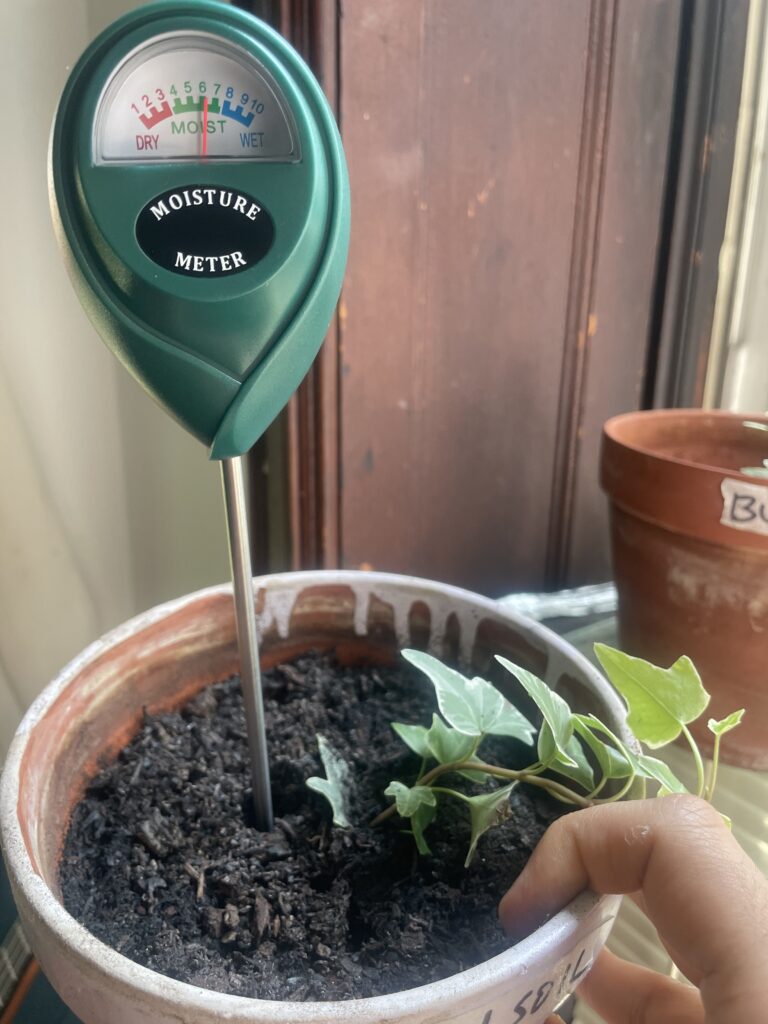
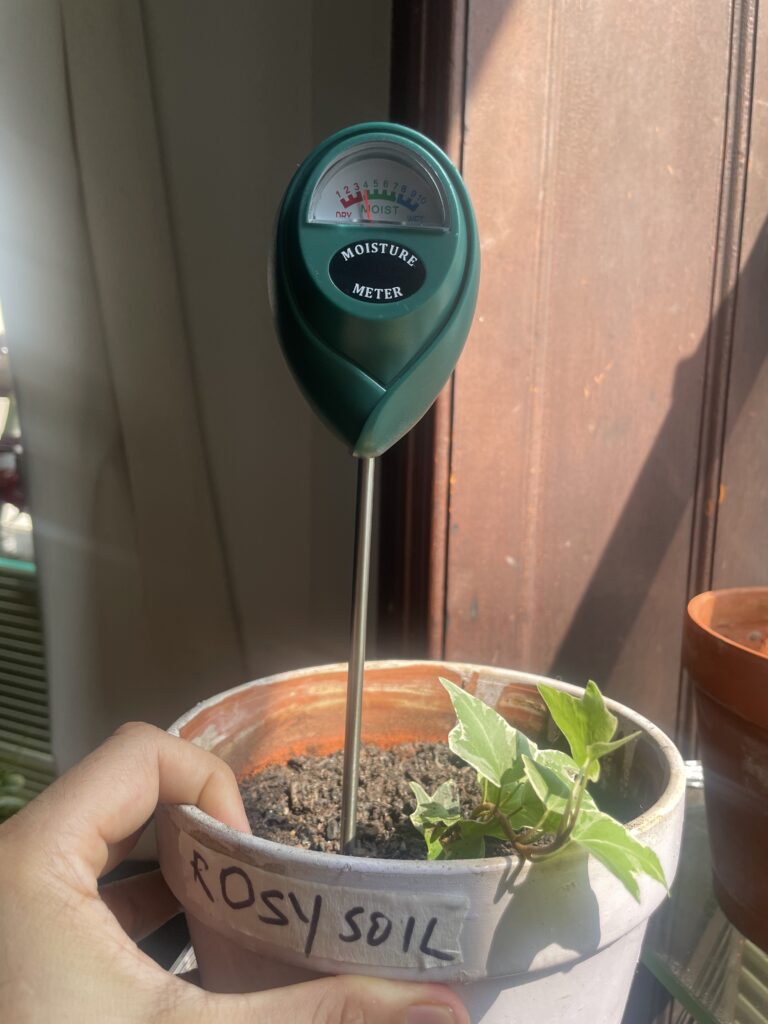
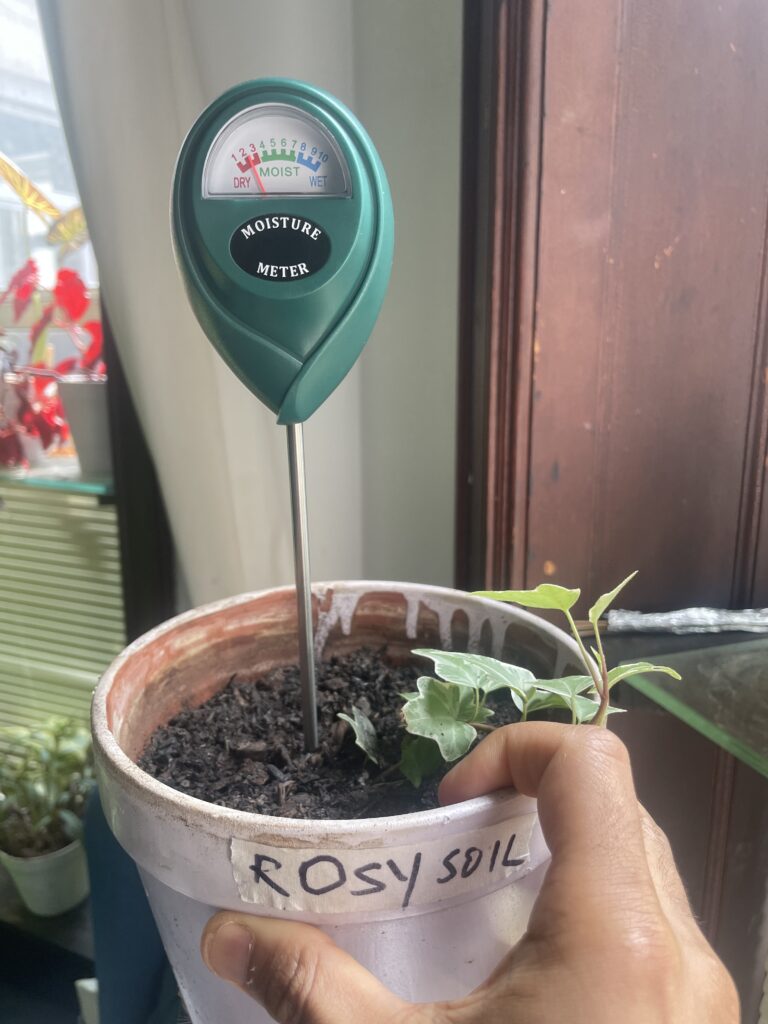
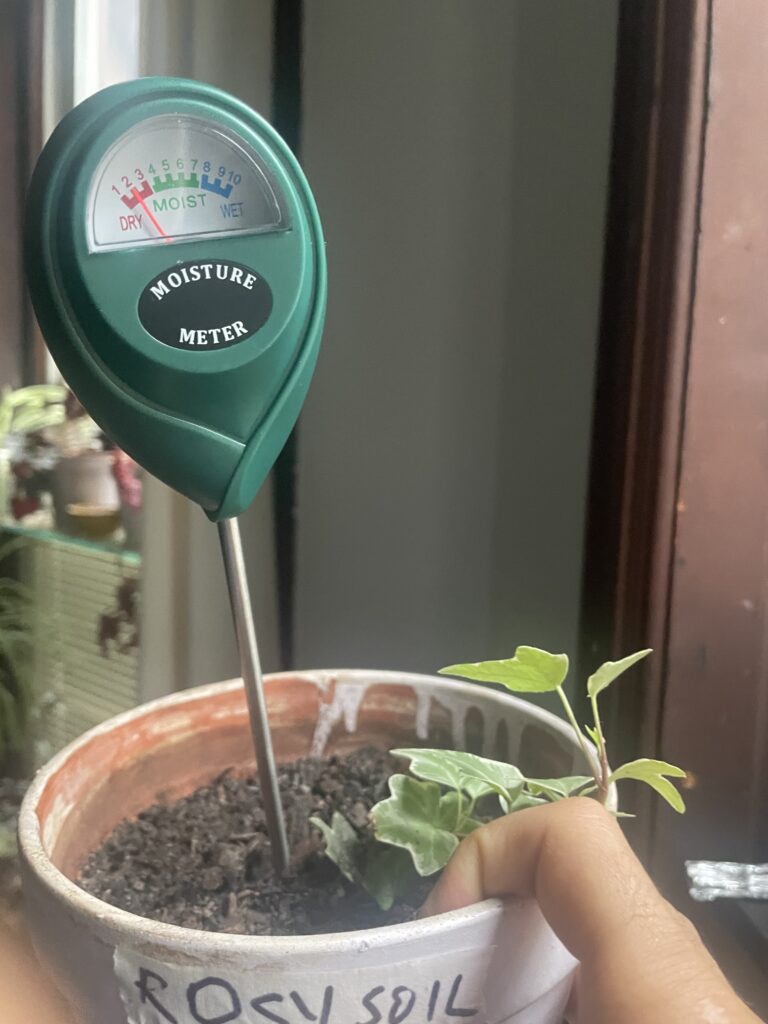
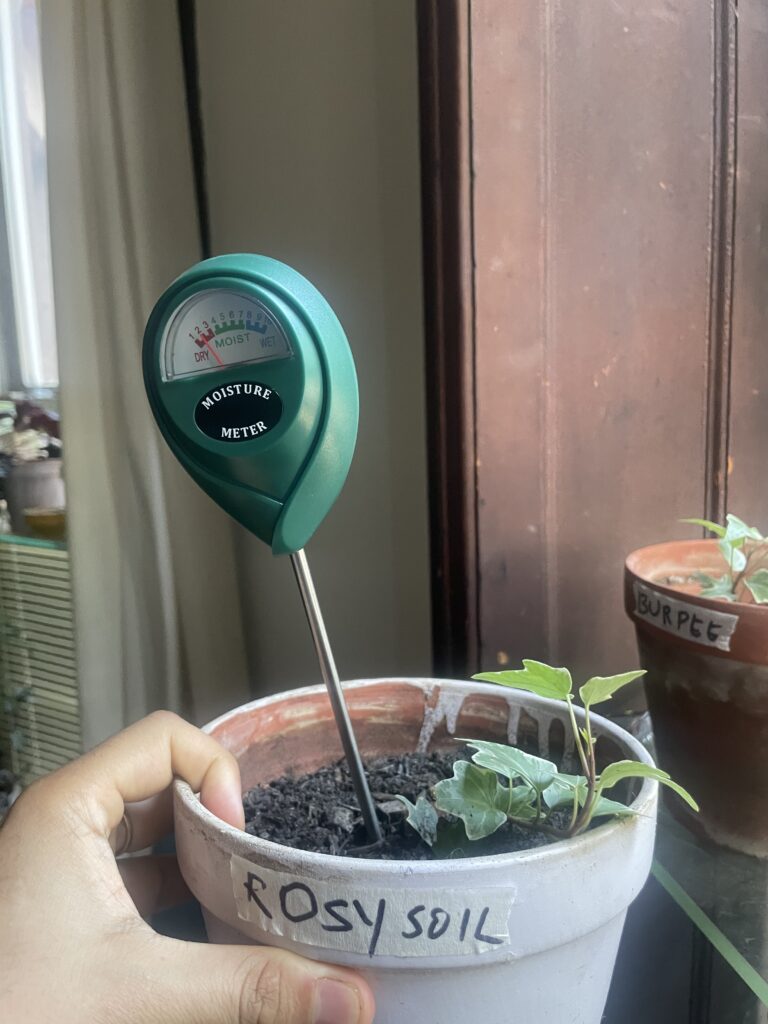
How did we test for moisture retention?
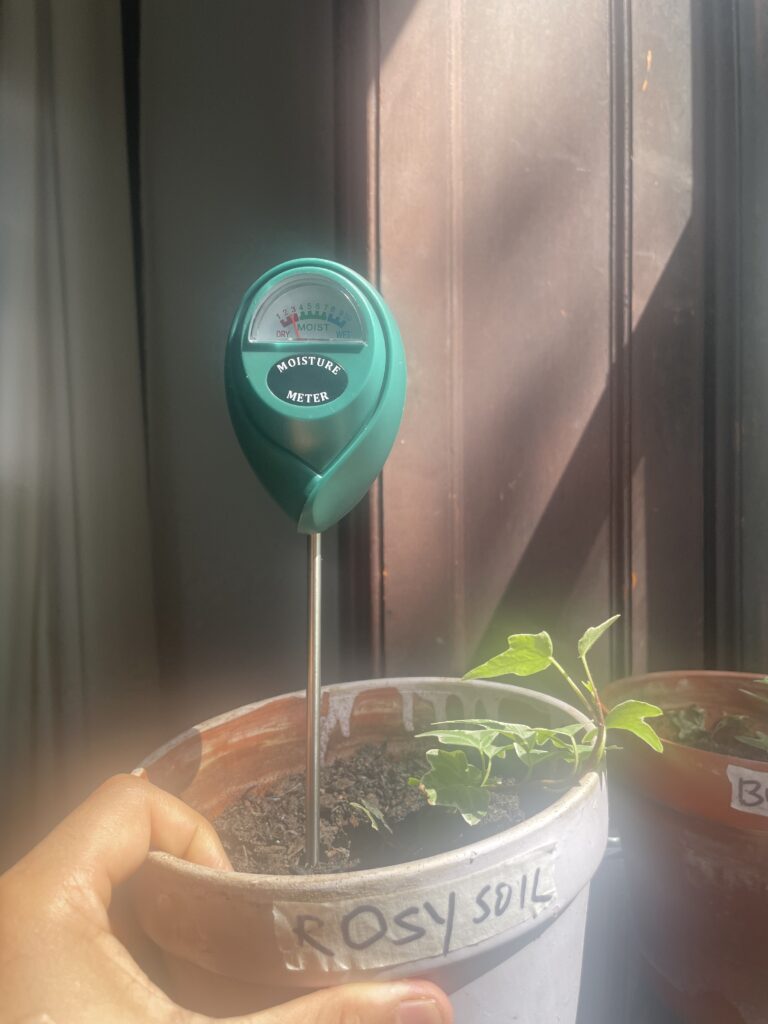
- Used 3-in-1 moisture meter, same depth and spot in each pot (marked with tape), checked at the same time every day, logged for 7 days after a full watering, as shown in the pictures above.
Why does moisture retention matter for English ivy? Moisture retention is how long the mix stays evenly damp before drying out.
- Overwatered ivy yellows and drops leaves; underwatered ivy wilts. The mix needs to land in between — moist, not soggy.
- Drainage and moisture retention only make real sense read together: a mix that drains fast but also dries out fast isn’t “good,” it’s just a different failure mode.
- Also a great indicator on what suits you. if the moisture retains for a long time, and you are the sort of parent that doesn’t want to water plants often, or doesn’t have time, then Miracle gro sort of mix is great because it retains moisture for a long time!
What did we find?
Rosy Soil Moisture retention: Score: 5/10 Rosy Soil’s moisture retention landed in the middle for us — better than we expected early on, but it faded faster than a true moisture-focused mix should. It started at a healthy reading of 6 on day 1, but had dropped to 2 by day 7, needing a refresh at roughly the same point as Burpee, despite draining much more slowly..
Miracle-Gro Moisture retention Score: 9/10 Miracle-Gro’s moisture retention was, by a clear margin, the best of the three we tested. It started highest of the three at a reading of 8, and was still registering a 3 on day 7 — a full week after watering. When we checked two inches down with a finger, it still felt genuinely moist, at a point when the other two mixes were already asking to be watered again.
Burpee Moisture retention Score: 5/10. Burpee’s moisture retention was the weakest of the three, which tracks with how fast it drained in the first place. It started lowest at a reading of 4 and dropped to 1.5 by day 7 — the driest of any mix we tested by the end of the week, and the mix we’d worry about most if you tend to go more than a week between waterings.
3. Root health
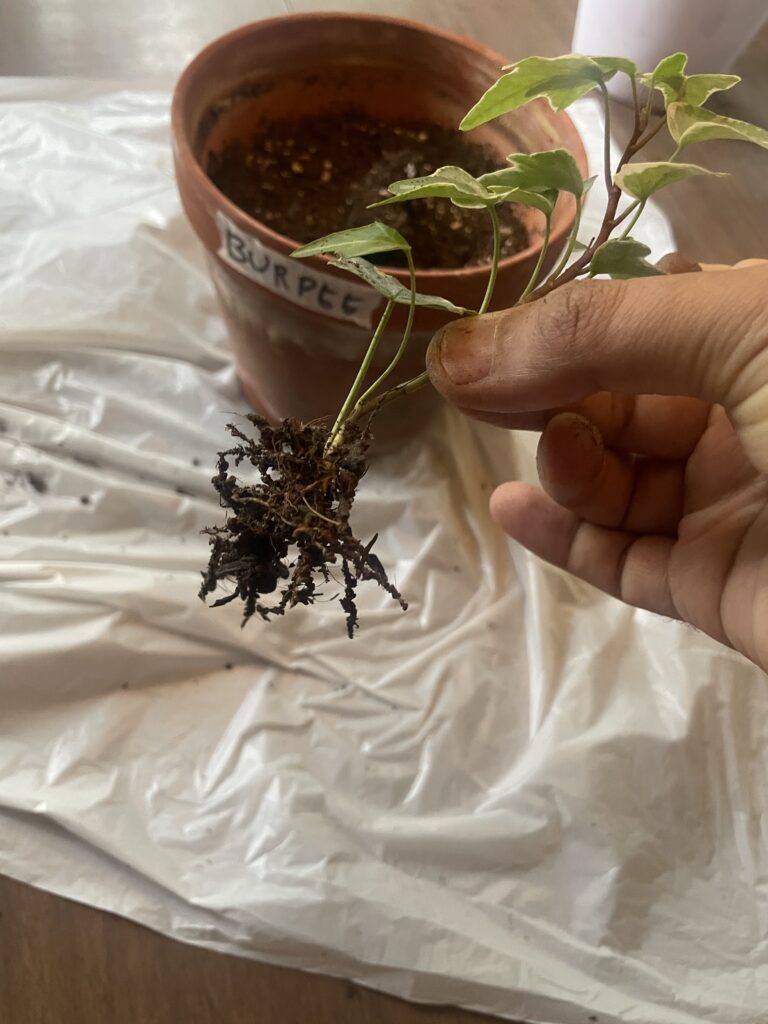
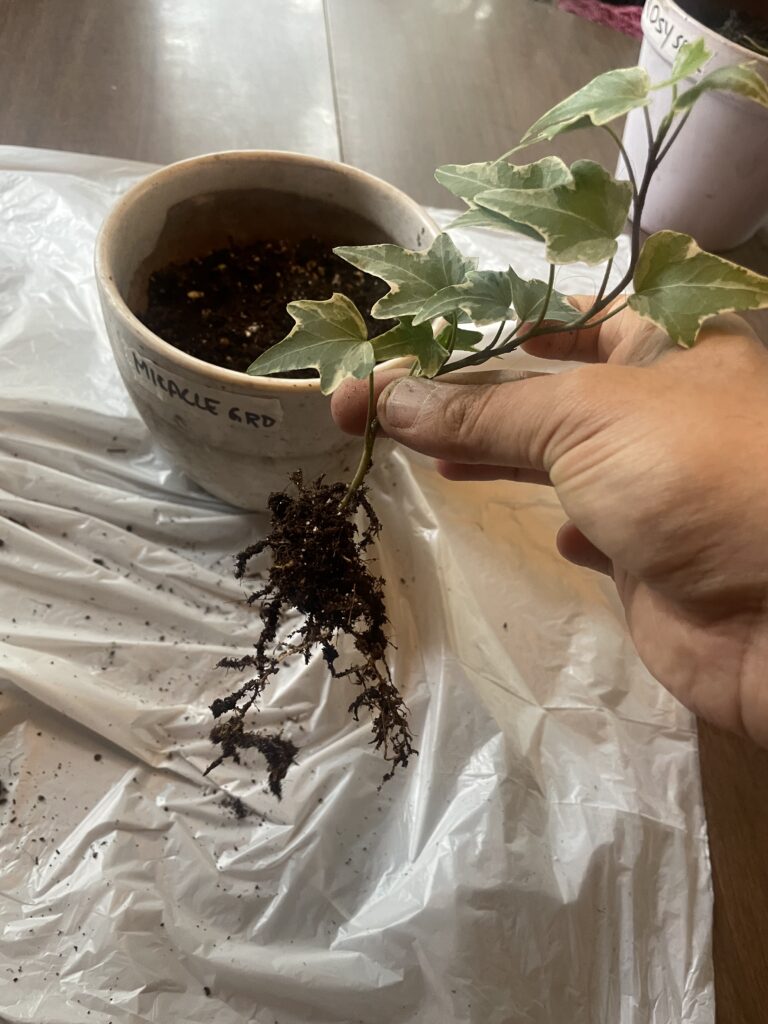
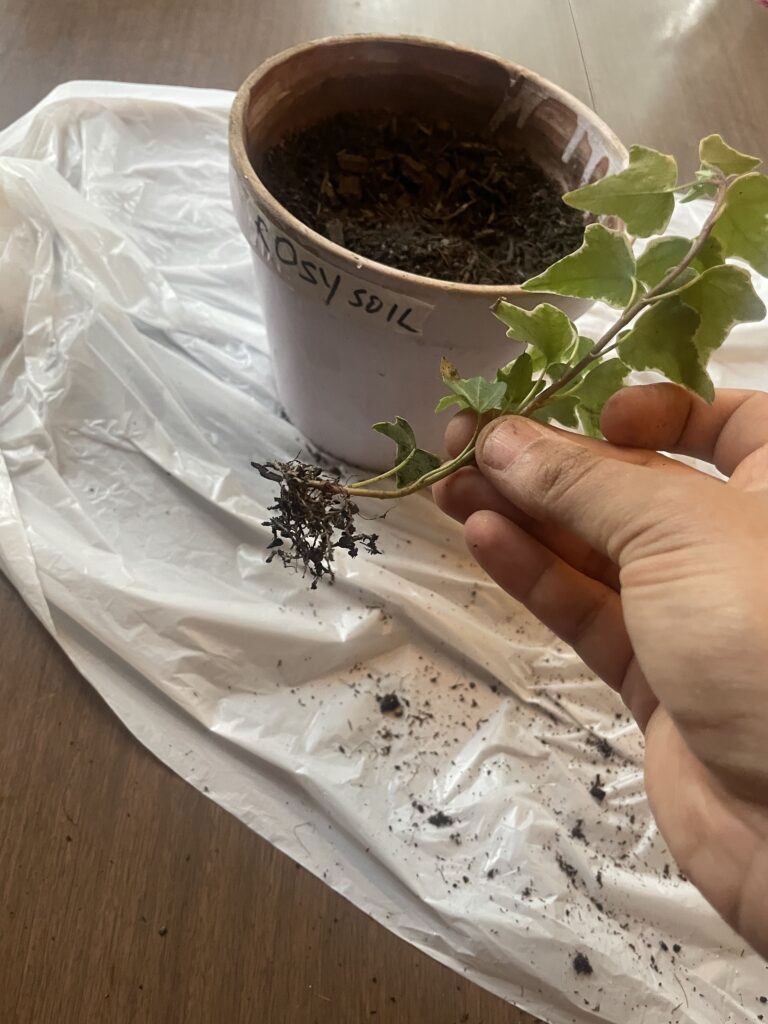
How did we test for root development?
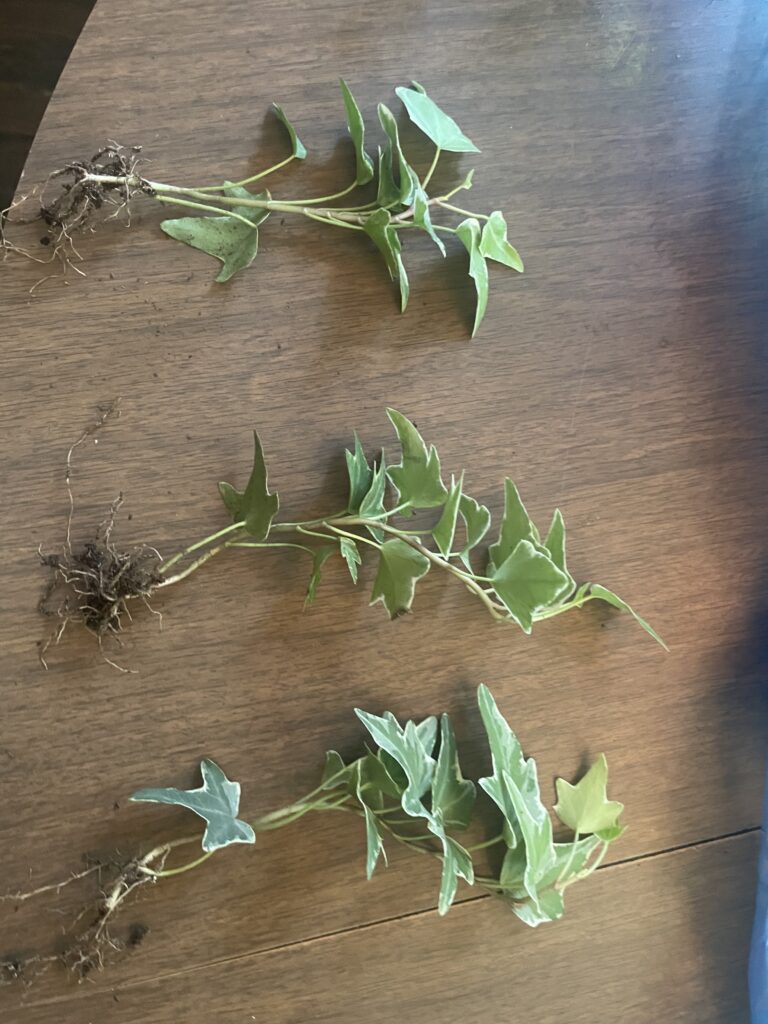
- At day 15, gently unpotted each plant, rinsed loose soil off the root ball, photographed immediately (roots discolor fast once exposed to air), and compared new root length and development across all three.
Why does root develpment matters for English ivy? Root health is the clearest evidence of whether a soil mix actually works.
- Rhizoctonia solani, a common soil-borne fungus, gets into potting mixes and attacks through root tips in warm, wet conditions.
- A mix that stays soggy doesn’t just risk vague “rot” — it invites this specific pathogen in through the roots.
What did we find?
Rosy Soil root development: Score: 4/10. Rosy Soil’s root health results were the most disappointing part of this test, especially given its price. By day 15, it had produced the least new root growth of the three — visibly behind Burpee, and roughly half the root length and size we saw on Miracle-Gro. Given how slowly it drained and how quickly it dried out relative to that, this wasn’t entirely a surprise.
Miracle-Gro root development: Score: 9/10. Miracle-Gro’s root health results were the clearest win of the entire test. By day 15, its roots had grown to roughly double the length and size of Rosy Soil’s, with noticeably more new white growth overall. That kind of development is exactly what the drainage and moisture numbers above predicted — plenty of air, plenty of sustained moisture, and the roots responded accordingly.
Burpee root development: Score: 6/10. Burpee’s root health results sat squarely in the middle. By day 15, its new root growth was ahead of Rosy Soil’s, but still well behind Miracle-Gro’s. That middling result lines up with its extremes elsewhere — excellent drainage, but not enough retained moisture to fully capitalize on it.
4. Leaf count and Growth response
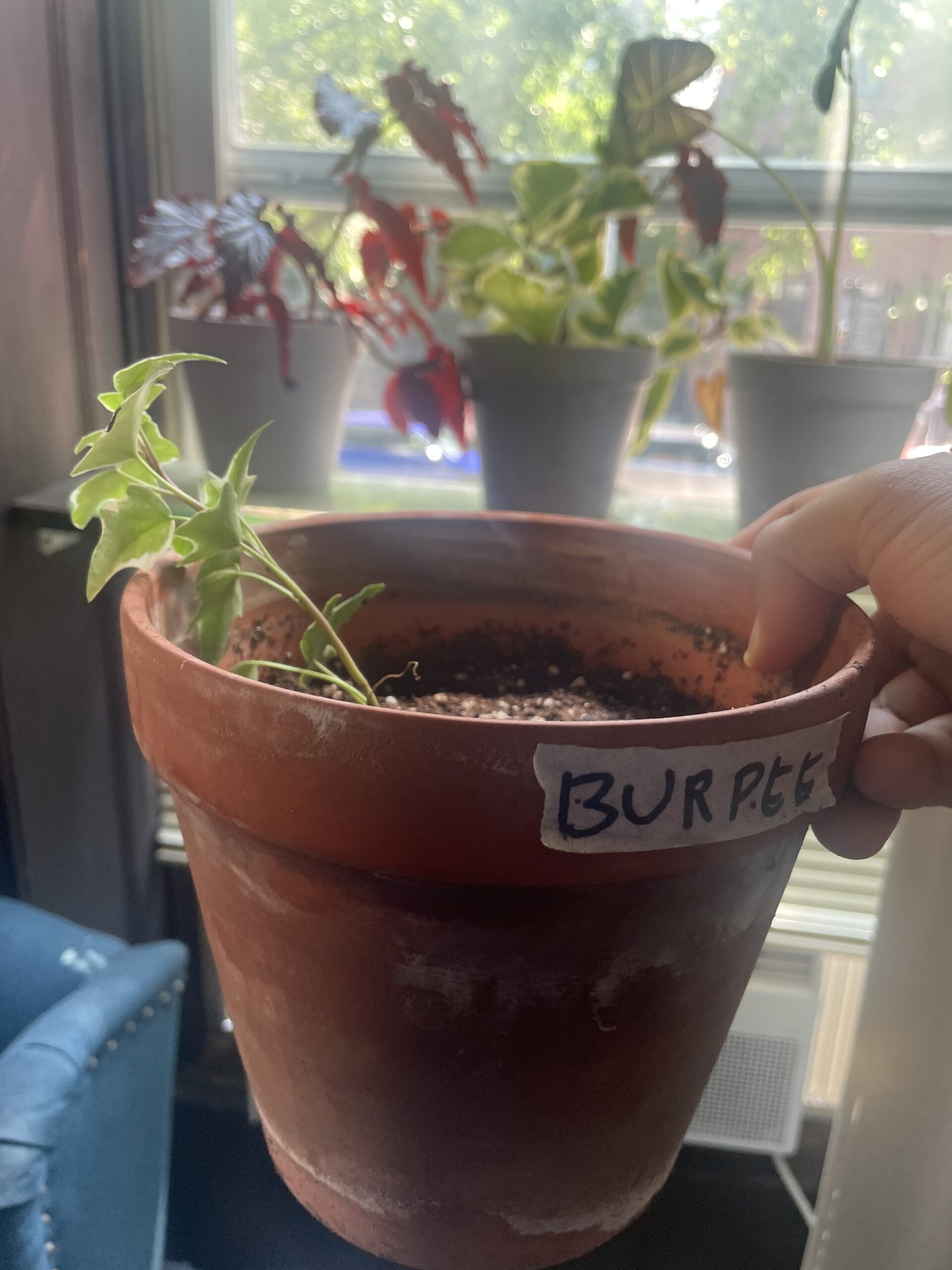
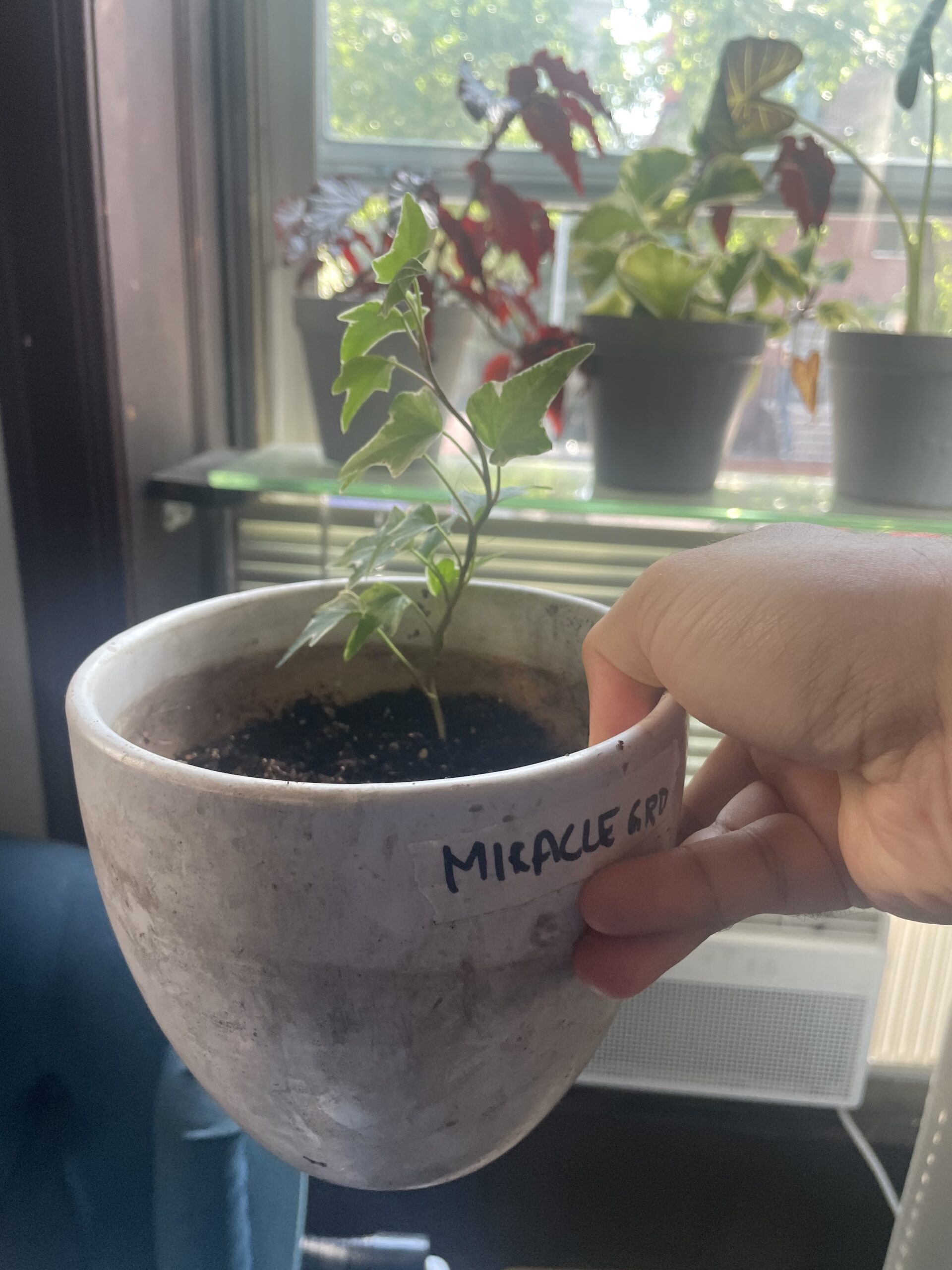
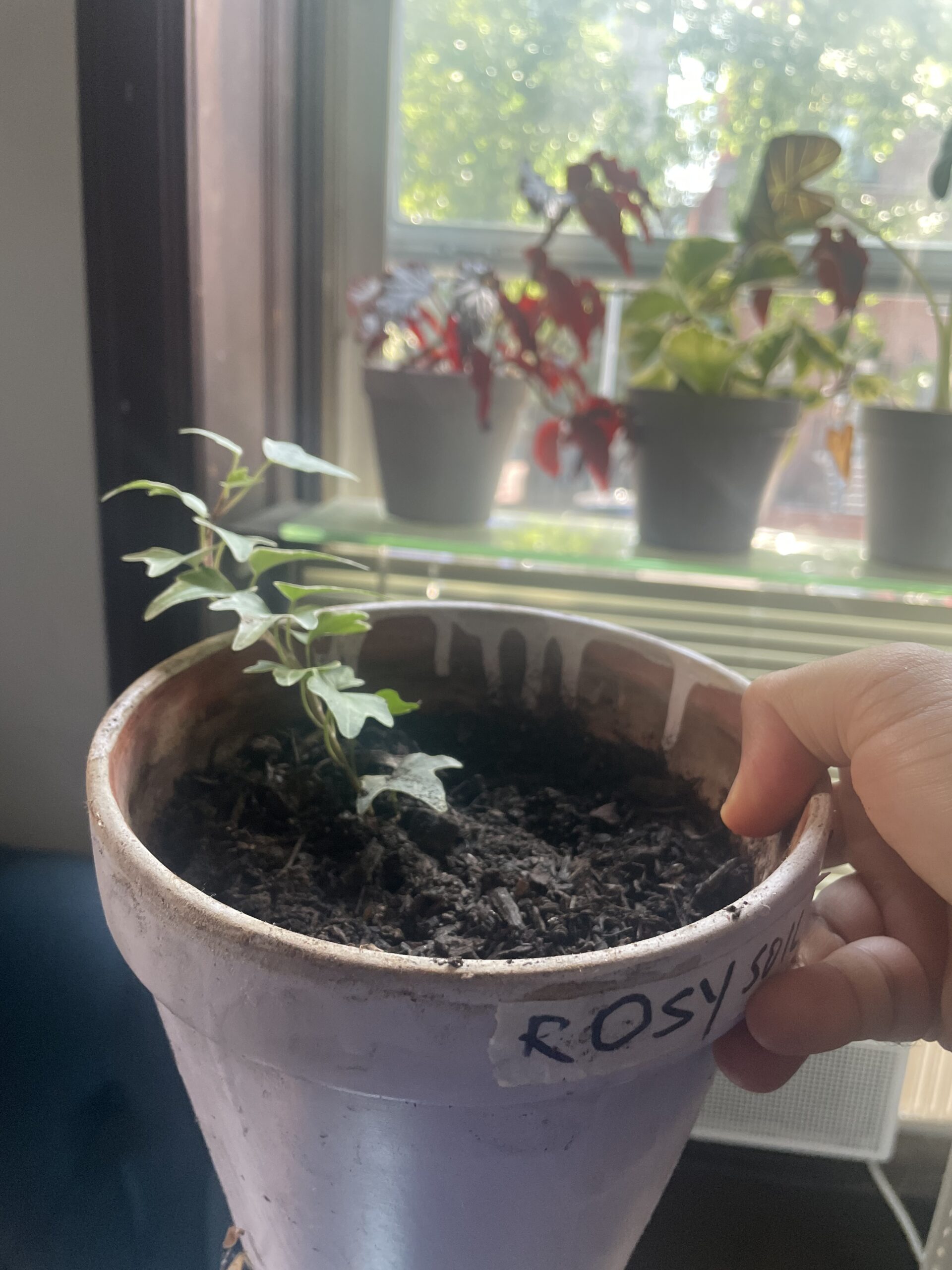
How did we test for leaf count and growth development?
- Counted new leaves weekly, measured vine length from a fixed reference point, same day and same photo angle each time..
Why does leaf count matter for English ivy?
- Growth response — new leaves and vine length over time — is the slowest but most reader-relevant signal, since it’s what someone actually sees week to week.
- It typically lags behind root health, which is why it’s best read alongside the root findings above rather than on its own.
What did we find?
Rosy Soil growth response: Score: 6/10. Rosy Soil’s growth results were the one place it looked genuinely competitive. It went from 11 to 15 leaves over the 15-day test — four new leaves, second-best of the three — even though its root health numbers were the weakest. It’s a reminder that leaf growth can lag behind what’s actually happening at the roots, for better or worse.
Miracle-Gro growth response: Score: 9/10. Miracle-Gro’s growth results were the strongest by a wide margin, and the most visually obvious result of the whole test. It went from 11 to 17 leaves in 15 days — six new leaves — and by the end looked noticeably fuller and bushier than either of the other two plants sitting right next to it.
Burpee growth response: Score: 4/10. Burpee’s growth results were the weakest of the three we tested, and the clearest sign that fast drainage alone doesn’t make a good soil mix. It went from 11 to just 13 leaves over 15 days — only one new leaf — which lines up with its middling root health and weak moisture retention: without enough sustained water at the roots, there wasn’t much fuel for new growth.
What makes a good soil for english ivy
What Type of Soil Does English Ivy Need?
1. Good drainage — but not extreme
- Ivy roots need air between waterings. Water that sits too long invites root rot.
- The best mixes let excess water pass through in under a minute, without pooling at the surface.
- How this mattered in our test: this is why Miracle-Gro’s balance — a quick first drop (17 seconds) but a fuller finish (55 seconds) — worked better than Burpee’s ultra-fast full drain (42 seconds). Burpee let water rush straight through before the mix had a chance to actually hold onto any of it.
2. Moisture that lasts, without staying soggy
- Ivy wants soil that’s consistently, evenly moist — not bone dry, not waterlogged.
- A mix that dries out too fast between waterings stresses the plant just as much as one that stays wet too long.
- How this mattered in our test: this is exactly why Miracle-Gro pulled ahead. It was still holding real moisture on day 7 (a reading of 3) while Rosy Soil and Burpee had already dropped to 2 and 1.5. That extra cushion is what kept its roots working instead of drying out between waterings.
3. Loose, aerated structure for root growth
- Compacted or overly fine soil suffocates roots — and invites the same fungal issues that come from staying too wet.
- A good mix should feel loose and chunky, not dense or muddy, even after repeated watering.
- How this mattered in our test: this is why Miracle-Gro produced roughly double the new root growth of Rosy Soil by day 15. Looser structure meant more oxygen reaching the roots, not just more water sitting there.
4. Enough nutrients to fuel steady new growth
- Even a well-draining, well-aerated mix won’t produce much new growth if it’s nutritionally thin.
- A fertilized, nutrient-rich mix gives ivy the fuel to actually put out new leaves and vine length, not just survive.
- How this mattered in our test: this is why Miracle-Gro — fertilized and formulated specifically for houseplants — pushed out six new leaves in 15 days, nearly bushy, while Burpee, weaker on moisture and structure, barely grew.
Our DIY english ivy Soil Mix
Base formula: 40% coconut coir / 35% perlite / 15% compost or worm castings / 10% pine bark
- The pine bark is the ingredient most DIY recipes leave out and we think it’s worth including for ivy specifically. It keeps the mix structurally open over time — bark takes much longer to break down than coir or compost, which means the mix stays loose and airy through a full season rather than slowly compacting.
- It also mimics the woodland floor conditions ivy actually evolved in, which we think of as a bonus.
The higher perlite ratio — 35% rather than the more common 20–25% in general houseplant recipes — is our apartment-specific adjustment.
Radiator heat dries soil unevenly in winter, surface humidity from humidifiers slows surface drying without slowing core drying, and the result is a pot that reads dry at the top while staying wet in the middle.
More perlite ensures drainage is consistent through the whole root zone rather than just at the surface, which is what prevents the chronic mild root rot that makes indoor ivy decline slowly without an obvious cause.
For hanging baskets: bump coir to 45%, drop perlite to 30%. Hanging baskets dry faster from all sides and need slightly more moisture retention to stay evenly moist between waterings.
Cost: a batch large enough for several repots runs us around $20–30 in materials.
Signs Your English Ivy Needs Better Soil
If your ivy is showing any of these symptoms and the usual care adjustments aren’t helping, soil is worth investigating before anything else.
Leggy growth despite good light. When the soil is compacted and root health is compromised, ivy can’t support dense leafy growth even with adequate light. Leggy vines with small leaves and long gaps between nodes often indicate root stress from poor soil structure rather than a light problem.
Yellowing despite correct watering. If you’re watering correctly and leaves are still yellowing, look at the soil. Compacted or waterlogged soil reduces root function and nutrient uptake — the plant looks hungry because the roots can’t access what’s there. It can also indicate pH drift from alkaline tap water causing nutrient lockout.
Chronic spider mite problems. This one is less obvious but real. Spider mites thrive when ivy is under stress, and soil-related root stress is one of the most consistent stress triggers. If you’re treating mites repeatedly and they keep coming back, look at whether the soil conditions are putting the plant into chronic low-level stress that makes it vulnerable.
Leaves dropping from healthy-looking vines. This is exactly what happened with our own ivy — perfectly green leaves dropping from the middle of vines, plant otherwise looking normal. The cause was dry radiator heat combined with soil that wasn’t draining evenly, creating root stress that wasn’t visible until the leaves started dropping. Moving the plant away from the heat source and repotting into a more perlite-heavy mix stopped it within two weeks.
Plant declining after a recent repot. If the ivy was healthy before repotting and declined after, the new mix is almost certainly the issue. Check whether it’s staying too wet — the most common repotting mistake is putting ivy into a mix that holds more moisture than it needs in a pot that’s slightly too large, creating soggy conditions in the outer soil the roots haven’t reached yet.
how to repot english ivy
Unlike some succulents and ZZ plants, which tolerate being root bound, ivy that’s overly pot-bound starts declining noticeably. The roots can’t access moisture or nutrients evenly when they’re too crowded, and the soil compaction that comes with a full root ball accelerates the aeration problem ivy is already sensitive to.
Signs it’s time:
- Roots visibly circling the drainage holes or emerging from the surface, growth slowing despite good light and feeding, water running straight through the pot without being absorbed, or soil that’s visibly pulling from the pot edges.
How to repot:
- Go up one pot size only — two inches wider in diameter at most. Ivy in an oversized pot sits in more soil than its roots can drink from, which keeps the outer soil wet and creates exactly the waterlogging conditions ivy hates. Choose a pot with drainage holes without exception.
- Remove the ivy from its current pot, shake off as much old soil as you can without being aggressive, and check the roots. Healthy roots are white or pale tan. Dark, mushy roots are rotted and should be trimmed back with clean scissors before repotting.
- Fill the new pot with fresh mix — our DIY formula or one of the pre-made picks above — and set the ivy at the same depth it was growing before. Don’t pack the soil down.
On pot material:
- we use terracotta for our indoor ivy specifically. This is the one plant where we prefer terracotta over plastic — the porous walls wick away excess moisture from the root zone, which compensates for the chronic overwetting risk that warm apartment conditions create.
- For ivy that you’re already managing well and not inclined to overwater, plastic is fine. For ivy that’s struggled with root rot or soggy soil, terracotta makes a real difference.
Post-repot care: move to a cool, bright spot out of direct heat for two weeks. Reduce watering slightly — the fresh soil will stay moist longer than the old compacted mix. Hold fertilizer for three weeks to let the roots establish before pushing them to feed.
Mid-season repotting: if ivy is declining in clearly degraded soil and spring is months away, repot carefully — shake off the old soil, check for rot, use fresh mix, and keep it in a cool high-humidity spot out of direct heat for a week. It’s riskier than spring repotting but often the right call if the soil has genuinely failed.
Best Fertilizer for english ivy
What English Ivy Needs From Fertilizer
English ivy is a moderately heavy feeder during active growth — more demanding than some houseplants, less so than boston ferns. During spring and summer it’s pushing out new vines and leaves continuously, and consistent feeding makes a visible difference in how full and green the plant looks.
- The NPK question for ivy is slightly different from most houseplants. Because ivy is a pure foliage plant — no flowers, no fruit — a mild nitrogen lean makes sense. Nitrogen drives leafy, vine growth, which is exactly what you’re growing ivy for. A 10-5-5 or 20-10-10 diluted to half strength works well, as does a balanced 20-20-20 at the same dilution.
- We’ve used both and the difference in results is modest; the nitrogen-forward formula gives slightly more vigorous vine extension, the balanced formula gives slightly denser leaf coverage. Either is correct.
What to avoid: high-nitrogen formulas that push rapid, soft growth. Soft new growth on ivy is more vulnerable to spider mites and tip burn, and fast lush extension without corresponding root development stresses the plant. Half-strength application of whatever you choose is more important than the specific NPK ratio.
Organic fertilizers — seaweed, fish emulsion, worm casting tea — are particularly well-suited to ivy because of the fine root system. Synthetic fertilizers at full strength can burn those fine roots faster than you’d expect, especially in a compacted or already-stressed mix. Organic options are gentler and have a near-zero burn risk at normal application rates.
Frequency: monthly from early spring through early fall. Stop entirely in winter — ivy in low winter light with radiators running is not growing, and feeding a dormant plant just causes salt accumulation with no benefit. Resume in spring after you see new growth starting.
Pro Tip: Always fertilize into moist soil. This is non-negotiable for ivy’s fine root system.
Best fertilizer picks (Top 3)
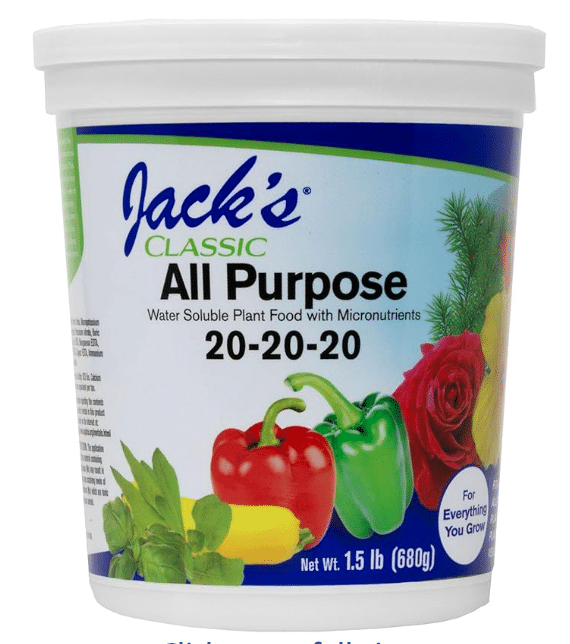
Jack’s Classic All Purpose 20-20-20 — Best for Stronger Growth
This one’s water-soluble, dissolves completely and cleanly, and delivers a genuinely balanced NPK with a solid micronutrient profile.
We use it at half the recommended dose, same as with our other plants. At half strength it’s safe for ivy’s fine roots and delivers noticeably more vigorous growth than Plant Magic. The combination we use: Plant Magic for regular monthly feeding, Jack’s once in early spring as a growth boost.
Pros: Balanced complete NPK, clean dissolution, good micronutrients, effective growth driver at half strength. Cons: Synthetic — higher salt accumulation risk than organic options if used at full strength or too frequently. Requires careful dilution. Best for: Spring growth boost, post-pruning recovery

Plant Magic Organic Fertilizer — Our Current Pick
This is what we use on our english ivy and recommend in our care guide. Plant Magic is gentle enough for regular monthly use without any risk of burning ivy’s fine roots, and we’ve seen consistent results — fuller vines, deeper leaf color, noticeable improvement within a week of each application after a winter rest.
The NPK numbers are lower than synthetic options, which means it’s not the right choice if you need to push rapid growth quickly, but for regular monthly maintenance it’s exactly what ivy needs. The organic formula also means zero salt buildup risk at normal application rates.
Pros: Organic, gentle on fine roots, consistent results, no burn risk, good for regular maintenance feeding.
Cons: Low NPK — not a heavy-duty growth driver. Won’t visibly accelerate growth the way a stronger synthetic will.
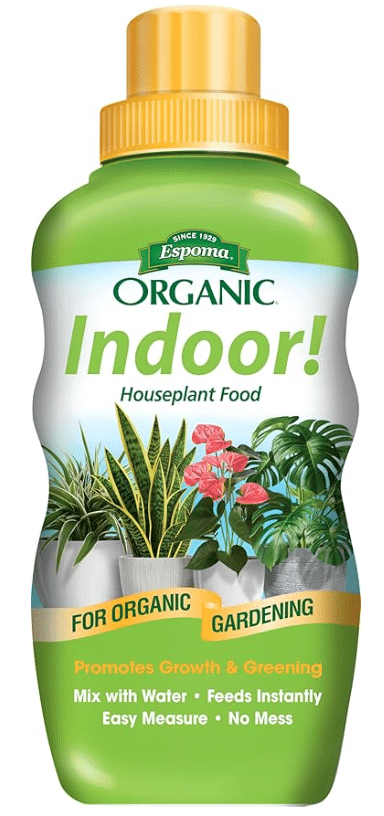
Espoma Organic Liquid Seaweed — Best Organic Option
The NPK is low, the application rate is forgiving, and the seaweed extract provides trace minerals that support overall plant health. It also has a mild acidifying effect on soil over time, which helps counteract the pH drift that alkaline tap water causes — a quiet bonus that most fertilizer guides don’t mention. We use it as a supplement alongside Plant Magic rather than as a standalone fertilizer.
Pros: Organic, very low burn risk, mild acidifying effect on soil, good trace minerals, gentle enough for struggling plants.
Cons: Too low in NPK to be a standalone fertilizer for active growing season feeding. Best as a supplement. Best for: Organic growers, rehabilitation feeding for stressed ivy
Fertilizer Flushing — When and How
English ivy accumulates fertilizer salts faster than its appearance suggests, particularly because it’s growing in relatively small pots with dense root systems. The fine roots that make ivy elegant also make it more vulnerable to salt damage than coarser-rooted plants.
What salt buildup looks like: a white or pale yellow crust forming on the soil surface, brown tips that spread inward from the leaf edges rather than just sitting at the very tip, and a plant that seems to plateau or decline despite consistent feeding.
How to flush:
- take the pot to a sink and water slowly and thoroughly with plain water — no fertilizer — passing roughly three times the pot’s volume through the soil.
- Go slowly enough that the water is actually absorbing rather than running straight through.
- Let it drain completely before returning the pot to its spot. Never let it sit in the runoff.
How often:
- every eight weeks during the growing season as a preventive measure, even without visible salt buildup.
- Our Brooklyn tap water leaves its own mineral deposits on top of fertilizer salts, so we flush every six to seven weeks and it makes a visible difference in how the ivy looks mid-season versus when we were fertilizing continuously without flushing.
After flushing: wait one week before resuming fertilizer, and restart at half strength. This reset approach keeps the root zone clean and reduces the chronic low-level stress that salt accumulation causes even before it’s visible.
REad also: Best soil for tradescantia bubblegum
FAQ
Why is my english ivy yellowing even with fertilizer?
Most likely one of two things. First, compacted or waterlogged soil is reducing root function — the fertilizer is present but the roots can’t access it efficiently. Fix the soil structure before adjusting the feeding. Second, pH drift from alkaline tap water may have pushed the soil toward neutral or above, causing nutrient lockout. Try watering with filtered water for a month and see if new growth improves. If the yellowing is on older leaves first and new growth looks healthy, it’s normal lower-leaf senescence — not a feeding problem at all.
Does english ivy need acidic soil?
Mildly acidic to neutral — pH 6.0–6.5 is the target range. Less demanding on pH than plants like boston ferns or blueberries, but ivy still performs best slightly below neutral. Most quality potting mixes land in this range naturally. The ongoing concern is pH drift from alkaline tap water nudging the soil upward over months of regular watering — occasional use of filtered water or a dilute acidic amendment helps maintain the right range over time.
How often should I repot english ivy?
Every one to two years, or when the roots are visibly circling the drainage holes and growth has slowed despite good conditions. Ivy fills pots faster than most trailing houseplants and doesn’t tolerate being overly root bound the way some plants do. When you do repot, go up only one pot size — too large a pot creates soggy outer soil that the roots can’t drink from, which is a direct route to the waterlogging conditions ivy is most sensitive to.