Best Soil and Fertilizer for Pink Princess Philodendron (What Actually Works)
We grow Pink Princess Philodendron in our Brooklyn home alongside hundreds of other aroids — here’s the soil mix we actually use, the fertilizer that keeps new leaves coming, and honest reviews of every product worth buying.

We are an Ad-free community driven site. When you purchase through links here, we may earn an affiliate commission, which helps sustain our blog!
Pink princess philodendron is not a forgiving plant. You paid real money for it — possibly a lot of money! — and the fastest way to lose it isn’t light or water: it’s soil. Get the mix wrong and you’ll be nursing root rot within a season, watching those pink leaves yellow and go soft at the base while you try to figure out what happened.
We’ve grown pink princess philodendron in our Brooklyn home long enough to make lot of the mistakes worth making. This page is a buying guide: what the plant actually needs in a soil mix, which products we’d buy again, a DIY formula you can put together for under $30, and a fertilizer section that covers NPK, timing, and our go-to products.
For full care — light, watering, propagation, troubleshooting — head to our Pink Princess Philodendron care guide.
Read also: why does my pink princess philodendron lose variegation
Summary
- Soil is the most critical variable for PPP. Because its variegation reduces chlorophyll and slows water uptake, it needs a chunky, airy aroid mix — not standard potting soil. Our go-to formula is 40% coir, 30% perlite, 20% orchid bark, 10% worm castings. If buying pre-made, rePotme Aroid Mix is the top pick.
- The best fertilizers are balanced, not nitrogen-heavy. High-nitrogen formulas can suppress variegation by pushing green growth. We recommend Dyna-Gro Foliage Pro (9-3-6) as the top all-around pick, with TPS Nutrients Philodendron Fertilizer as the best plant-specific option and Easy Peasy as the best value concentrate.
- Timing matters as much as product choice. Feed every 4–6 weeks in spring and summer, reduce in fall, and stop (or go to quarter strength) in winter. Always fertilize into moist soil — dry soil plus concentrated fertilizer is a root-burn risk.
- The most expensive mistakes are avoidable. Dense moisture-retaining mix causes root rot, over-fertilizing in winter causes salt buildup, and going too chunky without adjusting your watering frequency causes underwatering. Get the soil right first and the rest of PPP care becomes significantly more forgiving.
Read also: our favorite pink indoor plants, Philodendron Micans care, and Alocasia Pink Dragon care and Best soil for tradescantia bubblegum
Best Soils for Pink Princess Philodendron — Our Top Picks
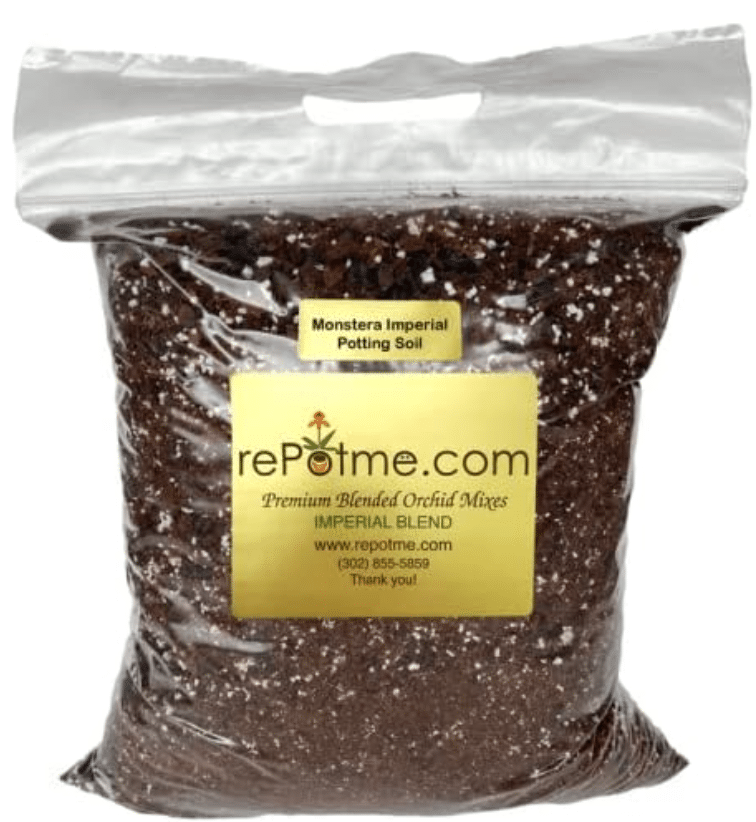
rePotme Monstera & Aroid Mix — Best Overall Pre-Made Option
This is the pre-made mix we’d reach for first if we weren’t mixing our own. It’s genuinely chunky — bark, perlite, and coir in proportions that work for aroids out of the bag. You can use it straight without amending and it’ll drain well and hold just enough moisture. The price is higher than big-box options but for a plant you paid $40–$100 for, this isn’t the place to economize.
Pros:
- Aroid-specific formula, chunky texture, excellent drainage, no amendment needed.
Cons:
- More expensive per bag than standard mixes. Not available in every garden center — usually an online order.
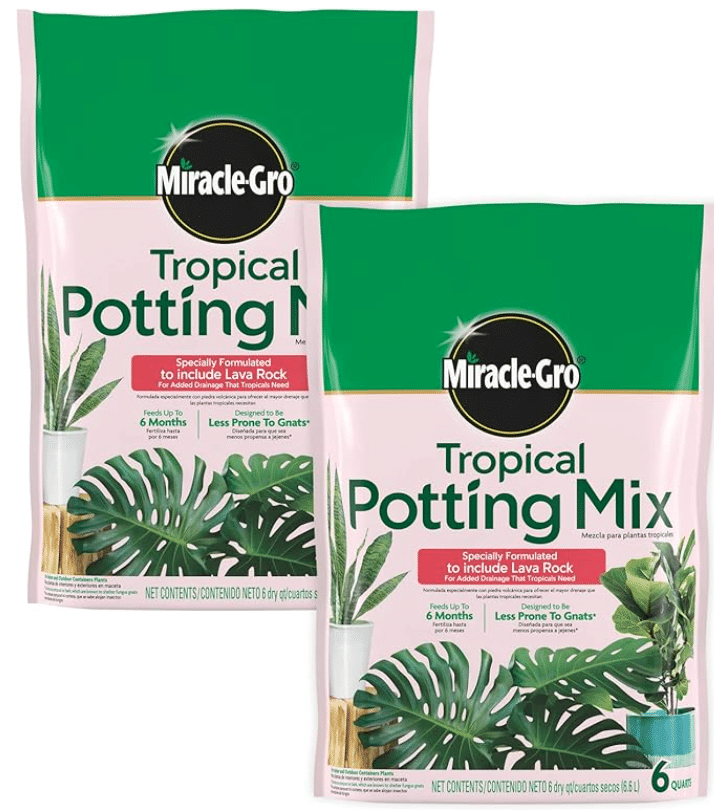
Miracle-Gro Tropical Potting Mix — Best versatile – Budget Option
In all honesty, this one is denser than we’d like and the moisture retention is higher than an aroid needs. But it’s everywhere, it’s affordable, and works for most plants if that flexibility is important for you..and if you amend it with 25–30% perlite it becomes amazing. The Miracle-Gro we recommend in our care article works fine in a pinch — just don’t skip the perlite.
Pros: Available everywhere, affordable, familiar brand, decent starting point when amended.
Cons: Not chunky enough for PPP on its own. Holds more moisture than an aroid wants. Needs significant perlite.
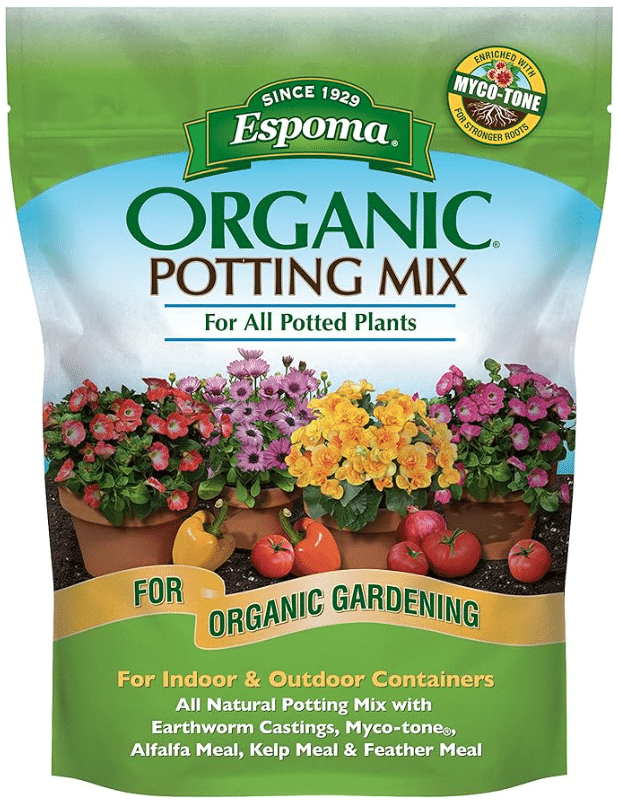
Espoma Organic Potting Mix — Best Organic Base to Amend
Espoma is our go-to when we want an organic base. On its own it’s too dense for Pink princess philodendron, but it responds really well to amendment — we add perlite and bark and it becomes a solid mix. If you’re growing organically and want to avoid synthetic anything in your soil, this is the starting point. It holds moisture more than we’d like for a pure PPP mix, which is why perlite is non-negotiable here.
Pros: Organic, good base for customizing, widely available at garden centers.
Cons: Too dense straight from the bag for PPP. Requires amendment with perlite and bark.
What Pink Princess Philodendron Actually Needs in a Soil Mix
In the wild, Philodendron erubescens grows as a hemiepiphyte — it climbs trees, its roots exposed to air, bark, and fast-draining forest floor material. It has never lived in dense, moisture-retaining soil, and it doesn’t want to start now.
Add to that the fact that PPP’s variegation — the pink you actually bought this plant for — reduces its chlorophyll. Less chlorophyll means slower photosynthesis and slower water uptake. That means roots sit in moist soil longer than they would in a fully green plant, which means the margin for error with a dense mix is quite low!
The four things every good PPP mix needs:
- Aeration: roots need oxygen, not just moisture. Chunky materials like bark and perlite keep air pockets in the mix even after watering.
- Fast drainage: water should move through quickly and not pool. This is what perlite and coarse bark do.
- Moderate moisture retention: the mix shouldn’t dry out in 24 hours either. Coconut coir holds just enough moisture without compacting.
- Slightly acidic pH (5.5–6.5): PPP prefers a mildly acidic environment. Most quality potting mixes land here, but it’s worth checking if you’re mixing from scratch.
What to avoid:
- Dense, moisture-retaining mixes marketed as ‘tropical’ or ‘moisture control’ — these are designed for plants that drink heavily and PPP is not one of them.
- Straight topsoil or garden soil — too compact for any container plant, let alone an aroid.
- Peat-heavy mixes — they compact over time, become hydrophobic when dry, and are harder to rewet evenly.
PRO TIP: This is exactly why we stopped using straight bagged potting mix on ours. It worked fine for the first few months, then compacted after one season and the drainage slowed noticeably. We repotted into our chunky mix and the difference was immediate!
Our DIY Pink Princess Philodendron Soil Mix
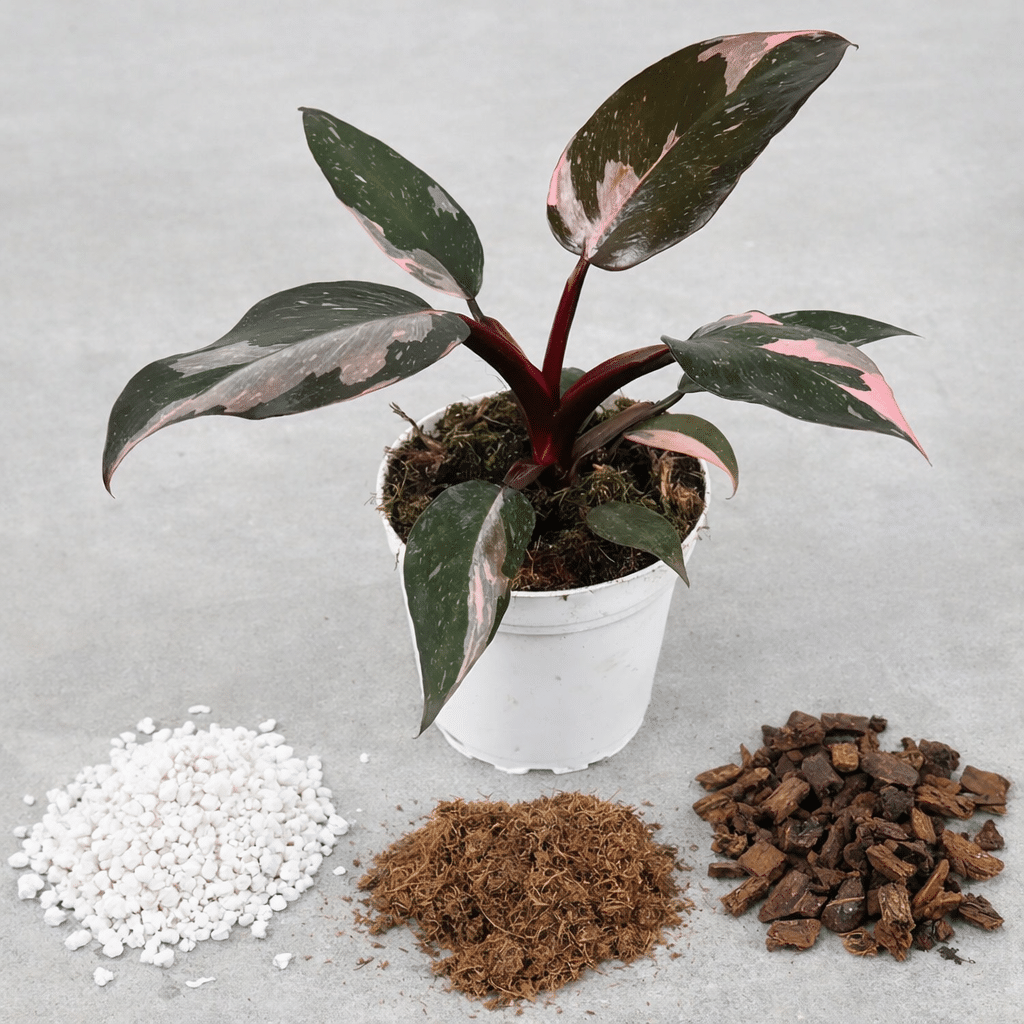
This is the mix we use. Our PPP is sitting in it right now. We’ve refined it over several repots and it hits the balance we were looking for: airy enough that roots get oxygen, moisture-retentive enough that we’re not watering every two days, and chunky enough that it doesn’t compact after a season.
The formula:
- 40% coconut coir — the backbone of the mix. Coir retains moisture without compacting and doesn’t become hydrophobic when it dries out the way peat does. It also has a near-neutral pH that plays nicely with the slight acidity we’re targeting.
- 30% perlite — the drainage workhorse. Perlite keeps air pockets in the mix and prevents compaction. We use medium or coarse perlite, not fine — fine perlite moves around too much and ends up at the bottom. If you’re a chronic overwaterer, bump this to 40% and drop the coir to 30%.
- 20% orchid bark chips — this is what gives the mix its chunky, forest-floor quality. Bark mimics what PPP’s roots would encounter in the wild and keeps the structure open over time. We use medium-grade orchid bark.
- 10% worm castings — a small amount of organic nutrition built into the mix from day one. Worm castings are gentle enough that they won’t burn roots and they add microbial activity that helps the whole system function. We prefer castings over compost here because they’re finer, less likely to introduce pests, and easier to measure.
How to mix it: If you’re using a compressed coir brick, hydrate it first — one brick typically expands to about 2 gallons of coir. Then combine everything by volume in a large container or bucket and mix thoroughly. We use a trowel and just turn it over a few times until it looks consistent. Aim for a finished pH of 5.5–6.5 if you have a soil pH meter; most quality coir and worm castings will land there naturally.
Cost: A batch large enough for several repots runs us around $25–$35 in materials. Over time it’s significantly cheaper than buying pre-made aroid mix repeatedly, and we can adjust the ratios for different plants (we use a wetter version for our calatheas and a drier version for our hoyas).
Read also: Best soil and fertilizer for Boston Fern
best fertilizers for pink princess philodendron
Soil gets the structure right; fertilizer handles nutrition. Pink Princess Philodendron isn’t a heavy feeder but it does need consistent feeding during the growing season to push out healthy, well-variegated leaves. Skip it entirely and growth slows, leaves come in smaller, and the plant just looks tired. Overdo it and you’ll see salt buildup, brown tips, and potentially root damage. The goal is steady and moderate.
What NPK Ratio Does PPP Need?
A balanced fertilizer — something close to equal N-P-K, like 20-20-20 — works well for PPP during the growing season. Nitrogen supports foliage growth, phosphorus supports root development, and potassium supports overall plant health and disease resistance.
PRO TIP: very high nitrogen fertilizers can actually suppress variegation. Nitrogen pushes green, chlorophyll-producing growth — which is exactly what the plant wants to do when it’s trying to revert anyway. We stay away from anything with N significantly higher than P and K (like 30-10-10 lawn-type fertilizers) and stick to balanced formulas.
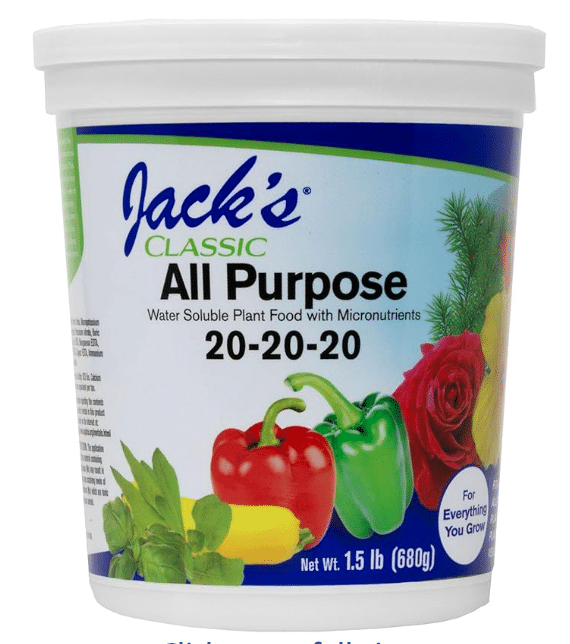
Jack’s Classic All Purpose 20-20-20 — Best Balanced Water-Soluble
This is the pre-made mix we’d reach for first if we weren’t mixing our own. It’s genuinely chunky — bark, perlite, and coir in proportions that work for aroids out of the bag. You can use it straight without amending and it’ll drain well and hold just enough moisture. The price is higher than big-box options but for a plant you paid $40–$100 for, this isn’t the place to economize.
Pros:
- Aroid-specific formula, chunky texture, excellent drainage, no amendment needed.
Cons:
- More expensive per bag than standard mixes. Not available in every garden center — usually an online order.
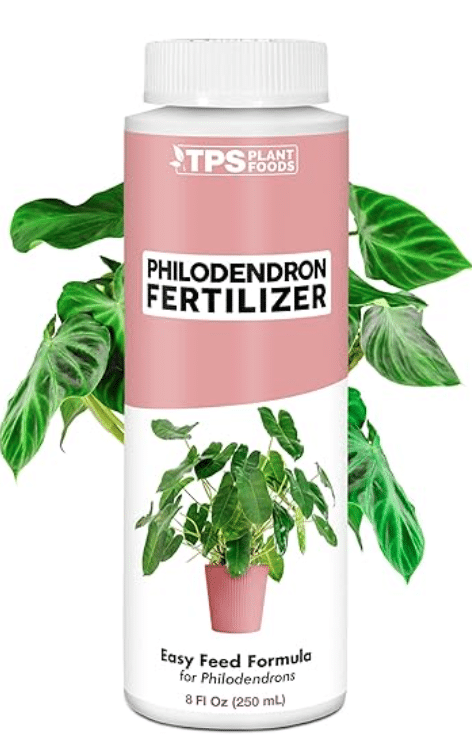
TPS Nutrients Philodendron Fertilizer — Best Plant-Specific Liquid Formula
This one is enhanced with kelp and essential micronutrients including iron, magnesium, zinc, and manganese, which matter more for Pink princess philodendron than most people realize. The micronutrients support leaf color and development in ways that a basic NPK-only formula won’t. We’d use it at half the recommended dose on PPP and apply every 4–6 weeks during growing season.
Pros: Philodendron-specific formula, micronutrient-enhanced, small business brand, liquid for easy dilution control.
Cons: Smaller 8oz bottle — if you have a large collection you’ll go through it faster than a concentrate.
Best for: Growers who want a fertilizer built specifically for philodendrons rather than a general houseplant catch-all.
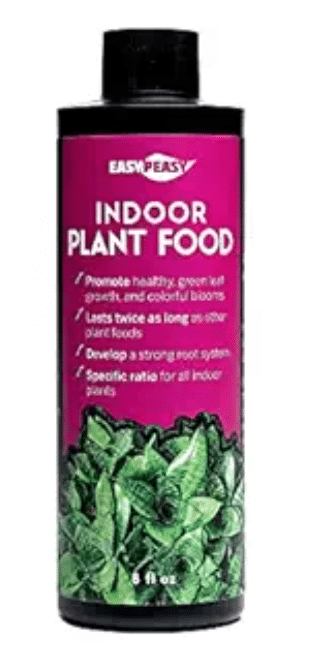
Easy Peasy Plants Liquid Indoor Plant Food (4-3-4) — Best Value Concentrate
Easy Peasy’s 4-3-4 is a well-balanced general-purpose liquid concentrate and it goes a long way — half a teaspoon in two cups of water per application. The slight potassium lean in the formula is actually a reasonable fit for PPP, since potassium supports overall plant resilience without pushing heavy green foliage growth the way a nitrogen-heavy fertilizer would.
Pros: Highly concentrated so it lasts, balanced NPK, small family business, cost-effective for a multi-plant household.
Cons: Dilution instructions aren’t calibrated for single-pot use. Doesn’t cover the full micronutrient range of something like Dyna-Gro.
Best for: Growers with multiple plants who want a reliable all-purpose liquid at a good price point.
Soil and Fertilizer Mistakes We’ve Made With pink Princess Philodendron
These are the actual errors we’ve made, not a generic warning list.
- Using a moisture-retaining mix on our first PPP. We used a ‘tropical blend’ that held water for days. Within two months the crown had soft, dark patches that turned out to be early rot. We lost a $60 plant. This is the mistake that made us start mixing our own soil for aroids.
- Fertilizing in winter. We kept feeding at our normal frequency through a cold December and January. By February we had brown-tipped leaves and a white crusty salt buildup on the top of the soil. We flushed the pot thoroughly and the plant recovered, but it took most of spring to come back properly.
- Skipping a pH check after mixing. We had a batch of coir from a new brand that ran quite alkaline. The plant showed a slow, subtle decline over a couple of months — no dramatic symptoms, just slightly smaller leaves and sluggish growth. We couldn’t figure it out until we tested the soil pH and found it sitting at 7.2. We remixed with a pH adjustment and the plant came back. Now we test every new batch.
- Going too chunky without adjusting watering. We over-corrected after the rot incident and made a mix that was almost entirely bark and perlite. The soil dried out within 36 hours and we were underwatering without realizing it because we were still watering on our usual schedule. If your mix is very fast-draining, water more frequently and stick your finger in the soil rather than going by days on a calendar.
- Fertilizing into dry soil. Once, in a rush, we applied liquid fertilizer to a pot that was pretty dry. Within a week we had root burn symptoms — wilting despite moist soil, brown patches on lower leaves. Always water first, then fertilize into moist soil.
Read also: Best soil and fertilizer for English Ivy
Can I use regular potting mix for pink princess philodendron?
You can, but you’ll need to amend it significantly. Standard potting mix is too dense and moisture-retentive for PPP on its own. If you’re using a regular bagged mix, add 25–30% extra perlite at minimum, and ideally some orchid bark too. The goal is a mix that drains freely and doesn’t stay wet for more than a day or two after watering. Straight potting mix on its own is one of the most common reasons PPP develops root rot.
Does pink princess philodendron need acidic soil?
Yes, PPP prefers a slightly acidic pH of 5.5–6.5. Most quality potting mixes and aroid blends fall within this range naturally. If you’re mixing your own, coconut coir and worm castings both tend to run close to neutral or slightly acidic, which makes them well-suited as base ingredients. It’s worth testing your finished mix with an inexpensive soil pH meter if you’re seeing unexplained slow growth or subtle decline.
What’s the difference between aroid mix and regular potting mix?
Regular potting mix is designed for a broad range of container plants and optimized to hold moisture so most plants don’t dry out too quickly. Aroid mix is specifically designed for hemiepiphytes and epiphytes — plants like philodendrons, monsteras, and pothos — that need aeration and fast drainage above all else. The key physical difference is texture: aroid mixes contain chunky bark, coarse perlite, and coir that keep air pockets open; regular potting mixes are finer and denser. PPP will tolerate regular potting mix if amended, but it will thrive in an aroid mix.