
Why Is My Pink Princess Philodendron Losing Variegation
We grow pink princess philodendron in our Brooklyn home — here’s what actually causes variegation loss, why it’s almost never what you think, and the step-by-step process we used to bring our own reverting PPP back to pink.

We are an Ad-free community driven site. When you purchase through links here, we may earn an affiliate commission, which helps sustain our blog!
If your Pink Princess Philodendron is pushing out plain green leaves when it used to produce beautiful pink ones, you’re not imagining it and you’re not alone. Variegation loss — or reversion — is one of the most common and most misunderstood problems with this plant. We’ve lived through it ourselves, made the wrong diagnosis first, and eventually figured out what was actually happening.
This guide goes deeper than the standard advice. We’ll cover the science of why PPP produces pink in the first place, every genuine cause of variegation loss ranked by how often we actually see it, a step-by-step recovery guide you can start today, how to prune specifically for better variegation, and when grow lights are the real solution.
Read also:
- Our list of stunning pink houseplants
- For soil and fertilizer guidance: see our best soil and fertilizer for pink princess philodendron.
Summary
Why Is My Pink Princess Philodendron Losing Variegation?
- Almost certainly insufficient or inconsistent light. PPP needs reliably bright indirect light — not occasional bright light, and not ambient room light from a distance. Move it directly beside your brightest window and watch the next two to three new leaves. If light is genuinely not the issue, check for other stress: overwatering, pests, or recovery from a recent repot.
How do I make my pink princess philodendron more pink?
- More light is the single most effective intervention. Position it directly beside a bright window rather than across the room. Prune any all-green reverted growth. Avoid high-nitrogen fertilizers. If natural light is limited, add a full-spectrum grow light on a consistent daily schedule. Every measure that reduces stress and improves energy availability makes it easier for the plant to afford the metabolic cost of being pink.
Why Pink Princess Philodendron Has Pink Variegation (The Short Science)

Understanding why the pink exists is the key to understanding why it disappears.
- Pink Princess philodendronss variegation is caused by a genetic mutation — specifically, some of its cells lack chloroplasts, the structures responsible for photosynthesis and green color.
- Where those chloroplast-free cells cluster together at the surface of a leaf, you see pink (or white, or cream, depending on the degree of mutation). Where normal chloroplast-containing cells are present, you see green.
- This has two important consequences. First, the pink sections of a leaf cannot photosynthesize. They produce no energy for the plant.
- The plant is essentially carrying dead weight in every pink patch, which is why PPP grows more slowly than an all-green philodendron and why it’s more sensitive to stress.
- Second — and this is the part that explains reversion — the plant is always under evolutionary pressure to go green. Green is more efficient. Green means more energy. When conditions are suboptimal, the plant defaults toward producing cells with chloroplasts.
- New leaves come in greener. Over time, if nothing changes, the plant can revert almost entirely to green.
PRO TIP: The pink isn’t a stable state. It’s a genetic expression that your growing conditions are either supporting or suppressing with every new leaf. This is why variegation loss is almost always a care signal, not a permanent change — and why getting conditions right can genuinely bring it back.
Read also: Why do plants have pink leaves
Every Real Cause of Pink Princess Philodendron Variegation Loss
1. Insufficient Light (The Most Common Cause by Far)
This is the cause in the overwhelming majority of cases, including ours. When PPP doesn’t receive enough bright, indirect light, it responds by producing more chlorophyll — more green — in new leaves. The pink patches shrink. New leaves come in largely or entirely green. If it continues long enough, the plant can produce multiple consecutive all-green leaves and appear to have reverted completely.
The nuance most care guides miss: it’s not just about light intensity, it’s about light consistency. A plant that gets bright light for a few hours on sunny days but sits in dim conditions the rest of the time will still struggle to maintain variegation. PPP needs reliably bright indirect light — not occasional bright light.
- What counts as sufficient:
- Right beside an east-facing window (gentle morning sun, bright the rest of the day), or a few feet from a south or west window with a sheer curtain.
- Direct afternoon sun from a south or west window without diffusion will scorch the pink sections — those cells have no chlorophyll to protect them from UV damage.
- What doesn’t count as sufficient:
- across the room from a window, in a north-facing room, on a shelf where the plant gets reflected ambient light.
Our east window spot is the one thing we will not compromise on for our PPP. Every time we’ve moved it — even to a spot that felt bright to us — the next few leaves told us we were wrong.
2. Seasonal Light Drops
- Even if your PPP’s spot is perfect in summer, the same window delivers meaningfully less light in winter.
- Days are shorter, sun angle is lower, and in cities like ours — Brooklyn brownstone, neighboring buildings partially blocking winter sun — the effective light level can drop dramatically between October and February.
- This is why many growers see variegation fade in winter even without moving the plant.
The fix is either moving the plant closer to the window in winter, or supplementing with a grow light. We’ll cover grow lights in detail below.
3. True Genetic Reversion
Distinct from light-driven greening, true genetic reversion happens when a stem produces growth from cells that have lost the variegation mutation entirely. This growth will be all-green regardless of light conditions — it’s genetically green, not environmentally green.
You can usually identify it because the leaves are a slightly different shade (often brighter, more vivid green than the variegated stem’s green sections) and the growth is noticeably more vigorous.
The only response is pruning — cutting the reverted growth back to the last variegated node. Left unpruned, reverted stems often outgrow the variegated portions because they photosynthesize more efficiently, and the plant gradually becomes dominated by green growth.
4. Stress — From Any Source
Stress of any kind — overwatering, underwatering, repotting, pest damage, root disturbance, dramatic temperature changes — can trigger a run of green or less-variegated leaves. The plant is essentially in survival mode, prioritizing energy production over aesthetics.
This is usually temporary. Resolve the underlying stress, stabilize the care conditions, and variegation typically returns with the next few leaves once the plant settles. The problem is that people often don’t identify the stress correctly — they see green leaves and assume it’s a light problem when it’s actually recovering from root rot or adapting to a new pot.
Read also: why does tradescantia bubblegum lose color
Where to buy Pink Princess Philodendron

What Happened With Our pink princess philodendron (And What We Got Wrong First)
We want to tell this story specifically because we made the exact wrong diagnosis, and we see other plant owners make the same mistake constantly.
- About a year into growing our pink princess, it started pushing out plain green leaves. One, then two, then a third. The plant looked healthy otherwise — no yellowing, no drooping, new growth coming regularly.
- We assumed it needed fertilizer. We’d been feeding it, but maybe not enough, or maybe the wrong formula. We tried a different fertilizer. We adjusted the frequency. Nothing changed. A fourth green leaf unfurled.
We almost gave up on that plant. Then we moved it from its spot in the corner of our living room — a spot that felt bright and well-lit to us — to directly beside our east-facing window. Within two new leaves, the pink was back. Not faint pink. Proper, vivid, PPP pink.
The corner had felt bright because the room itself was well-lit. But the plant was about six feet from the window, receiving reflected and diffused light rather than direct window light. That was enough for it to survive and grow. It was not enough for it to maintain variegation.
The counterintuitive lesson: the plant doesn’t need more food to make more pink. It needs more light. Give the plant enough light and it will produce variegated leaves because the green cells can carry the photosynthetic load and the pink cells can afford to exist. Reduce the light and the plant eliminates the pink to survive.
Read also: common problems and solutions with pink houseplants
Step-by-Step Recovery Guide: What to Do If Your PPP Is Losing Pink Right Now
- Diagnose before you act. Look at the newest two or three leaves. Are they coming in green? Less pink than before? This tells you variegation loss is ongoing. If only older leaves look faded, the plant may be fine — that’s normal leaf aging, not reversion.
- Assess your light situation honestly. Stand at your plant’s location and look toward the window. How far away is it? Is direct window light reaching the plant for several hours a day, or is it ambient room light? Is anything blocking the window — a curtain, another plant, a neighboring building? Most people significantly overestimate how much light their PPP is actually receiving.
- Move to the brightest viable spot. For most homes this means directly beside an east window, or within two to three feet of a south or west window with a sheer curtain. Not across the room. Not on a bookshelf. Right at the window. If you genuinely don’t have a qualifying spot, skip to step 5.
- Check for and resolve any other stress. Is the soil staying wet too long? Are there signs of pests under the leaves? Has the plant been recently repotted or moved? Resolve any stress factors before expecting variegation to return — a stressed plant will keep prioritizing survival over pink.
- Prune reverted growth immediately. Any stems producing all-green leaves with no pink should be cut back to the last variegated node. Don’t leave reverted stems hoping they’ll pink up — they won’t. See the pruning section below for exactly how to do this.
- Count leaves, not days. Variegation recovery is measured in new growth, not time. Our plant showed improvement within two new leaves after we moved it. But PPP grows slowly — two new leaves might take six to eight weeks depending on the season. Watch each new leaf as it unfurls. More pink than the last one means recovery is working.
- Add a grow light if natural light is genuinely insufficient. If you’ve optimized every window in your home and still can’t give PPP what it needs, a grow light is the right answer — not a workaround. See the grow light section below.
How to Prune Pink Princess Philodendron for Better Variegation
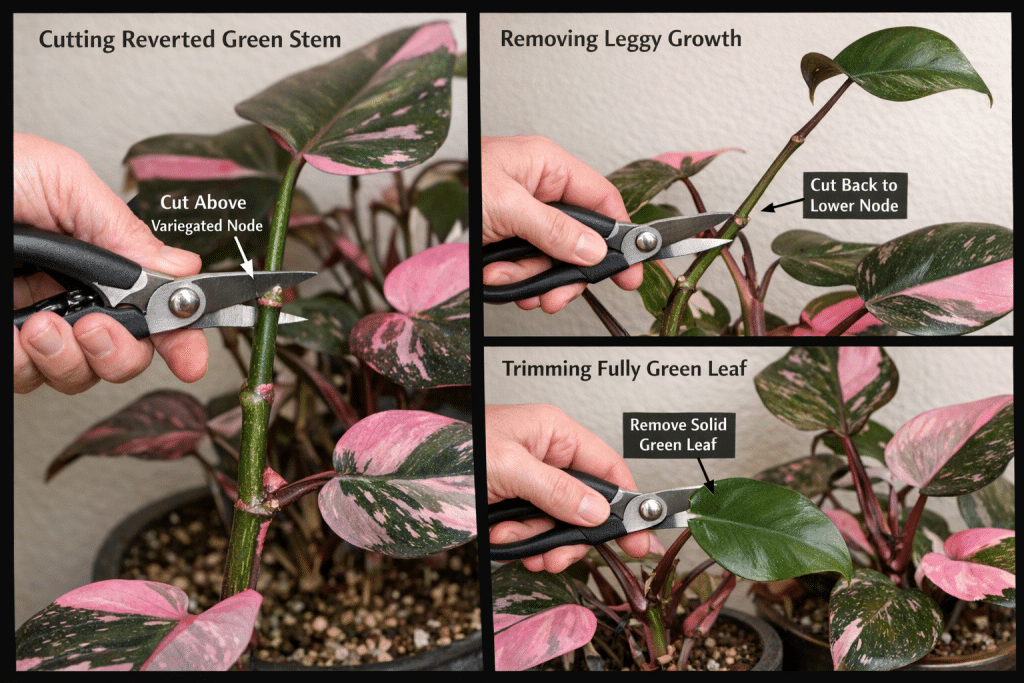
Pruning for variegation is different from pruning for shape or size. The goal is strategic: remove what’s pulling energy away from variegated growth, and redirect the plant’s resources toward nodes most likely to produce pink.
What to Cut
- All-green reverted stems: Cut back to the last node that showed variegation. A node looks like a small bump or leaf scar on the stem. Cut just above it with clean, sterilized scissors or pruning shears. If an entire stem has gone green from base to tip, cut it back to the main plant. These stems will not pink up regardless of light.
- Leggy stems with few leaves: Long bare stems with one or two leaves at the tip are pulling resources from more productive growth. Cut back to a node closer to the base to redirect energy.
- Fully green individual leaves on a variegated stem: A leaf with zero pink on a stem that normally produces pink is photosynthetically dominant — it draws disproportionate resources and can push the plant toward producing more green cells in subsequent growth. Worth removing.
What Not to Cut
- Leaves with even a small amount of pink: You’re pruning for direction, not perfection. Any pink is a sign the stem is still expressing the variegation gene.
- The active growing tip of a variegated stem: Don’t remove the tip of a stem that’s actively growing pink leaves. You’d be cutting your most productive current growth point.
- More than 20–25% of the plant at once: Heavy pruning stresses PPP and can itself trigger a run of plain leaves during recovery. Do it in stages if there’s a lot to remove.
When and How
Spring and early summer are ideal — the plant is in active growth and will redirect resources quickly. Sterilize tools with rubbing alcohol before cutting. Wear gloves; PPP sap can irritate skin. The cuttings from reverted stems are not worth propagating if you want variegated plants — they’ll grow true to their reverted genetics. Cuttings from variegated stems with pink nodes are worth propagating and will carry the variegation forward.
FAQ
Can pink princess philodendron get its variegation back?
Yes, in most cases. If the loss is light-driven — the most common cause — improving light conditions will bring variegation back in new growth. Existing green leaves won’t turn pink, but new leaves will reflect the improved conditions. If a stem has undergone true genetic reversion, pruning it redirects the plant’s energy toward variegated growth elsewhere.
Is my pink princess philodendron reverting to green permanently?
Not necessarily. Light-driven greening is reversible — improve the light and new leaves will show more pink. True genetic reversion on a specific stem is permanent for that stem, but the rest of the plant can still produce variegated leaves. Prune reverted stems and focus on the growth that still carries the variegation gene.
Does fertilizer affect pink princess philodendron variegation?
Rarely, and not in the way most people assume. Fertilizer doesn’t directly cause or prevent variegation. The one edge case: very high-nitrogen fertilizers can push vigorous green growth that seems to outcompete pink development. Stick to balanced fertilizers with equal or near-equal NPK. But fertilizer is almost never the primary cause of variegation loss — if your PPP is going green, check the light first. See our best soil and fertilizer for PPP page for our full fertilizer recommendations.
How long does it take for pink princess philodendron variegation to come back?
Count leaves, not weeks. Our plant showed clear improvement within two new leaves after we corrected its light situation. PPP grows slowly — those two leaves might take six to eight weeks. In winter, growth can nearly stop and results may not be visible until spring. The direction of change is what matters: each successive new leaf should show more pink than the last if you’ve addressed the underlying cause correctly.





The article is good and provides clear information. The site is useful for learning new things.