
Houseplants Humidity Production Chart: How Much Humidity 50 Popular Plants need
See the exact humidity range for 50 popular houseplants in one sortable chart. We cross-referenced ASPCA, RHS, and university extension sources — plus three floors of Brooklyn growing experience.
We didn’t think about humidity until February of our second year in this brownstone — when the radiators kicked into full winter mode and we lost three calatheas in six weeks. The leaves curled inward, the edges turned brown and papery, and no amount of watering fixed it. We were blaming ourselves for overwatering, then underwatering, then the light. It was none of those things. It was the air.
A basic hygrometer — a $12 device we now keep on every floor — told us our second-floor bedroom was running at 24% relative humidity in January. Our calatheas wanted 60–80%. We were giving them desert air and wondering why they were suffering.
That experience is why we built this chart. Not to give you a number to obsess over, but to help you understand which plants fit the air you already have — and which ones need you to change something before they’ll ever thrive.
We cross-referenced humidity data for all 50 plants against four authoritative sources:
ASPCA toxic and non-toxic plant database, Royal Horticultural Society houseplant guides, University Cooperative Extension, University of Missouri Extension Where those sources gave explicit ranges, we used them. Where they didn’t, we triangulated from horticultural consensus and our own multi-year experience growing these plants across three floors of a Brooklyn brownstone.
If you want a personalized plant recommendation based on your actual conditions, try our Best indoor plants
We also have other handy charts: Oxygen production chart, Pet toxicity chart, and light requirement chart for indoor plants
humidity requirements infographic
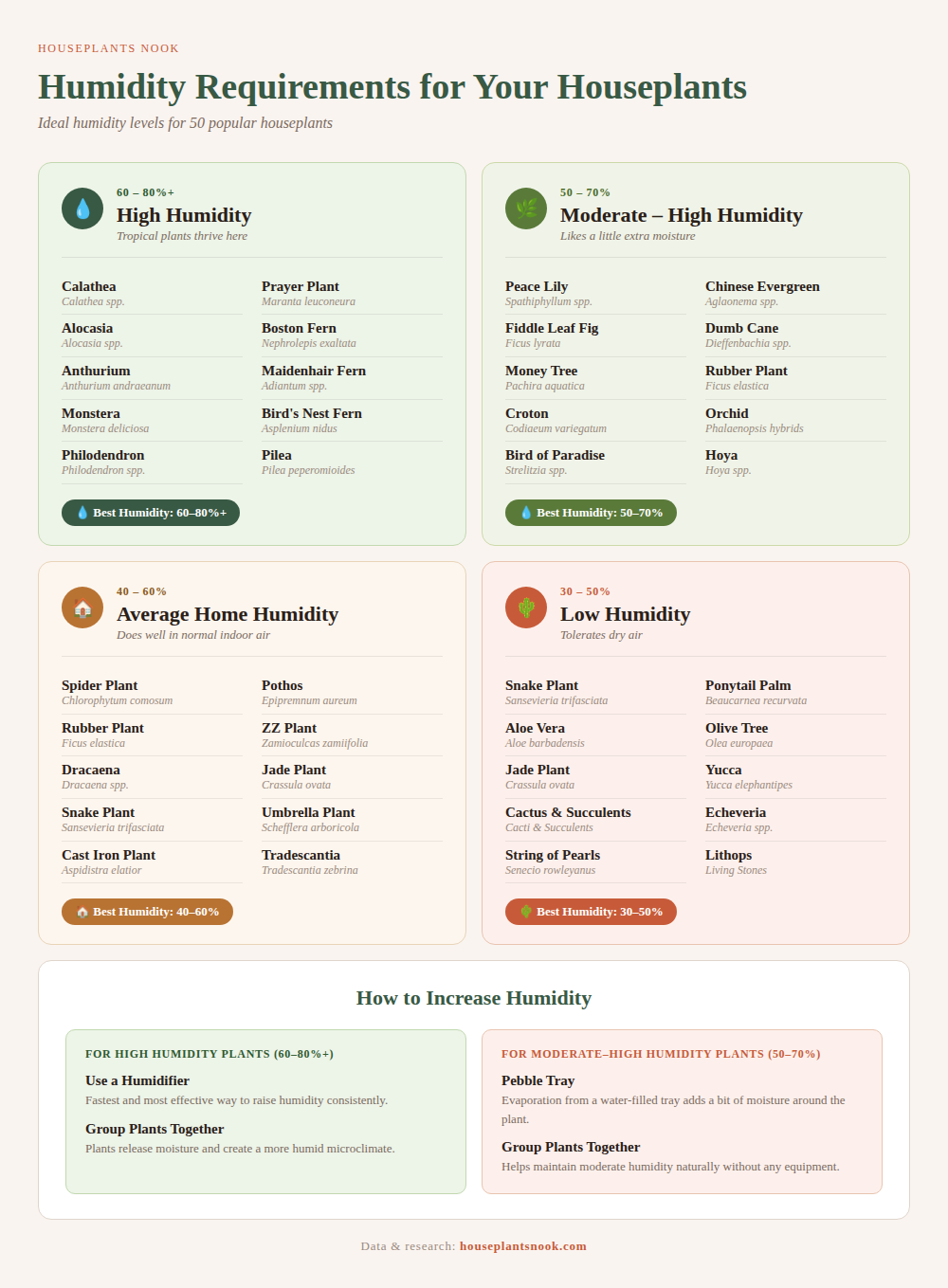
Use this chart on your site — copy the code below:
The Science: Why Humidity Matters More Than Most People Realize
Relative humidity is simply the percentage of water vapor in the air compared to the maximum it can hold at that temperature. When we say a calathea wants 60–80% humidity, we mean the surrounding air should carry at least 60% of its maximum possible water vapor. That sounds abstract. Here’s what it means in practice.
Plants lose water constantly through tiny pores in their leaves called stomata. This process — transpiration — is how they regulate temperature and move nutrients from roots to leaves. When the air is dry, transpiration accelerates. The plant loses moisture faster than its roots can replace it. The stomata close to conserve water. Photosynthesis slows. Growth stalls. The leaf edges, which are the furthest point from the root system, desiccate first — that’s the brown crispy tip you’re seeing on your fern.
The reverse problem is less common in homes but real: too much humidity, especially with poor airflow, creates the conditions for fungal disease. Botrytis on African violets. Root rot on succulents. Mold on the soil surface of slow-draining pots. High humidity isn’t automatically good — it has to match the plant.
What surprised us most, tracking this across our brownstone, is how differently the three floors behave. Our ground floor, with the original tile and a northwest exposure, runs 5–10% more humid than the top floor year-round. The second floor — where the main radiators are — crashes below 30% every January without intervention. One humidifier changed everything up there. But we had to know the numbers first before we knew what to fix.
The other thing worth knowing: a handful of plants on this list use CAM metabolism — aloe, jade plant, string of pearls, ponytail palm, kalanchoe. These plants evolved in arid environments and have adapted to conserve water by closing their stomata during the day and opening them at night. They genuinely prefer dry air. Putting them in a pebble tray next to your humidifier isn’t kindness — it’s stress.
How We Researched This
Every humidity range in this chart was cross-referenced against at least two of our four primary sources: the ASPCA plant database, the Royal Horticultural Society, Clemson University Cooperative Extension, and the University of Missouri Extension. These are the same sources we cite throughout Houseplants Nook because they publish peer-reviewed or professionally reviewed horticultural data — not crowdsourced forum opinion.
For plants where authoritative ranges weren’t explicit, we used horticultural consensus from published university extension materials and applied our own observed data from growing those plants in our brownstone over multiple years across different humidity conditions.
A few methodology notes worth being honest about:
All ranges reflect a typical mature indoor specimen in normal home conditions — not a greenhouse, not a grow tent, not a highly optimized setup. We assumed standard indoor temperatures of 65–75°F, because humidity tolerance shifts at temperature extremes. A calathea in a 60°F room behaves differently than one at 80°F even at identical humidity.
Ranges show the zone where a plant performs well, not the absolute floor where it survives. Most plants will survive outside their preferred range for a period. Thriving is a different standard.
We own and use hygrometers on every floor. The data in this chart reflects conditions we’ve actually measured, not theoretical averages.
chart of 50 popular houseplants with their humidity needs
What humidity does a snake plant need?
A snake plant does best in 30–50% relative humidity — the dry, heated air that stresses most other houseplants. If your apartment runs below 40% in winter with the radiators on, your snake plant is genuinely comfortable. High humidity is more likely to harm it through root rot than low humidity is to cause any stress.
What humidity does an areca palm need?
An areca palm prefers 60–80% relative humidity and is one of the more demanding palms on this list. Brown tips on areca fronds are almost always a humidity problem — they appear reliably below 50%. A humidifier running nearby is the honest solution; grouping it with other plants helps but won’t get you to 60% on its own in a dry winter apartment.
What humidity does a spider plant need?
A spider plant does well in 40–60% relative humidity, which falls within the range of a typical well-sealed home without any intervention. It is one of the most humidity-adaptable plants on this list. Brown tips can appear in very dry air below 35%, but a spider plant will not punish you the way a calathea will if your home runs on the drier side.
What humidity does a pothos need?
A golden pothos prefers 50–70% relative humidity but tolerates average home air well. It is forgiving down to around 40% without significant leaf damage. Below that, you may see crispy edges on older leaves. It sits in the comfortable home air category — no humidifier required in most homes, though one nearby doesn’t hurt.
What humidity does a dracaena need?
A dracaena does well in 40–60% relative humidity, making it one of the easiest tropical-looking plants to maintain in a typical home without any humidity intervention. The genus as a whole is exceptionally tolerant of the dry air that radiators and forced-air heating create in winter. Brown tips on dracaena are more often a fluoride or water quality issue than a humidity problem.
| Plant | Humidity Range | Category | If You Don’t Own a Meter |
|---|
Sources: ASPCA toxic & non-toxic plant database · Royal Horticultural Society · Clemson University Cooperative Extension · University of Missouri Extension. Ranges reflect typical mature indoor specimens in normal home conditions (65–75°F). Data compiled by Houseplants Nook from brownstone growing experience cross-referenced against these authoritative sources.
How we calculate humidity and how to read the chart
How to read this chart: The Humidity Range column gives the percentage your air should ideally sit at. The “If You Don’t Own a Meter” column translates that into real home conditions you already know. Sort by category to find all the plants that fit your current air — or to see what you’d need to change for the plants you want.
What the Categories Mean in Your Home
Very High (70–90%): Bathroom shelf or greenhouse cabinet Only one plant on this list genuinely needs this: Boston Fern. This is not typical home air anywhere in a Brooklyn brownstone, including our bathrooms. If you want a Boston Fern to thrive — not just survive — you need either a bathroom with a window and a daily shower, a humidity cabinet, or a dedicated humidifier running close by. We keep ours on the second-floor bathroom shelf where it gets indirect light from a frosted north window and enough steam from morning showers to stay happy through most of winter. Come February, we supplement with a small cool-mist humidifier. It’s a commitment. We think it’s worth it.
High (60–80%): Humidifier running nearby, or grouped with other plants This is the tropical core of most plant collections — Monstera, Alocasia, Calathea, Philodendron, Anthurium, Areca Palm, Bromeliad, Lipstick Plant. These plants come from rainforest floors and understories where the air is consistently moist. In a typical home without intervention, you’ll hit 60% in summer if you’re lucky. In winter with heat running, you won’t come close. Grouping plants together raises local humidity slightly through shared transpiration — but not enough on its own for this category. A humidifier is the honest answer.
Moderate–High (50–70%): Comfortable home air, or a humidifier in the same room This is where most of our brownstone lands in spring and fall — and where a single room humidifier gets you comfortably through winter. Plants in this range are the workhorses of a varied collection: Peace Lily, Bird of Paradise, Parlor Palm, Money Tree, Tradescantia, Orchids, Pothos. They want better than average air but won’t punish you for a dry week the way a calathea will.
Moderate (40–60%): Average well-sealed home, no humidifier needed This is the easiest category to manage. Rubber Plant, ZZ Plant, Spider Plant, English Ivy, Cast Iron Plant, African Violet, Dracaena, Jade Plant — these tolerate the air most homes produce naturally without any intervention. If your home runs in this range in winter, these are your lowest-maintenance options from a humidity standpoint. Our ground floor sits here year-round, which is why it houses most of our dracaenas and rubber plants.
Low–Moderate (30–50%): Heated home in winter is fine Snake Plant, Aloe, String of Pearls, Jade Plant, Kalanchoe, Ponytail Palm, Assorted Succulents — these are genuinely happy in the air that stresses everything else out. Radiator heat, forced air, dry winter rooms. If your apartment runs 30–40% in January and you’ve been losing tropical plants, this category is your friend. Stop fighting your air. Work with it.
Low (30–40%): The drier the better Aloe Vera sits alone here. It evolved in semi-arid conditions and genuinely prefers the driest air in your home. Our south-facing top-floor bedroom — the one that gets the most direct radiator heat and runs 25–30% in winter — is where our aloe lives. It has never looked better.
How We Compiled This Guide
We built this chart the same way we approach all our data guides at Houseplants Nook — by starting with authoritative sources and then layering in what we’ve actually observed growing these plants across our Brooklyn brownstone over multiple years.
Our primary references were the ASPCA toxic and non-toxic plant database, the Royal Horticultural Society houseplant guidance, Clemson University Cooperative Extension, and the University of Missouri Extension. Where those sources provided explicit humidity ranges, we used them directly. Where they didn’t, we triangulated from horticultural consensus across university extension materials.
We own hygrometers on every floor. The plain-English descriptions in the “If You Don’t Own a Meter” column come directly from the conditions we’ve measured and lived with — not from averaging lab data. If we say a plant is happy in “radiator room in winter,” it’s because we’ve grown that plant in exactly that condition and watched it thrive.
This is the chart we wish we’d found three winters ago, before we lost four calatheas to air we didn’t understand.
FAQ
What humidity do houseplants need?
Most houseplants do best between 40% and 60% relative humidity, which falls within the range of a typical well-sealed home. Tropical plants such as calatheas, monsteras, and anthuriums prefer 60–80%, while succulents and snake plants thrive in 30–50%. The right humidity depends entirely on the plant’s origin — desert natives want dry air, rainforest natives want moist air.
What is the ideal indoor humidity for tropical houseplants?
Tropical houseplants generally prefer 60–80% relative humidity. This includes popular varieties such as monstera, philodendron, alocasia, calathea, and anthurium. Most homes without a humidifier fall well below this range in winter, which is the most common cause of brown leaf edges and curling in tropical plants indoors.
Do houseplants increase humidity?
Yes, houseplants release moisture into the air through a process called transpiration, and grouping plants together does raise local humidity slightly. However, the effect is modest in a well-ventilated home. A cluster of six medium plants might raise humidity by 2–5% in the immediate area — helpful but not a substitute for a humidifier if your home runs below 40% in winter.
What humidity does a monstera need?
Monstera deliciosa prefers 60–80% relative humidity. In practice, this means a humidifier running nearby or placement in a naturally humid room. Brown leaf edges on a monstera are almost always a humidity problem before they are a watering problem. Our monstera lives on the second floor near the humidifier and has never produced a brown tip since we moved it there.
What humidity do calatheas need?
Calatheas prefer 60–80% relative humidity and are among the most humidity-sensitive plants commonly sold as houseplants. Below 50%, calathea leaves begin to curl and develop brown edges quickly. We learned this the hard way over two winters before we put a dedicated humidifier on the shelf where our calathea collection lives.
Is 40% humidity enough for houseplants?
40% humidity is sufficient for moderate-tolerance plants such as pothos, spider plants, rubber plants, ZZ plants, and dracaenas. It is not enough for high-humidity tropicals like calatheas, alocasias, or anthuriums, which need 60% or above to perform well. If your home runs at 40% year-round, you have a strong foundation — you just need to supplement for the most demanding plants.
Is 50% humidity good for houseplants?
50% humidity is good for the majority of popular houseplants. Most moderate and moderate-high plants perform well at 50%, and even some high-humidity plants tolerate it with minor adjustments. The plants that suffer at 50% are primarily calatheas, alocasias, Boston fern, and anthuriums — all of which prefer 60% or above.
What humidity is too low for houseplants?
Below 30% humidity, most houseplants outside of succulents and cacti begin to show stress — curling leaves, brown tips, and slowed growth. Most heated homes in the northeastern US fall into the 25–35% range during winter without a humidifier. This is the single most common cause of houseplant decline in Brooklyn apartments from November through March, in our experience.
What humidity is too high for houseplants?
Sustained humidity above 80–85% increases the risk of fungal disease, particularly for plants with fuzzy or overlapping leaves like African violets and calatheas. It also creates conditions for soil mold and, in poorly draining pots, root rot. Good airflow matters as much as the humidity number — high humidity with stagnant air is riskier than high humidity near an open window.
Does misting actually raise humidity for plants?
Misting raises humidity around a plant for only a few minutes before the water evaporates, making it largely ineffective as a humidity solution. It can also leave water spots on leaves and, on plants like African violets, cause permanent spotting. We stopped misting years ago. A pebble tray with water, grouping plants together, or a cool-mist humidifier are all more effective and less labor-intensive.
What is the best way to raise humidity for indoor plants?
The most effective way to raise humidity for indoor plants is a cool-mist humidifier placed within a few feet of the plants. Secondary options include grouping plants together to share transpiration, placing pots on a tray of pebbles and water so the evaporation rises around the leaves, and situating high-humidity plants in naturally moist rooms like bathrooms with good light. We use a combination of all three across our brownstone depending on the floor.




3 Comments
Comments are closed.